Every customer interaction leaves behind valuable clues. A website visit, an email click, a product comparison, or a pricing-page view can reveal what buyers are thinking long before they contact a sales representative. Yet many businesses still struggle to recognize these signals because their CRM focuses primarily on historical records instead of real-time behavior. Understanding Customer Intent in CRM allows organizations to move beyond static customer profiles and create experiences based on what customers are likely to do next rather than what they did yesterday.
Traditional CRM platforms were designed to organize information.
Names.
Phone numbers.
Purchase history.
Sales notes.
Support tickets.
These records remain valuable, but they only tell part of the story.
Modern customers interact with brands across websites, social media, live chat, email campaigns, mobile apps, and digital marketplaces. Every interaction generates intent signals. Ignoring those signals means missing opportunities to engage customers at the right moment.
What Is Customer Intent in CRM?
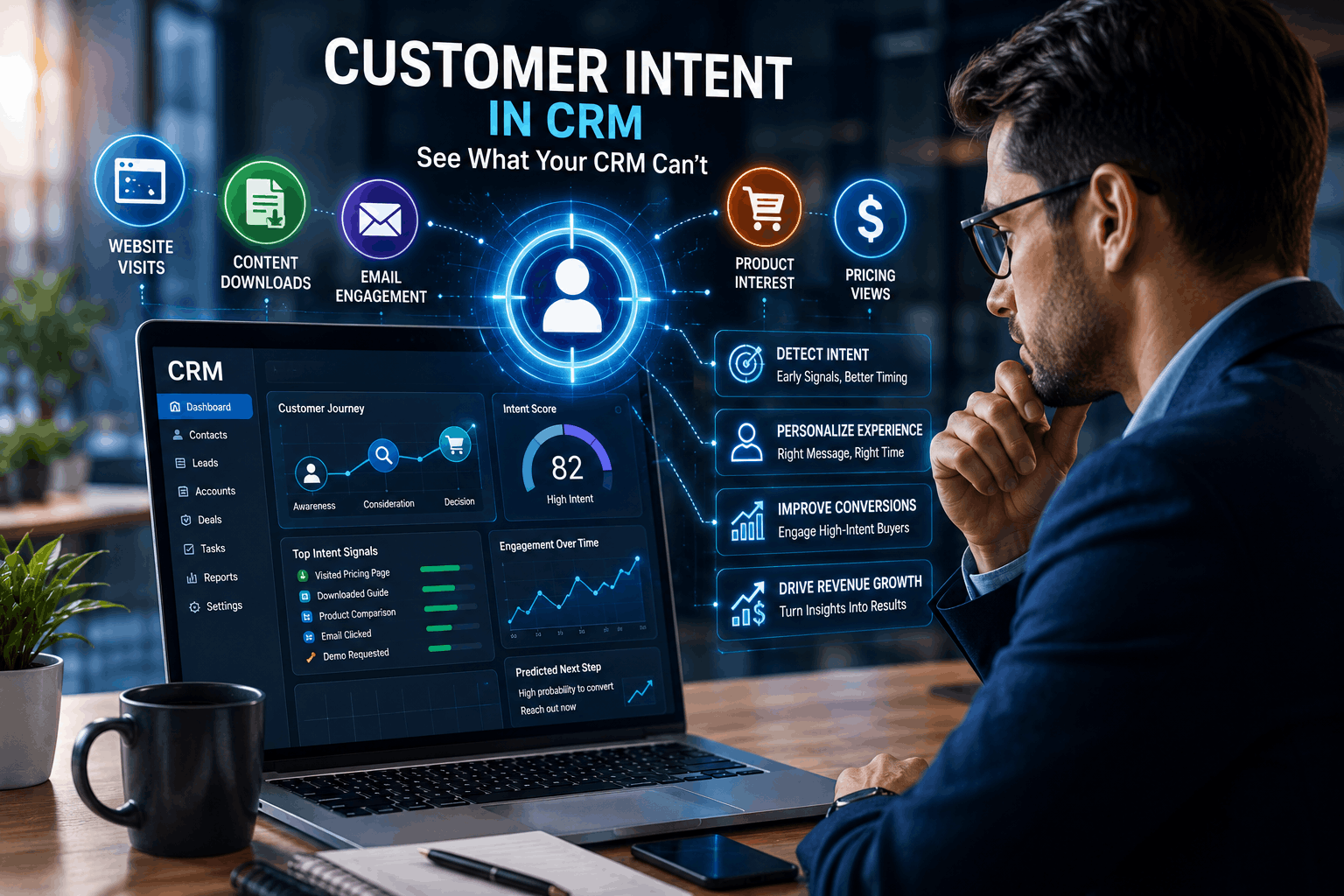
Customer Intent in CRM refers to identifying and understanding the behaviors that indicate whether someone is researching, comparing, considering, or preparing to make a purchase. Unlike demographic information or transaction history, intent data reflects current interests.
For example, a customer who repeatedly visits pricing pages, downloads product guides, and watches feature demonstrations is sending stronger buying signals than someone who only subscribed to a newsletter months ago.
When these activities are connected inside a CRM, sales and marketing teams gain a clearer picture of customer readiness. Instead of relying on assumptions, they respond using timely insights supported by actual customer behavior.
Why Traditional CRM Systems Miss Customer Intent
Many CRM platforms excel at storing customer records.
However, they often struggle to interpret what customers are doing right now.
Imagine two prospects.
Both requested a product demo six months ago.
One hasn’t interacted with the company since.
The other has visited the pricing page five times this week, opened three emails, and downloaded a buyer’s guide.
A traditional CRM may display similar customer profiles for both. An intent-driven approach recognizes that the second prospect deserves immediate attention. This difference highlights why businesses are investing in CRM analytics that combine customer history with behavioral intelligence. Historical information explains where customers have been. Intent signals suggest where they’re heading.
The Difference Between Customer Data and Customer Intent
Businesses often collect enormous amounts of customer data.
Purchase history.
Support conversations.
Invoices.
Contact information.
Survey responses.
Although useful, this information mainly describes completed actions.
Customer intent focuses on present behavior.
It answers questions such as:
- Which products are customers researching?
- Which emails receive repeated engagement?
- Which content attracts returning visitors?
- Which pages suggest purchase readiness?
- Which interactions indicate declining interest?
These insights help businesses prioritize opportunities instead of treating every customer the same.
How Customer Behavior Reveals Buying Intent
Customers rarely make purchasing decisions immediately.
Most follow a journey involving research, comparisons, discussions, and evaluation.
During this process, customer behavior provides valuable clues.
Common buying signals include:
- Repeated visits to pricing pages
- Downloading technical documents
- Viewing comparison articles
- Registering for webinars
- Requesting product demonstrations
- Spending longer on solution pages
Individually, these activities may seem insignificant.
Together, they create a stronger picture of purchase intent.
Businesses capable of recognizing these patterns can personalize outreach before competitors enter the conversation.
The Role of AI CRM in Understanding Intent
Artificial intelligence has changed how CRM systems process information.
Instead of waiting for employees to review reports manually, AI CRM platforms continuously analyze customer interactions across multiple channels.
They identify patterns that would otherwise remain unnoticed.
For example, AI can recognize when several actions occur within a short period.
A prospect might:
- Read multiple blog articles
- Watch product videos
- Compare pricing
- Open promotional emails
- Return to the website several times
Rather than treating these actions separately, AI combines them into a meaningful intent profile.
Sales teams receive recommendations based on behavior instead of relying solely on intuition.
This enables faster and more relevant customer engagement.
Why CRM Personalization Depends on Intent
Personalization is no longer limited to inserting someone’s first name into an email.
Modern CRM personalization depends on understanding customer goals, interests, and timing.
Two customers may purchase identical products.
That doesn’t mean they require identical communication.
One customer may be exploring premium features.
Another may need onboarding assistance.
Someone else may be evaluating renewal options.
Intent-driven personalization allows businesses to deliver relevant content instead of generic campaigns.
Customers receive recommendations that align with their current stage in the buying journey, improving both engagement and trust.
Improving Every Stage of the Customer Journey
The customer journey rarely follows a straight path.
People move between devices.
They revisit websites.
They compare competitors.
They pause purchasing decisions before returning weeks later.
Businesses that understand intent can adapt throughout this process instead of relying on fixed marketing sequences.
For example, if a returning visitor repeatedly explores implementation guides, automated workflows can trigger educational content rather than promotional offers.
If another prospect requests multiple pricing estimates, sales teams can prioritize direct conversations before interest declines.
Small adjustments like these improve customer experiences while increasing conversion opportunities.
Understanding intent transforms CRM from a system that records customer activity into one that actively supports smarter business decisions.
Turning Sales Intelligence Into Action
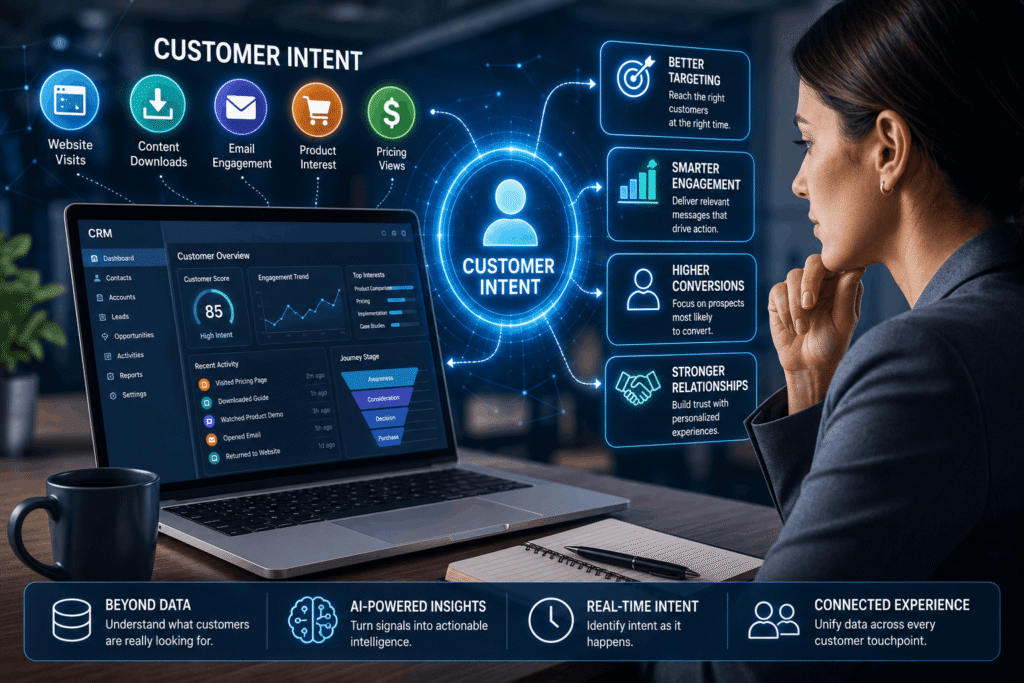
Collecting customer information is only valuable when teams know how to use it. That’s where sales intelligence becomes important. Instead of asking sales representatives to manually analyze dozens of customer interactions, modern CRM platforms combine behavioral signals into actionable insights.
Imagine a prospect who has:
- Visited the product comparison page several times
- Downloaded an industry report
- Opened multiple email campaigns
- Returned to the pricing page within two days
- Requested a product brochure
Viewed individually, these actions may seem routine.
Viewed together, they suggest strong purchase intent.
Rather than waiting for the prospect to submit another inquiry, sales teams can proactively reach out with relevant information while interest is still high.
How Predictive Analytics Improves CRM Decisions
One of the biggest advantages of modern CRM technology is the ability to anticipate customer behavior instead of simply recording past activity.
Using predictive analytics, CRM systems evaluate historical trends alongside current engagement to estimate what customers are likely to do next.
For example, predictive models may identify customers who are likely to:
- Upgrade their subscription
- Request product demonstrations
- Renew existing contracts
- Become inactive
- Respond to promotional campaigns
These insights help businesses prioritize opportunities more effectively.
Rather than contacting every lead with the same urgency, sales and marketing teams can focus their attention where the probability of success is highest.
Why Customer Engagement Matters More Than Contact Records
Many organizations measure CRM success by the number of contacts stored in their database.
A large contact list doesn’t necessarily generate more revenue.
Meaningful customer engagement creates stronger business outcomes.
Customers who regularly interact with valuable content, attend webinars, explore product pages, or respond to personalized campaigns are often much closer to making purchasing decisions than inactive contacts.
Monitoring engagement allows businesses to improve communication without overwhelming prospects with unnecessary messages.
Quality interactions often outperform high communication volume.
Building a Smarter CRM Strategy
A successful CRM strategy isn’t based solely on collecting customer information.
It combines technology, data, and timing.
Organizations should focus on answering practical questions:
- Which customer actions indicate genuine buying intent?
- Which content generates the highest engagement?
- Where do prospects leave the buying journey?
- Which sales activities produce the strongest conversion rates?
- How quickly should teams respond to high-intent customers?
Answering these questions transforms CRM from a storage platform into a decision-support system.
Businesses begin responding to customer behavior rather than reacting after opportunities have already passed.
Common Challenges When Measuring Customer Intent
Intent-based CRM delivers valuable insights, but businesses should recognize its limitations.
One challenge is incomplete data.
Customers often interact across multiple devices and platforms before making purchasing decisions.
If these interactions aren’t connected, intent signals become fragmented.
Privacy regulations also require organizations to collect and manage customer information responsibly.
Transparency and customer consent remain essential when using behavioral data.
Another challenge involves overreliance on automation.
Although AI CRM platforms identify patterns quickly, human judgment remains important when evaluating complex customer relationships.
Technology should support business decisions rather than replace them entirely.
Combining CRM Software With Human Expertise
Modern CRM software continues evolving beyond simple contact management.
Artificial intelligence, behavioral analytics, and workflow automation provide deeper customer insights than traditional systems could offer.
However, technology alone doesn’t close deals or build trust.
Sales professionals still understand customer emotions.
Marketing teams still create compelling messages.
Customer service representatives still solve unique problems.
The most successful organizations combine intelligent CRM platforms with experienced teams that know how to interpret insights and act on them.
The Future of Customer Intent in CRM
As businesses generate more digital interactions, CRM platforms will continue shifting from historical record-keeping toward real-time decision support.
Future systems are expected to analyze conversations, website activity, purchasing behavior, and engagement patterns simultaneously.
Instead of asking, “What has this customer done?” organizations will increasingly ask, “What is this customer likely to do next?”
That shift changes how businesses approach marketing, sales, and customer experience.
Companies that successfully combine Customer Intent in CRM, CRM analytics, customer behavior, AI CRM, CRM personalization, sales intelligence, predictive analytics, and a well-planned CRM strategy will be better positioned to deliver timely, relevant experiences that strengthen relationships and improve long-term business growth.