AI Employee Performance Evaluation refers to using AI in HR, machine learning and analytics, to assist or automate parts of performance reviews. Companies cite faster, data-driven feedback as a benefit. For example, Citi’s “Performance Assist” tool auto-gathers metrics to draft manager evaluations, saving time and improving consistency. However, experts warn that algorithmic reviews can inherit bias, data errors, and privacy issues. U.S. and EU guidelines (EEOC, GDPR/AI Act) stress that AI should assist not replace human judgment in evaluations. HR leaders should measure both efficiency gains and fairness outcomes, keep humans in the loop, and audit AI outputs for bias. The following analysis covers definitions, use cases, benefits, limitations (accuracy, bias, data quality, legal risks), best practices, measurement, vendor tools, and recommended next steps for HR teams.
What Is AI Employee Performance Evaluation?
AI Employee Performance Evaluation means applying algorithms, machine learning, or large language models to analyze employee data and help assess performance. Rather than relying solely on managers’ memory and opinions, AI tools may compile project metrics, feedback, and activity logs to score or even generate draft review text. For instance, Citi’s AI tool pulls data from various internal systems and creates an initial performance appraisal draft. In practice, these systems range from résumé-scanning software to AI-driven performance summaries and chatbots that assist in writing feedback. The AI output is typically reviewed and adjusted by managers, not used as a final judgment. In all cases, human oversight remains key: U.S. regulators emphasize that an AI evaluation cannot legally replace human review, and GDPR Article 22 requires a human in high-stakes employment decisions.
Why Businesses Are Using AI in HR
Companies are adopting AI in HR for three main reasons:
- Efficiency: Managers spend hours compiling review data. AI can collate objective metrics (sales figures, project completions, peer feedback, etc.) instantly. Citi reported that their managers, who used AI-generated drafts, felt “delighted to get a leg up” on the time-consuming task. By automating data collection and drafting, AI slashes busywork.
- Consistency and Insight: AI treats each review against the same criteria. For example, Workday advertises that AI can ground feedback in objective data (goal achievements, project outcomes) rather than subjective memories. This aims to reduce recency or affinity bias in reviews. AI tools can also surface patterns (e.g. quality of code commits, client feedback) that a single manager might miss.
- Perceived Fairness: Some research suggests employees may prefer AI evaluation when they fear human favoritism. In simulated studies, workers trusted AI-driven ratings over human ones if they expected unfair bias from managers. In other words, the perceived objectivity of AI can boost trust when concerns about human bias exist.
Governance analysts note that AI should augment managers, not obliterate judgment. Ideally, HR teams use AI to bring more data and “best practices” into reviews, as Forrester suggests, like coaching managers to write less-biased feedback with AI support. In many organizations, the AI draft remains just that: a starting point for managers to refine.
Benefits of AI in Performance Reviews
- Time Savings and Productivity: AI can compile disparate information into one draft. Citi’s experience shows managers save time: the AI draft auto-gathers “all that information…in real time” so managers start with a complete summary. Rather than sifting through old emails or spreadsheets, a manager can review and edit a coherent draft. This frees up perhaps dozens of hours per year (Workday cites ~210 hours annually spent by managers on reviews).
- Objective Data Insights: By linking to goal-tracking, CRM, and collaboration tools, AI captures a wider view of an employee’s work. For example, Workday’s tool can cite specific achievements (“Your Slack update accelerated decision-making by 2 days…”) to back up qualitative comments. Firms report that AI can flag relevant metrics or trends that managers may overlook.
- Reducing Human Bias: Human reviewers often have unconscious biases (gender, recency, affinity). Vendors claim AI helps spot and correct biased language. Workday notes its system can flag terms (e.g. “aggressive” for women) and suggest neutral wording. Lattice’s AI, for example, “summariz[es] feedback, identify[es] trends, and reduc[es] bias” in aggregated reviews. In principle, AI tools grounded on hard data (project outcomes, attendance) rather than impressions can catch inequities.
- Enhanced Employee Experience: When used properly, AI enables more personalized, continuous feedback. Managers become “coaches” not just graders. Workday emphasizes building a “human-centric workplace” where AI provides timely, individualized guidance. In surveys, employees expressed more trust in AI evaluations when they feared unfair treatment by humans, suggesting AI could improve perceptions of fairness if implemented carefully.
Limitations and Challenges
Despite potential, AI-driven evaluations carry significant pitfalls:
Accuracy and Algorithmic Bias
AI models are only as good as their design and data. If historical review data or company records contain biases, the AI will reproduce them. A leading concern is that algorithmic bias will arise: e.g., if past promotions favored one group, an AI might continue that pattern under the guise of “data-driven” decisions. Legal experts warn that biased outcomes are still illegal – the EEOC makes clear an employer “remains responsible” for unlawful results from an AI system. In practice, studies show mixed perceptions: one experiment found algorithmic assessments felt less respectful and not clearly more unbiased than human ones. AI’s lack of empathy or context can make employees feel treated like statistics, even if outright discrimination isn’t detected.
Data Quality and Context
Clean, comprehensive data is a must. Workday cautions that the “power of AI relies on clean, relevant data” and integrated systems. Incomplete records (e.g. missed projects, informal wins) or siloed tools can yield inaccurate drafts. The famous GIGO principle applies: “garbage in, garbage out.” Moreover, nuanced factors (a remote worker’s off-hours deliverables, subtle leadership contributions) might not be captured in raw data. Overemphasis on what’s measured can miss critical context.
Legal and Ethical Risks
Automated reviews are scrutinized by law. In the U.S., Title VII requires that any “selection procedure” (like a promotion decision influenced by AI) not have adverse impact on protected groups. The EEOC’s guidance treats AI tools as requiring the same fairness analysis as human decisions. GDPR (EU data law) adds that AI “should assist, not replace” human judgment in employment (Article 22), and mandates transparency about automated processing. In effect, HR teams must conduct data protection impact assessments for high-risk AI (the forthcoming EU AI Act also labels performance reviews “high risk” requiring stringent checks). Failure to follow these rules can invite lawsuits or fines.
Vendors note privacy too: algorithms processing employee data may reveal sensitive information or run afoul of labor privacy laws. The Mitchell law firm warns that opaque AI (“black box” systems) can make it impossible for workers to challenge unfair scores. Employers often need to provide explanations of how the AI works, allow appeals, and ensure accommodations under ADA (for example, if an employee needs non-standard evaluation methods).
Employee Trust and Experience
Even if objectively unbiased, AI-driven processes can feel impersonal. As the Nature study found, people evaluated by AI often feel a lack of individualized consideration. This can reduce feelings of respect, even if overt bias is lower. Some employees may perceive AI as suspicious or error-prone. Transparency, opting-out options, and continued human dialogue are critical. Citi’s pilot allowed workers to opt out of AI assistance, and only a tiny fraction did so, suggesting some comfort, but companies should still respect employee concerns.
Best Practices: Human Oversight and Controls
Given the stakes, experts recommend multiple safeguards:
- Human-in-the-Loop: Always make AI outputs advisory. Managers must review and edit any AI-generated text or score. Cite: Citi notes its AI draft is “just a starting point – managers are still fully responsible” for final reviews. Similar to GDPR’s stance, human judgment must guide final outcomes.
- Bias Audits and Calibration: Regularly test the AI models on fairness metrics. For example, run “adverse impact” analyses per EEOC’s four-fifths rule to catch disparities. Facilitate calibration meetings where multiple managers compare ratings to offset one-sided AI suggestions. Oracle’s solution even includes a “Calibration and Review” workspace to identify rating inconsistencies and suggest evidence-based adjustments.
- Data Governance: Ensure data feeding the AI is accurate and up-to-date. Establish data quality checks – missing data or stale inputs should be flagged before being used. As Workday advises, invest in integrated systems where performance goals, projects, and feedback are linked so AI has a complete picture.
- Transparency and Employee Communication: Inform staff about what the AI tool does. Offer written policies on AI use in reviews, allow employees to see what data is used. Allow appeals or corrections. The law suggests providing at least notice that automated tools are used and explaining evaluation criteria. In practice, Citi reports letting employees opt out, reinforcing trust.
- Training and Change Management: Train managers on how to use AI recommendations (e.g., to challenge their own biases). Workday emphasizes a mindset shift: use AI to become “managers-as-coaches” rather than directors. Provide example guidelines or checklists so managers know to verify AI drafts for tone and fairness. For instance, managers might paste their draft into an internal LLM (with identifying info removed) and ask it to flag biased language or ensure balanced tone.
- Security and Privacy Protections: Limit who sees sensitive AI outputs. If the AI model uses personal data, comply with GDPR/EEOC rules on consent and minimal use. For example, use techniques like differential privacy or anonymized analysis where possible.
Measuring Impact and Metrics
To justify AI investments and detect problems, HR should measure outcomes. New metrics may be needed in the AI era. Besides traditional KPIs (review completion rate, time saved), consider:
- Fairness Indicators: Track distribution of ratings across demographics to detect bias. Monitor whether equality gaps (e.g., gender or ethnicity in promotion scores) shrink or widen over time after AI adoption.
- Quality of Reviews: Survey managers and employees on satisfaction and perceived usefulness of AI-assisted reviews. HBR experts warn against optimizing only for speed – metrics should include employee judgment and accountability.
- Model Performance: Use validation data to check AI accuracy over time (precision/recall of performance predictions, as one peer-reviewed study did). Monitor for model drift: if the underlying data patterns change, re-train or recalibrate the AI.
- Compliance and Issues Logged: Record any complaints or appeals related to AI outcomes. If an adverse impact is flagged (per EEOC guidance), log the corrective steps taken.
- Adoption Rate: Track how managers actually use the tool (prompt usage, opt-outs) – low usage might signal trust issues.
In short, measure both process metrics (efficiency, adoption) and fairness/quality metrics (bias checks, survey feedback). Adjust the AI model and human policies in response.
Vendor Landscape
Many HR software vendors now embed AI into performance management. Key examples include:
- Workday Human Capital Management: Offers generative assistance and analytics. Strengths: enterprise-scale HCM integration, bias-checking language, personalized growth guidance. Risks: requires extensive data integration, can be costly, and still relies on managers to finalize content.
- SAP SuccessFactors (Joule): Provides AI-driven goal suggestions and feedback coaching. Strengths: tight integration with SAP HR suite, continuous feedback and skills analysis. Risks: complexity of configuration and potential for over-reliance on templated feedback; bias-reduction features exist but depend on correct setup.
- Oracle Cloud HCM: Embeds AI agents across talent workflows (goal-setting, performance summaries, calibration insights). Strengths: broad features (e.g., “Team Talent Calibration” workspace for fairness) and strong data security. Risks: potential “black box” issues with multiple AI agents; vendors warn human oversight is required.
- Lattice: A dedicated performance management platform with AI tools. Strengths: user-friendly interface, AI that auto-drafts reviews from historical data, and analytics on trends and engagement. Risks: mainly SMB-focused (may lack large-enterprise scale), and its AI’s fairness depends on the data input from managers.
- Cornerstone OnDemand: Established talent suite with performance modules and AI suggestions. Strengths: highly configurable, supports many feedback modalities (check-ins, OKRs), and analytics dashboards for HR. Risks: less emphasis on AI fairness checks, and implementation complexity for older systems.
- Generic AI Reviewer (Example Tool): A hypothetical or emerging product. Strengths might include ease of setup or domain-specific insights. Risks: unknown model provenance, little track record, and potential lack of vetting for bias or privacy.
Below is a summary comparison:
| Tool | Strengths | Risks |
| Workday HCM AI | Enterprise HCM integration; personalized feedback; bias–language checks. | Complex/expensive; relies on high-quality integrated data; still nascent tech. |
| SAP SuccessFactors (Joule) | Strong goal alignment; continuous coaching; AI feedback agent. | Configuration complexity; best with full SAP HCM stack; bias filters depend on proper use. |
| Oracle Cloud HCM AI | Broad AI agents (performance summaries, coaching tips, calibration tools); secure. | Many features may overwhelm users; transparency limited; human final approval needed. |
| Lattice Performance Platform | Intuitive design; AI drafts reviews from multiple sources; insights dashboards. | May best fit mid-sized orgs; relies on managers feeding good data; fairness depends on input. |
| Cornerstone Performance | Scalable for large orgs; flexible review processes; robust goal tracking. | AI features more basic; customization can be complex; standardization vs personalization trade-off. |
| (Generic) AI Review Assistant | Easy AI-assisted drafting; cost-effective for small teams. | Unproven accuracy; vendor or data ownership unclear; potential bias if not audited. |
Note: Product names and features are illustrative. Always evaluate vendors’ latest documentation and compliance features.
Recommended Next Steps for HR Teams
HR leaders considering AI for performance reviews should proceed deliberately:
- Pilot Carefully: Start with a small, willing department. Compare AI-assisted reviews versus traditional ones on key outcomes (time, consistency). Test the AI draft against human drafts for bias or errors.
- Set Up Governance: Form a cross-functional team (HR, IT, Legal) to set usage policies. Define who owns the AI tools and data, and how results are reviewed.
- Train Stakeholders: Educate managers on how to use AI recommendations and continue exercising judgment. Inform employees about AI’s role and their rights (opt-out, appeal). Transparency is crucial.
- Conduct Bias/Fairness Audits: Regularly evaluate outputs for adverse impact. Use EEOC guidelines (four-fifths rule) as a benchmark. Engage external experts if needed.
- Ensure Compliance: If in the EU, prepare GDPR Data Protection Impact Assessments. Under both GDPR and U.S. law, ensure employees’ data rights and anti-discrimination safeguards are respected.
- Monitor and Iterate: Continuously collect feedback from managers and staff. Adjust the AI model, training data, or business rules based on issues encountered. Treat implementation as an ongoing improvement process, not a one-off project.
Flowchart: Human+AI Performance Review Workflow
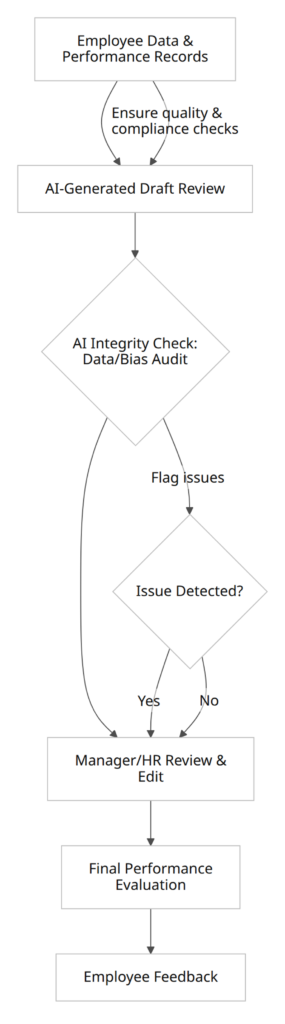
Each step above should include manual checkpoints: data validation before AI analysis, AI output auditing (for bias or errors), and manager sign-off before finalizing any review.
Sources: Recent industry analysis, academic studies, vendor docs, and regulatory guidance were used to compile this evidence-based overview. All advice assumes current laws (ADA, Title VII, GDPR) and best practices. Any unnamed tool or example is illustrative. Future developments (technology or regulations) may affect these points.