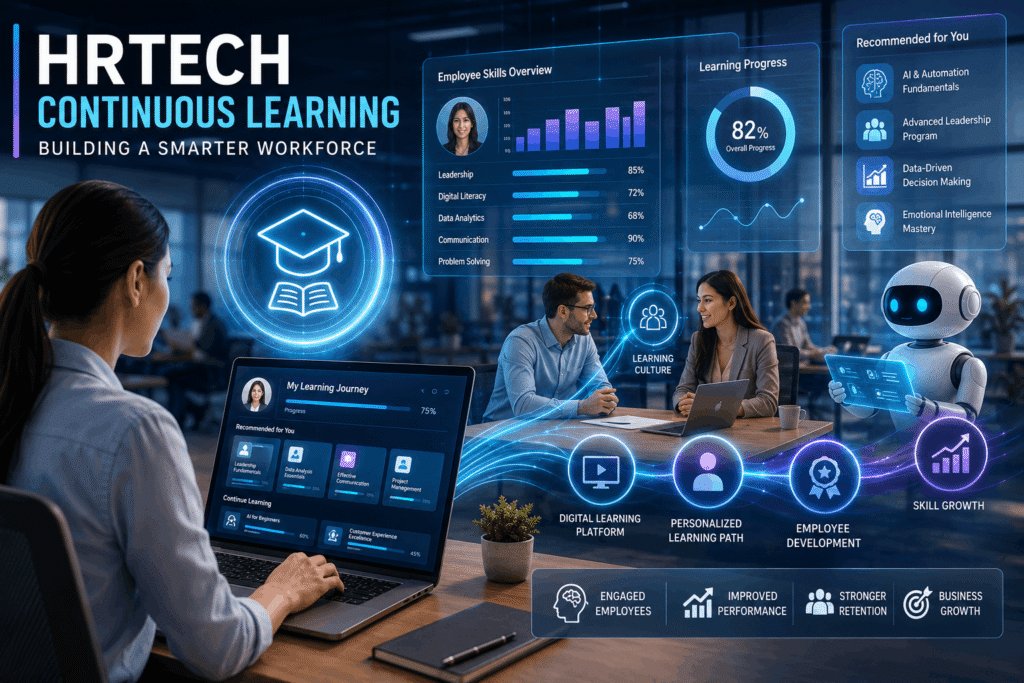
HRTech continuous learning is changing how organizations develop their employees. Traditional training programs often relied on annual workshops or one-time courses that employees quickly forgot. Today’s workplaces move much faster. New technologies, changing customer expectations, and evolving job roles require people to keep learning throughout their careers. Modern HR technology makes that possible by delivering learning when employees need it instead of waiting for the next scheduled training session.
A company can invest in the latest software, automate business processes, and hire experienced professionals.
None of those investments reach their full potential if employees stop learning.
Skills that were valuable a few years ago may no longer be enough for today’s workplace.
That’s why organizations are shifting from occasional training to continuous development.
The goal isn’t simply to teach employees something new.
It’s to help them keep improving as their roles evolve.
What Is HRTech Continuous Learning?
HRTech continuous learning is an approach that uses digital HR tools to support ongoing employee growth instead of limiting development to occasional training events.
Employees no longer need to wait for scheduled classroom sessions.
Learning can happen during everyday work.
An employee preparing for a customer meeting might receive a short product lesson.
A manager taking on a new leadership role can access coaching resources immediately.
A newly hired employee can follow a personalized onboarding path without waiting for the next training cycle.
Technology delivers the right information at the right moment, making learning part of daily work instead of a separate activity.
Why Traditional Training No Longer Works
Many organizations still depend on training programs built for a different era.
Employees attend a workshop.
Complete an online course.
Receive a certificate.
Then return to work exactly as before.
Several weeks later, much of that information has already been forgotten.
Learning isn’t the problem.
Retention is.
People remember knowledge they use regularly.
When training happens months before employees need those skills, much of its value disappears.
Continuous learning solves this challenge by providing knowledge closer to the moment it’s will be applied.
Instead of overwhelming employees with large amounts of information at once, businesses deliver smaller lessons that fit naturally into everyday workflows.
How HR Technology Supports Employee Growth
Modern HR technology does much more than manage payroll or employee records.
It has become a central platform for developing skills across the organization.
Today’s HR platforms can:
- Recommend personalized learning paths
- Track employee progress
- Identify skill gaps
- Suggest certification programs
- Measure learning outcomes
- Support career planning
- Connect learning with business goals
Managers also gain better visibility into workforce capabilities.
Instead of guessing where development is needed, they can use data to make informed decisions about training priorities.
That creates better outcomes for employees and the business alike.
Creating Better Employee Learning Experiences
Employees engage more when learning feels relevant.
Generic training rarely delivers lasting results because every employee performs a different role.
Sales representatives need different skills than software developers.
Customer service teams face different challenges than finance professionals.
Modern HR platforms personalize employee learning by recommending content based on job responsibilities, experience, career goals, and previous training.
This makes development feel practical rather than mandatory.
Employees spend less time searching for useful resources and more time applying new knowledge to real situations.
Why Workplace Learning Should Be Part of Daily Work
Learning doesn’t always require classrooms or lengthy online courses.
Some of the most valuable development happens while employees solve everyday problems.
A short instructional video.
A quick knowledge article.
An AI-powered coaching suggestion.
A peer recommendation.
These small learning moments accumulate over time.
Organizations that encourage continuous workplace learning create teams that adapt more quickly to new tools, changing customer expectations, and evolving business priorities.
Instead of treating development as an annual event, learning becomes a normal part of work.
The Role of a Learning Management System
A modern learning management system helps organizations organize, deliver, and measure employee training from one central platform.
Instead of storing training materials across multiple systems, businesses can manage learning more efficiently.
Employees gain access to:
- Compliance training
- Leadership programs
- Technical certifications
- Product knowledge
- Soft skills courses
- Internal documentation
Managers can monitor completion rates, identify participation trends, and understand where additional support may be needed.
More importantly, learning platforms continue evolving beyond course libraries.
Many now include AI recommendations, interactive learning paths, and personalized development plans that keep employees engaged long after onboarding is complete.
Building Long-Term Employee Development
Successful organizations don’t view training as a one-time project. They treat employee development as an ongoing investment.
Employees who continue building new skills are better prepared to take on additional responsibilities, adapt to changing technologies, and contribute in new ways as business needs evolve.
This creates advantages beyond productivity.
Employees often feel more confident in their roles, managers gain stronger internal talent pipelines, and organizations reduce the need to recruit externally for every new position. When continuous learning becomes part of company culture, development benefits individuals and strengthens the entire workforce.
Creating a Strong Learning Culture
Technology alone doesn’t create better learning outcomes.
Employees also need an environment where learning is encouraged rather than treated as an extra task.
A strong learning culture starts with leadership.
When managers actively participate in training, share knowledge with their teams, and encourage curiosity, employees are more likely to develop the same habits.
Recognition also matters.
Celebrating new certifications, completed learning paths, or newly developed skills reinforces the idea that growth is valued across the organization. Learning becomes something employees want to pursue instead of something they are required to complete.
Why Workforce Upskilling Has Become a Business Priority
Business needs change much faster than they did a decade ago.
New software platforms appear regularly.
Automation reshapes daily responsibilities.
AI introduces entirely new ways of working.
Hiring new employees every time a new skill becomes important isn’t practical.
That’s why workforce upskilling has become a strategic priority. Organizations can build on the knowledge their employees already have instead of starting from scratch with every new hire.
For example, a customer support representative can learn to use AI-powered service tools.
A marketing specialist can develop data analysis skills.
A manager can strengthen leadership capabilities through personalized learning programs.
Helping existing employees grow often produces better long-term results than relying solely on recruitment.
The Growing Importance of a Digital Learning Platform
Employees expect learning to be as accessible as the software they use every day.
A modern digital learning platform makes that possible by allowing people to access training from laptops, tablets, or mobile devices whenever they need it.
This flexibility supports different learning styles. Some employees prefer short videos. Others learn through interactive exercises, articles, or practical simulations. Giving people multiple ways to learn increases engagement because training fits naturally into their schedules instead of interrupting them.
Many platforms also recommend content based on previous learning activity, helping employees discover relevant resources without searching through extensive course libraries.
Following the Latest HRTech Trends
The way organizations approach learning continues to evolve.
Current HRTech trends focus less on delivering large amounts of information and more on creating meaningful learning experiences.
Businesses increasingly use AI to recommend personalized content, identify emerging skill gaps, and provide learning suggestions based on individual career goals.
Analytics also plays a larger role.
Instead of measuring only course completion, organizations can evaluate how learning influences productivity, employee engagement, internal promotions, and business performance.
This shift helps leaders understand whether training is creating measurable value instead of simply recording participation.
Making Continuous Employee Training More Practical
One of the biggest reasons training programs fail is that they demand too much time at once. Employees already manage meetings, projects, deadlines, and customer requests. Adding several hours of training to an already busy schedule often reduces participation.
Continuous employee training takes a different approach.
Learning happens in smaller, manageable sessions that fit into the workday.
A five-minute lesson before a meeting.
A short video explaining a new feature.
A quick assessment after completing a project.
These small learning moments are easier to complete and easier to remember because employees can apply new knowledge almost immediately. Over time, these incremental improvements build stronger skills without overwhelming employees.
Measuring Learning Success
Organizations should evaluate learning using business outcomes rather than completion rates alone.
Useful performance indicators include:
- Employee skill growth
- Internal promotion rates
- Training participation
- Knowledge assessment scores
- Employee engagement
- Productivity improvements
- Time required to develop new skills
- Retention of high-performing employees
Reviewing these metrics helps HR leaders identify which learning programs deliver real value and where improvements may be needed.
More importantly, they demonstrate how learning contributes to broader business goals.
As organizations continue adapting to changing technologies and workforce expectations, HRTech continuous learning gives employees the opportunity to build new capabilities throughout their careers instead of relying on occasional training events. Combined with effective HR technology, ongoing employee learning, a supportive learning culture, and consistent continuous employee training, businesses create workforces that remain adaptable, confident, and prepared for future challenges.