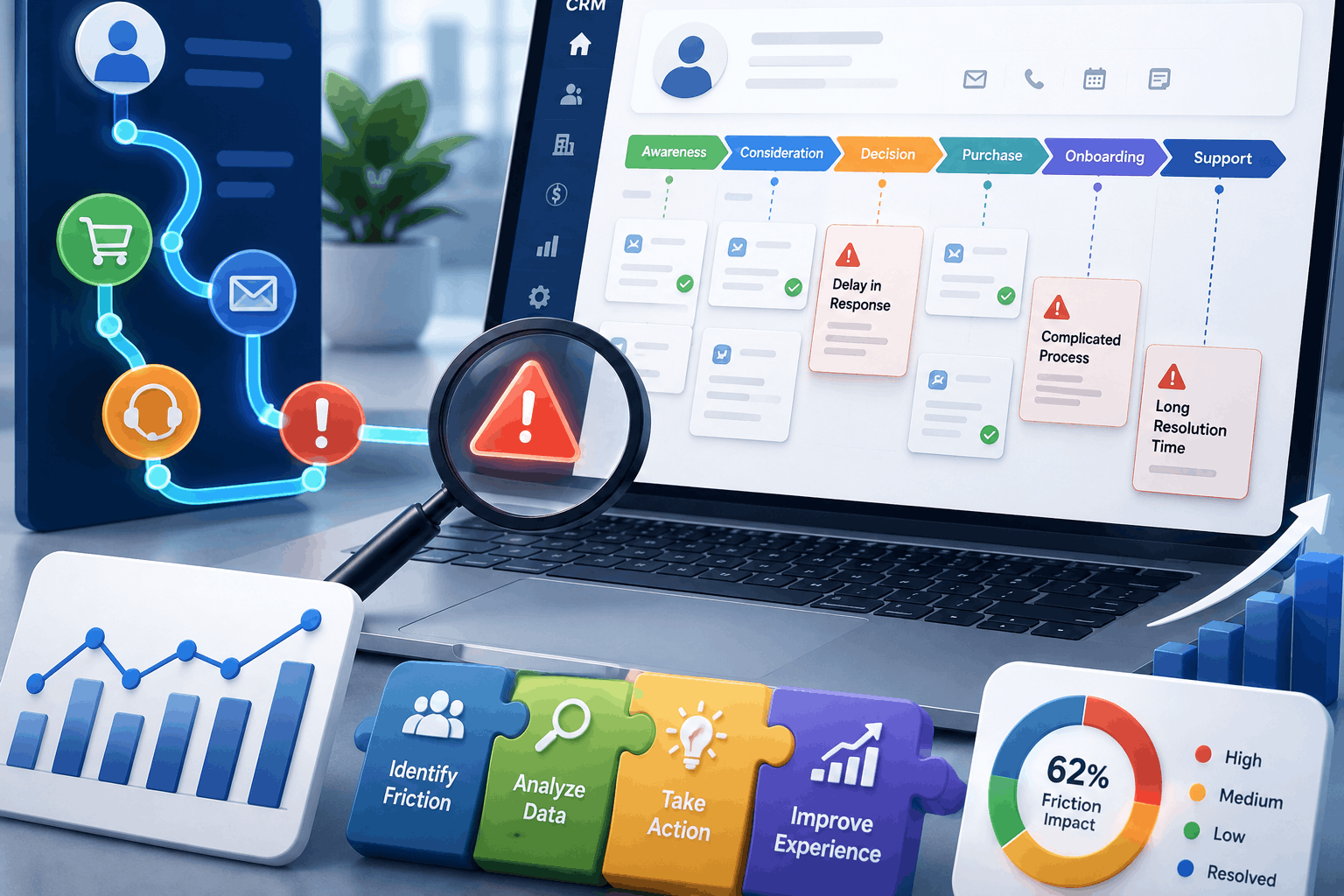
Every customer journey has moments where people hesitate, get confused, or give up. CRM friction mapping helps businesses identify moments before they turn into lost sales or unhappy customers. Instead of relying on assumptions, companies can use CRM data to understand where customers struggle, why they abandon a process, and what changes can improve the overall experience. When businesses remove friction instead of guessing where it exists, conversions improve naturally, and customer relationships become stronger.
Think about the last time you abandoned an online purchase.
The checkout process may have asked for too much information.
Nobody followed up after you requested a product demo.
Or you had to explain the same problem to three different support agents.
These small frustrations often seem unrelated.
Together, they shape how customers feel about a business.
Finding those issues early is exactly what CRM friction mapping is designed to do.
What Is CRM Friction Mapping?
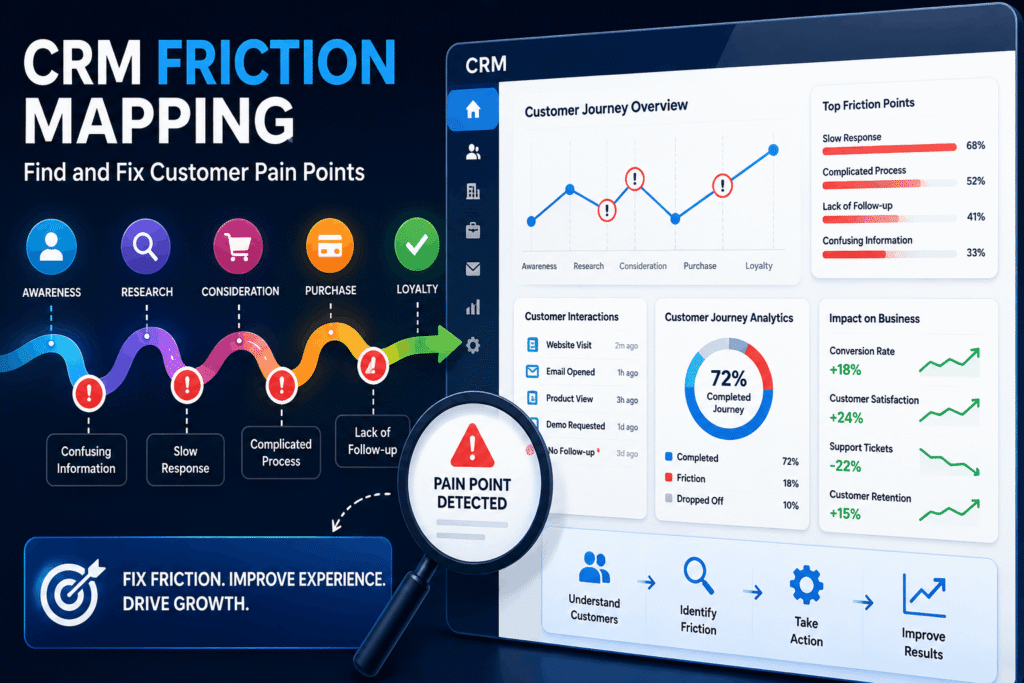
At its core, CRM friction mapping is the process of identifying obstacles throughout the customer journey by analyzing CRM data and customer interactions.
Every conversation, email, support ticket, sales call, website visit, and purchase leaves behind useful information.
When these interactions are connected within a CRM platform, they begin to tell a much bigger story.
Businesses can see:
- Where prospects stop responding
- Which sales stages create delays
- Which support issues appear repeatedly
- Where customers abandon purchases
- Which touchpoints create the most complaints
Instead of treating every problem as an isolated event, organizations are beginning to recognize patterns that affect hundreds or even thousands of customers.
Why Small Frustrations Become Bigger Business Problems
A customer rarely leaves because of one bad experience.
More often, several small frustrations build over time.
A delayed email response.
Confusing product information.
Repeated requests for the same details.
Long approval processes.
Slow customer support.
Each issue feels minor on its own.
Combined, they become major customer pain points.
Without visibility into the entire journey, different departments only see their own part of the process.
Sales believes marketing generates poor leads.
Support assumes that onboarding created confusion.
Marketing blames the website.
The CRM consolidates those experiences into a single timeline, making it easier to understand where the real problems begin.
Looking Beyond the Sales Funnel
Many businesses focus only on generating leads.
The customer journey doesn’t end after someone becomes a customer.
In reality, friction appears across every stage.
Effective customer journey mapping includes:
- First website visit
- Lead generation
- Product research
- Sales conversations
- Onboarding
- Customer support
- Renewals
- Upselling opportunities
Each interaction influences the next.
A difficult onboarding experience may increase future support requests. Slow support can reduce renewal rates. Poor communication during implementation may prevent future referrals.
Viewing every stage together creates a more complete picture of the CRM customer experience.
Turning CRM Data Into Useful Insights
Modern CRM platforms collect far more information than contact details.
Every interaction creates valuable signals.
Email engagement.
Meeting history.
Support conversations.
Purchase records.
Live chat sessions.
Website activity.
Customer surveys.
When analyzed together in a CRM, this information reveals trends that would otherwise remain hidden. For example, a business might discover that customers who wait longer than three days for a product demonstration are far less likely to make a purchase. Another company may notice that support requests increase dramatically after a specific onboarding step. These insights allow teams to address the underlying issue rather than repeatedly dealing with the same symptoms.
Why Customer Journey Analytics Matter
Businesses often make decisions based on isolated metrics. Sales tracks conversion rates. Marketing measures campaign performance. Support reviews ticket volumes. Each metric tells part of the story. Customer journey analytics combine those data points into one connected view. Instead of asking why conversions declined, businesses can examine every interaction leading up to that outcome. That broader perspective helps identify where customers lose momentum, become frustrated, or stop engaging altogether.
The goal isn’t collecting more reports. It’s understanding the experience from the customer’s point of view rather than through separate departmental dashboards.
Using Customer Interaction Tracking to Remove Friction
Finding friction is only the first step.
The real value comes from understanding why it happens.
This is where customer interaction tracking becomes essential.
Every customer action leaves a clue.
Opening an email.
Booking a demo.
Visiting a pricing page.
Downloading a guide.
Submitting a support request.
Viewed individually, these actions don’t reveal much.
Together, they create a timeline that explains how customers move through the buying process.
For example, imagine several prospects request a product demonstration but never schedule a follow-up meeting.
Without tracking interactions, sales teams may assume the leads weren’t qualified. The CRM may reveal something completely different. Perhaps prospects waited too long for a response. The scheduling process may require too many steps. Or the pricing information wasn’t available early enough. Understanding these patterns allows businesses to fix the process rather than blame the outcome.
Turning Insights Into Better Customer Experiences
Data becomes valuable only when it leads to action.
After identifying friction, businesses should focus on improving the areas that have the greatest impact.
That could mean simplifying online forms.
Reducing response times.
Automating routine follow-ups.
Improving onboarding communication.
Or giving support teams quicker access to customer history.
Small improvements often yield noticeable results by removing the barriers customers encounter every day.
Over time, these adjustments strengthen customer experience optimization by making every interaction smoother and more consistent. Customers rarely notice when everything works perfectly. They immediately notice when it doesn’t. Reducing friction helps create experiences that feel effortless.
Common CRM Friction Mapping Mistakes
Many organizations collect large amounts of customer data but struggle to turn it into useful decisions.
One common mistake is focusing only on sales metrics.
Revenue matters, but conversion rates don’t explain why customers leave during earlier stages of the journey. Another mistake is allowing departments to work independently.
Marketing, sales, customer success, and support each see different pieces of the customer experience. If those teams don’t share information, important patterns remain hidden. Some businesses also spend too much time reviewing reports instead of making improvements. Dashboards don’t improve customer experiences.
Action does.
The purpose of CRM friction mapping is to identify practical changes that remove obstacles for customers, not to create more reports.
Measuring Success
After making improvements, businesses should monitor whether those changes actually reduce friction.
Useful performance indicators include:
- Customer response time
- Sales cycle length
- Lead-to-customer conversion rate
- Customer retention
- Support resolution time
- Customer satisfaction scores
- Repeat purchase rate
Reviewing these metrics regularly helps determine whether changes are improving the overall journey.
More importantly, they reveal whether customers are completing important actions with fewer delays and less frustration.
Building Better Customer Journey Insights
Every customer follows a slightly different path. Some purchase after one conversation. Others spend weeks comparing options before making a decision.
Understanding those differences is what creates meaningful customer journey insights.
Instead of assuming every customer behaves the same way, businesses begin to recognize patterns from real interactions. Those insights inform future decisions. Marketing creates more relevant campaigns. Sales teams prioritize stronger opportunities.
Support teams resolve issues faster because they understand the customer’s previous interactions.
As these improvements accumulate, the CRM becomes more than a database.
It becomes a decision-making tool that helps every department understand where customers experience unnecessary friction and how to eliminate those moments before they affect satisfaction, loyalty, or future revenue.