Businesses have spent years automating repetitive work, but today’s technology is changing what automation can actually accomplish. Generative AI Automation doesn’t simply execute predefined tasks. It can generate content, summarize information, assist with decision-making, and adapt to different business scenarios. As organizations look for ways to improve efficiency without increasing operational costs, this new approach to automation is becoming a practical investment rather than an experimental technology.
Traditional automation was built around rules.
If a condition was met, the system performed a predefined action.
That worked well for structured processes like invoice approvals, payroll calculations, or inventory updates.
Modern businesses, however, deal with less predictable work.
Customer conversations vary. Marketing campaigns require fresh ideas. Support teams answer different questions every day. These situations demand more than fixed workflows. They require systems capable of creating, understanding, and responding intelligently.
That’s where generative AI is reshaping business operations.
What Is Generative AI Automation?
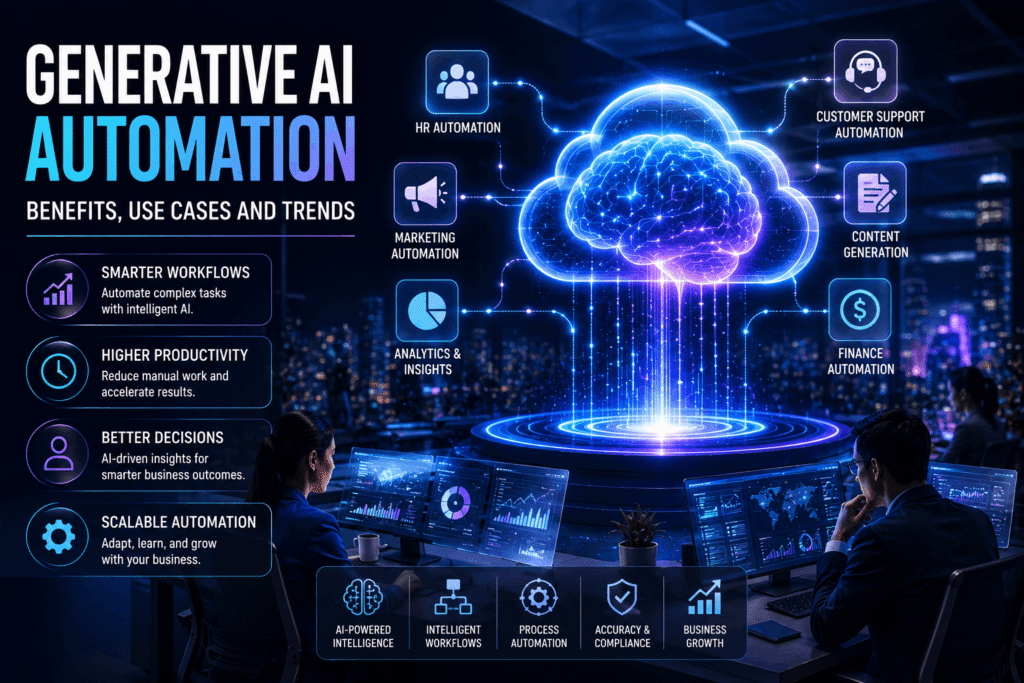
Generative AI Automation combines artificial intelligence with workflow automation to perform tasks that previously required human creativity or decision-making.
Instead of only moving information from one system to another, AI can analyze context, generate responses, draft documents, summarize reports, and recommend actions based on available data.
This changes automation from a process that follows instructions into one that actively assists employees.
For example, a customer service platform can automatically draft personalized replies.
A sales platform can prepare meeting summaries after every client call.
An HR system can create job descriptions tailored to specific roles.
Marketing teams can generate campaign ideas while finance departments automate reporting with written insights rather than raw numbers alone.
Why Businesses Are Investing in AI Automation
Organizations are facing increasing pressure to accomplish more with existing resources.
Hiring additional employees isn’t always practical.
Expanding operational budgets isn’t always possible.
As a result, leaders are exploring AI automation to improve productivity without compromising quality. Unlike traditional automation projects that focus mainly on reducing manual effort, AI-powered systems also help employees make faster decisions. Instead of spending hours reviewing documents or organizing information, teams receive summaries, recommendations, and actionable insights within seconds. This allows employees to focus on work that benefits from human judgment rather than administrative repetition.
From Workflow Automation to Intelligent Operations
The biggest shift isn’t that automation has become faster.
It’s that automation has become smarter.
Earlier automation platforms completed isolated tasks.
Today’s intelligent automation connects multiple business processes while understanding the information flowing between them. Imagine a customer submitting an online inquiry.
Instead of forwarding the request to several departments manually, an AI-powered workflow can:
- Classify the inquiry
- Identify customer history
- Draft an initial response
- Assign the request to the right team
- Recommend next actions
- Update the CRM automatically
Employees remain involved where decisions require experience, but routine coordination happens behind the scenes. This creates smoother operations without removing human oversight.
How AI Workflow Automation Improves Daily Operations
Every department manages repetitive work that consumes valuable time.
Marketing teams prepare campaign briefs.
HR departments answer recurring employee questions.
Finance teams organize reports.
Sales representatives document client interactions.
Operations managers monitor project updates.
Modern AI workflow automation reduces this administrative burden by handling repetitive information processing automatically.
For example, after a virtual sales meeting, AI can generate meeting notes, identify customer requirements, schedule follow-up reminders, and update CRM records before the sales representative moves to the next appointment. The process becomes faster while maintaining consistency across teams.
The Growing Role of Enterprise AI
Large organizations rarely depend on one software platform. Instead, they manage dozens or even hundreds of business applications across different departments. This complexity often creates disconnected workflows. Information remains trapped inside separate systems, forcing employees to switch between applications throughout the day.
Enterprise AI helps bridge these gaps.
Rather than replacing existing software, AI connects information across departments, making knowledge easier to access and use.
Customer service teams can view sales history.
Finance can receive purchasing insights.
HR can monitor workforce trends.
Executives gain better visibility into business performance through centralized AI-generated reporting.
Instead of working with isolated systems, organizations begin operating as connected businesses.
Increasing AI Productivity Without Replacing Employees
Discussions about AI often focus on replacing jobs. In reality, most businesses are using AI to improve AI productivity, not eliminate human expertise. Employees continue making strategic decisions, building customer relationships, negotiating contracts, and solving complex problems.
AI handles repetitive preparation.
For example:
- Drafting emails
- Summarizing lengthy documents
- Organizing meeting notes
- Creating first versions of reports
- Preparing data for analysis
- Recommending next actions
Removing these repetitive activities gives employees more time for higher-value work.
The goal isn’t to replace people.
It’s to reduce the time spent on routine administrative tasks that slow business operations. This balanced approach explains why organizations across industries are adopting automation software supported by generative AI instead of relying solely on traditional workflow tools.
Real-World Use Cases for Generative AI
The value of generative AI becomes much clearer when it’s applied to everyday business operations instead of isolated demonstrations.
Marketing teams use AI to draft campaign briefs, generate social media content, and personalize email campaigns based on customer behavior. Sales departments summarize meetings, prepare follow-up emails, and identify promising leads without manually reviewing CRM records.
Customer support teams generate response suggestions, categorize support tickets, and surface relevant knowledge base articles while conversations are still happening. Human resources automate job descriptions, onboarding documents, policy summaries, and internal communications. Finance departments produce executive-ready reports by turning spreadsheets into readable business summaries.
These examples show that AI isn’t replacing departments. It’s helping each team complete routine work faster while maintaining consistency.
Choosing the Right AI Business Tools
Not every AI solution delivers the same value. Some platforms specialize in content generation. Others focus on workflow orchestration, document analysis, or customer engagement. Before investing in AI business tools, organizations should evaluate their existing challenges.
Questions worth asking include:
- Which tasks consume the most employee time?
- Where do repetitive processes create delays?
- Which departments rely heavily on manual documentation?
- What information is difficult to locate quickly?
- Which workflows involve multiple software platforms?
Answering these questions helps businesses prioritize automation projects with measurable returns instead of adopting AI simply because it’s popular.
The most successful implementations solve practical operational problems first.
Supporting Business Automation Across Departments
Automation has traditionally focused on individual departments.
Finance automated invoices.
HR automated payroll.
Sales automated customer records.
Today’s business automation connects these processes into a unified workflow.
Consider a new employee joining a company.
Instead of HR manually notifying multiple departments, an AI-powered workflow can:
- Generate an offer letter
- Create onboarding documents
- Provision software accounts
- Notify the IT team
- Schedule orientation sessions
- Assign mandatory training
- Update employee records
What previously required several teams and multiple emails can happen automatically while employees oversee exceptions rather than every routine step.
Common Challenges Businesses Should Expect
Although AI offers significant opportunities, implementation isn’t always straightforward. One common mistake is assuming AI can improve disorganized processes. If workflows are already inefficient, introducing AI often amplifies existing problems instead of solving them.
Another challenge involves data quality.
AI systems depend on reliable information.
Incomplete customer records, inconsistent documentation, or outdated databases reduce the accuracy of AI-generated recommendations. Employee adoption also matters. Even the most advanced platform delivers limited value if teams don’t understand how to use it effectively. Organizations that invest in training alongside implementation generally achieve stronger long-term results.
Measuring the Success of Intelligent Automation
Successful automation projects should be evaluated using business outcomes rather than technology alone.
Instead of measuring how many workflows were automated, organizations should ask:
- Has response time improved?
- Are employees spending less time on repetitive work?
- Has customer satisfaction increased?
- Are reports produced more quickly?
- Have manual errors decreased?
- Is collaboration between departments improving?
These measurements provide a clearer picture of how intelligent automation contributes to overall business performance.
AI should create measurable operational improvements rather than simply introducing another software platform.
The Future of Digital Transformation
Businesses no longer view AI as a standalone technology.
Instead, it’s becoming part of broader digital transformation initiatives that modernize how organizations operate. Future automation platforms are expected to become more proactive.
Instead of waiting for instructions, they may identify workflow bottlenecks, recommend process improvements, highlight operational risks, and prepare suggested actions before employees request assistance. That doesn’t eliminate the need for human oversight. Leaders will still make strategic decisions. Managers will still guide teams. Employees will continue building customer relationships and solving complex problems.
AI simply provides faster access to information and reduces repetitive administrative work. Organizations that successfully combine Generative AI Automation, AI workflow automation, enterprise AI, and practical business automation strategies will be better positioned to adapt as technology continues evolving. Rather than treating AI as a replacement for people, they’ll use it as a tool that strengthens productivity, improves collaboration, and helps employees focus on work that creates lasting business value.