AI training programs fail more often than many organizations expect.
Not on day one.
Not even during the first week.
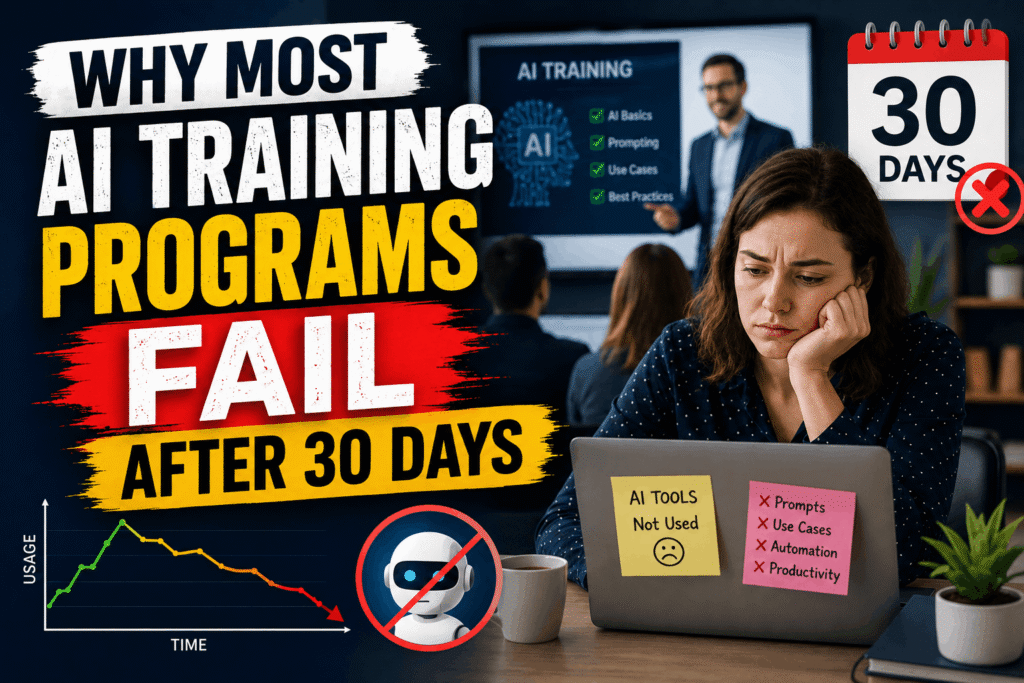
The problem usually shows up about a month later.
An employee attends a workshop. They learn how to write prompts, summarize documents, and use AI tools for everyday tasks. The feedback forms look great. Managers are pleased. Training providers report high completion rates.
Then something happens.
People return to their normal workload.
The AI tool gets opened less frequently. A few weeks later, many employees are back to working exactly as they did before the training happened.
The company paid for AI training. Employees attended the sessions. Yet very little changed.
The First 30 Days Look Promising
Most AI training programs start with enthusiasm.
Employees are curious. Leaders are excited. Teams experiment with new tools.
During the first few days, usage often spikes.
People test prompts. They ask AI to summarize meeting notes. They draft emails and brainstorm ideas.
Everything is moving in the right direction.
The problem is that early activity doesn’t automatically become a habit.
Trying a tool once and using it every day are two completely different things.
Training Creates Awareness, Not Behavior Change
Many organizations treat AI training as a knowledge problem.
If employees understand the technology, they’ll use it.
That sounds reasonable.
Unfortunately, workplaces rarely operate that way.
Most employees already know dozens of productivity shortcuts they never use. Many understand features inside software platforms that sit untouched for years.
Knowledge isn’t always the barrier.
Behavior is.
An employee might learn ten practical AI use cases during training. If none of those use cases become part of their daily workflow, the information slowly fades into the background.
The training worked.
The adoption didn’t.
Why AI Training Programs Fail to Change Daily Work Habits
Workplace habits are stubborn.
Consider a recruiter who has manually reviewed resumes for 5 years.
During AI training, they learn how to summarize candidate profiles in seconds. The process works well.
Then Monday arrives.
Open positions need attention. Hiring managers are waiting. Deadlines are approaching.
Instead of experimenting with a new workflow, the recruiter falls back on familiar routines.
Not because the AI tool failed.
Because established habits usually win when people are under pressure.
The same pattern appears in HR, finance, marketing, customer support, and operations.
People default to what feels familiar.
Most Training Happens Outside Real Work
This is where many AI training programs lose momentum.
Employees often learn through demonstrations that have little to do with their actual responsibilities.
The examples are generic.
The exercises are hypothetical.
The environment feels separate from the work employees do every day.
A customer support specialist might spend an hour learning AI use cases for content creation.
A payroll administrator might sit through examples designed for sales teams.
The information isn’t necessarily wrong.
It’s just not immediately useful.
When employees can’t connect training to their daily responsibilities, adoption drops quickly.
Managers Often Assume Training Is the Finish Line
Many organizations measure success by attendance.
How many employees completed training?
How many certificates were issued?
How many workshops were delivered?
Those numbers are easy to track.
Actual workplace usage is harder.
A company may proudly report that 500 employees completed AI training. Yet only a small percentage continue using AI tools regularly three months later.
Completion rates don’t reveal whether behavior changed.
Usage does.
Employees Need Repetition
Think about how people learn any skill.
Nobody attends a single driving lesson and becomes an experienced driver.
Nobody joins one fitness class and expects lifelong results.
AI skills develop the same way.
Employees need opportunities to use the technology repeatedly.
Small tasks often work better than large projects.
For example:
- Drafting internal emails
- Summarizing meeting notes
- Creating first drafts of job descriptions
- Organizing research findings
- Preparing interview questions
The goal isn’t mastering every AI feature.
It’s creating regular usage.
Repetition builds confidence.
Confidence increases adoption.
The Skills Gap Is Often a Workflow Gap
Many leaders assume employees lack AI skills.
In reality, some employees know exactly how the tools work.
What they lack is a clear place to use them.
Imagine teaching a team how to use AI for meeting summaries.
If the organization continues requiring manual meeting notes, employees have little reason to change.
The issue isn’t training.
It’s process design.
People adopt tools when those tools become part of expected workflows.
Without that connection, usage remains optional.
And the optional tools are usually forgotten.
Why Some Companies See Better Results
Organizations that maintain AI adoption often approach training differently.
Instead of treating training as a single event, they build ongoing support around it.
Managers discuss AI use cases during team meetings.
Employees share examples with colleagues.
Departments experiment with specific workflows.
Small wins receive attention.
The technology stays visible long after the workshop ends.
In these environments, employees don’t just learn about AI.
They continue using it.
That distinction matters more than any training certificate.
What HR and L&D Teams Should Measure Instead
If the goal is long-term AI adoption, different metrics become important.
Consider tracking:
- Weekly active users
- Monthly AI tool usage
- Time saved on common tasks
- Employee-reported productivity gains
- Department-level adoption rates
- Repeat usage after training
These indicators reveal whether employees are integrating AI into their work.
A training session may last one afternoon.
The real story starts after everyone returns to their desks.