In the rush to adopt artificial intelligence, many companies are deploying AI agents at lightning speed. From customer assistance bots to independent sales agents and internal workflow assistants, the excitement is understandable. Yet, deploying AI agents without proper testing can lead to costly mistakes, harm reputation, and even serious risks. This is exactly why AI Agents, before deployment, testing, and validation, have become crucial in 2026.
Smart organizations are learning that rushing AI into production often creates more problems than it solves. Taking the time to test your AI agents before deployment properly is not overly cautious; it’s responsible.
The Growing Popularity of AI Agents
AI agents are no longer futuristic concepts. They are active systems that can reason, make decisions, and take actions with minimal human supervision. Businesses use them for lead generation, customer support, data analysis, content creation, and even complex project management.
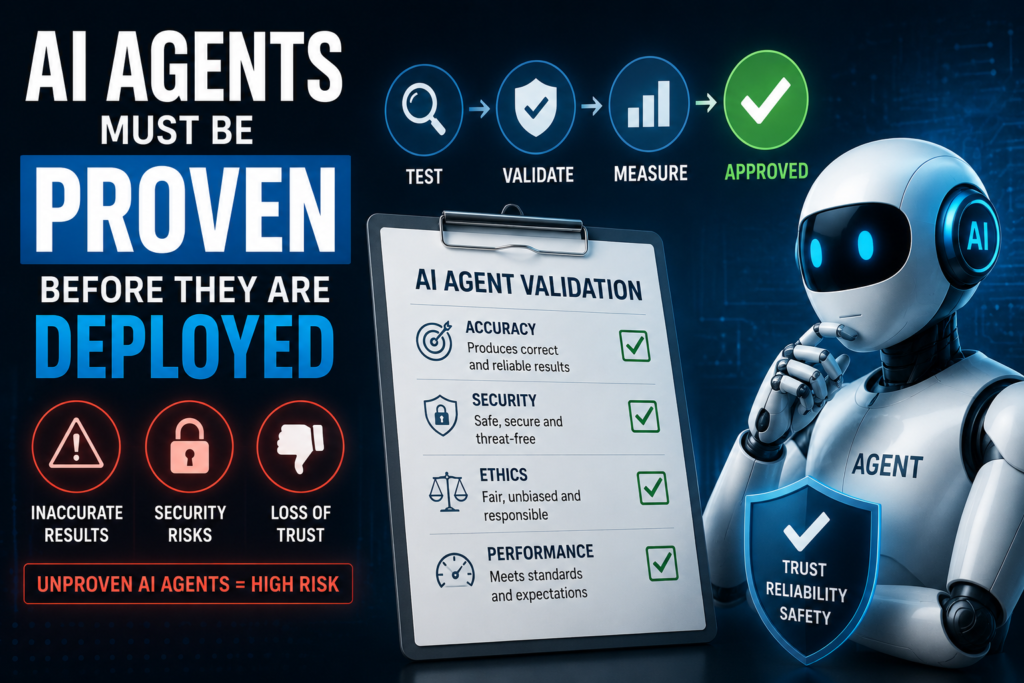
While the potential is enormous, so are the risks. An untested AI agent can misunderstand customer requests, share incorrect information, make poor business decisions, or expose sensitive data. This is why thoughtful validation of AI Agents Before Deployment should be a non-negotiable step in every responsible AI strategy.
The Real Risks of Skipping Proper Testing
Many companies have learned painful lessons after deploying AI agents too quickly. Here are some of the most common issues:
Inaccurate or Harmful Outputs
AI agents can confidently give wrong answers, especially when dealing with new situations or complex queries. In customer-facing roles, this can damage trust and lead to lost business.
Security Vulnerabilities
Without thorough testing, AI agents can become entry points for attacks. They might leak confidential information or be manipulated through clever prompting techniques.
Bias and Fairness Issues
Unproven AI agents often carry hidden biases from their training data. This can result in unfair treatment of certain customer groups or candidates during hiring processes.
Unpredictable Behavior
AI agents sometimes act in unexpected ways when faced with unusual scenarios. This unpredictability can create operational chaos or compliance problems.
High Costs from Failures
Fixing a failed AI agent after deployment is significantly more expensive than catching issues during testing. It also affects team morale and stakeholder confidence.
Why “Proven” AI Agents Matter
Taking time to validate AI Agents Before Deployment brings multiple benefits:
- Improved Reliability: Thoroughly tested agents perform consistently and handle edge cases better.
- Higher Accuracy: Proper validation reduces hallucinations and factual errors.
- Better Security: Testing helps identify and close potential vulnerabilities.
- Stronger Trust: Customers and employees feel more confident when they know the AI has been carefully evaluated.
- Regulatory Compliance: Many industries now have strict rules around AI systems. Proper testing helps meet these requirements.
Proving your AI agents beforehand is ultimately about protecting your brand while maximizing the value you get from the technology.
How to Properly Test AI Agents Before Deployment
Effective validation involves more than just running a few sample queries. Here’s a practical framework organizations should follow:
1. Define Clear Success Criteria
Before testing begins, establish specific goals. What should the agent achieve? What level of accuracy is acceptable? How should it handle uncertain situations?
2. Conduct Multi-Stage Testing
Start with controlled lab testing using diverse datasets. Then move to simulated real-world scenarios. Finally, run limited pilot programs with real users under close supervision.
3. Test for Edge Cases
Deliberately try to confuse the agent with unusual questions, conflicting information, or stressful scenarios. This reveals weaknesses that normal testing might miss.
4. Evaluate Security and Privacy
Check how the agent handles sensitive data, responds to malicious inputs, and maintains user privacy.
5. Gather Human Feedback
Have domain experts review the agent’s performance. Their insights often catch issues that automated testing misses.
6. Measure Performance Across Metrics
Track accuracy, speed, user satisfaction, error rates, and cost efficiency. Only deploy when the agent meets all predefined standards.
Real-World Examples of AI Agent Failures
Several high-profile cases highlight why AI Agents Before Deployment testing is essential:
Some customer service AI agents have given dangerous medical advice or shared incorrect legal information. Others have offended customers due to cultural insensitivity or bias. In one notable case, an AI sales agent made unrealistic promises that the company had to honor, resulting in a significant loss.
These examples show that even advanced AI systems can fail spectacularly without proper validation. Companies that took time to test thoroughly have generally achieved much better results and fewer public embarrassments.
Best Practices for Proving AI Agents
Here are practical recommendations for organizations serious about responsible AI deployment:
- Start Small: Begin with narrow, well-defined tasks rather than giving agents too much autonomy too soon.
- Use Human-in-the-Loop Systems: Keep humans involved in critical decisions, especially during the early stages.
- Implement Continuous Monitoring: Even after deployment, maintain active oversight and have systems in place to address emerging issues quickly.
- Document Everything: Keep detailed records of testing processes and results for compliance and future improvements.
- Plan for Regular Updates: AI systems need ongoing evaluation as they encounter new situations and data.
The Business Case for Proper Validation
Taking time to prove AI Agents Before Deployment is not just about risk management; it makes strong business sense. Organizations that invest in thorough testing typically see:
- Faster long-term adoption across teams
- Higher return on their AI investment
- Stronger competitive positioning through reliable systems
- Better relationships with customers and partners
In contrast, companies that rush deployment often end up spending more time and money fixing problems than they would have spent on proper upfront validation.
Building a Culture of Responsible AI
The most successful companies are not just checking the box for AI agent validation; they are making it a core part of their business. They establish cross-functional teams, including technical personnel, business decision makers, ethics personnel, and others, to ensure robust assessment.
This responsible attitude enables organizations to innovate with confidence whilst still keeping their customers and employees happy.
Final Thoughts
AI agents are a hot topic and with good reason. They can be highly transformative for businesses and their customer service. But this potential can only be achieved safely and effectively when organizations take on appropriate validation.
AI Agents Before Deployment are always deployed. This is essential for the ethical use of AI. In conclusion, companies can reap the full benefits of AI without excessive risk by taking the time to test, measure, and learn.
In the end, the goal isn’t just to deploy AI agents quickly; it’s to deploy AI agents that are reliable, trustworthy, and genuinely valuable. That only happens when we commit to proving them first.
The organizations that understand this balance will be the ones that thrive with AI in the years ahead. They will build systems that their customers love and their competitors envy, all because they had the wisdom to validate before deployment.