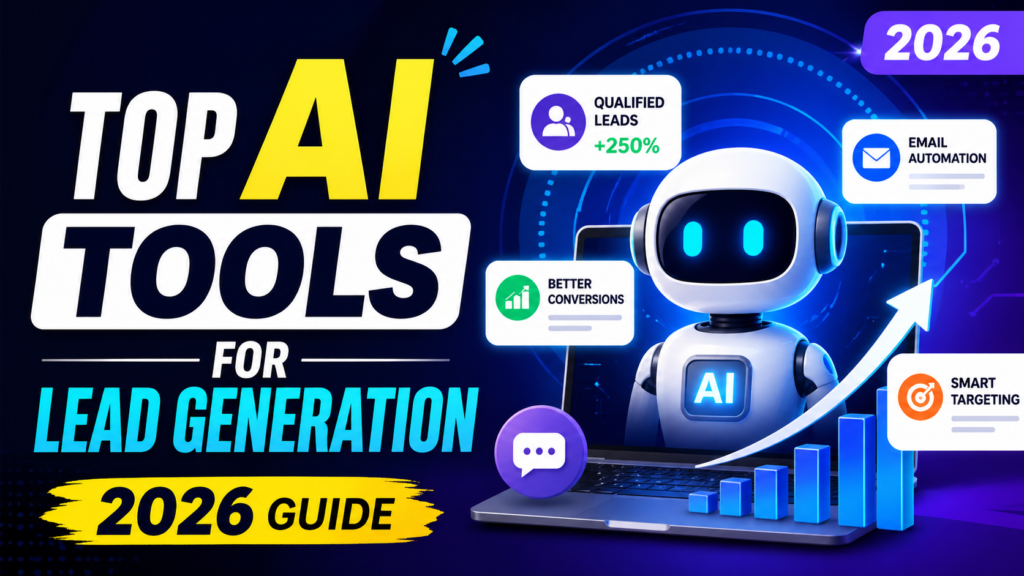
One of the most challenging aspects for businesses in today’s competitive digital landscape is generating high-quality leads. Traditional methods like cold calling, manual prospecting, and mass email campaigns are no longer effective at capturing attention or driving conversions. This is where AI tools for lead generation are transforming the process, enabling businesses to attract, capture, and convert leads more efficiently than ever before.
AI lead gen tools employ sophisticated techniques like machine learning, predictive modelling, and natural language processing to identify, understand, and communicate with potential leads. Rather than guesswork, companies can now use data to understand their audience and boost conversions.
Businesses that use AI gear for lead generation in 2026 are not best making their lives easier, they are building scalable systems that generate leads and result in increased sales. This guide will explain how AI tools function, why they are critical and how to leverage them to advantage your business.
What Are AI Tools for Lead Generation?
Lead generation AI tools are digital platforms that help businesses identify, engage and convert leads. These tools gather information from various channels, such as websites, social media and user behaviour, to identify potential leads.
AI equipment employ system learning to examine styles in consumer behaviour and are expecting which leads are most in all likelihood to turn into customers. This enables agencies to focus on high-value opportunities, as opposed to squandering resources on leads that are much less likely to convert.
The primary features of AI lead era equipment are lead scoring, audience segmentation, automated outreach and tracking. These capabilities allow companies to deal with a large quantity of leads with out dropping personalisation.
The Future of Lead Generation Is AI
Moving to AI in lead generation is more than a passing fad; it’s a paradigm shift. With increasing customer demands, businesses need more intelligent tools. Efficiency is a key driver for businesses to use AI. AI automates routine tasks like data management, follow-up and lead segmentation, freeing up time for planning and building relationships.
The next key benefit is lead quality. AI systems assess user intent, interactions and other factors to identify high-value leads. This leads to improved conversion rates and ROI. Personalisation is another key factor. Consumers now expect personalised interactions, and AI makes it possible to deliver personalised communications. From email marketing to website visits, AI can tailor the message to individual leads.
Data-driven decision-making is also a significant benefit. AI tools offer in-depth analytics, allowing businesses to gain insight and improve their campaigns for performance.
The Technologies that Power AI Lead Generation
Knowing the technology behind AI tools can help you get the most from them.
AI tools use machine learning to learn from experience. As they learn from more data, they can recognise patterns and make predictions.
Natural language processing enables AI tools to process and interpret human language. This is often used in chatbots and other conversational AI systems to interact with users.
Predictive analytics leverages data from the past to predict future outcomes. This allows companies to target and prioritise leads with high purchase intent.
Automation takes care of routine tasks. Automation can handle tasks such as emailing and updating CRM data, freeing up time and improving efficiency.
Types of AI Tools for Lead Generation
Businesses can employ various types of AI tools for lead generation.
Chatbots and other conversational AI tools engage with website visitors and generate leads on-the-spot. These offer instant support and help navigate the buyer’s journey.
AI-driven CRM software assists with lead management, tracking and follow-up. They offer a platform to manage customer information and enhance sales workflows.
AI-powered email marketing automation solutions personalise email campaigns and determine the best times to send emails. This helps increase open rates, click-through rates and engagement.
Lead enrichment tools improve your data by adding more details about leads. This might include information like company size, industry, and job title.
Lead-scoring tools use data to determine which leads are most likely to become customers. This allows sales representatives to prioritise leads.
Top AI Lead Generation Tools in 2026
There are many AI tools available to enhance lead generation. The best tool for you will depend on your specific requirements but the most successful tools will have a combination of automation, analytics and segmentation.
Effective AI tools may have real-time analytics, user behaviour tracking and cross-channel integration. The most successful businesses employ a mix of tools including chatbots, CRM software and email marketing automation tools.
Look for user-friendly, integrated and scalable solutions. You want a solution that can scale.
How to Use AI for Lead Generation
To effectively use AI tools, it is important to follow a systematic approach.
This involves identifying your target audience. This means defining your audience based on industry, geography and job title. This will help inform your strategy.
Then select AI tools to meet your needs. For instance, if lead generation is your goal, consider conversational AI. If you want to track and nurture leads, a CRM is a must-have. With the right tools, set up lead generation from various sources. These can be your website, landing pages and social media. The more opportunities, the greater the chance of capturing leads.
Segmentation is a critical step in the process. Using AI, leads can be automatically segmented based on their interests. You can then tailor marketing campaigns for each group. You should use automation to manage communication. You can automate emails, follow-up messages and other communications to keep them engaged.AI Lead Generation for B2B Businesses
AI tools are particularly valuable for B2B lead generation, where the sales process is more complex and involves multiple decision-makers. B2B companies can use AI to identify key stakeholders within organisations and track their interactions. This helps sales teams understand the buying process and tailor their approach accordingly.
AI also enables more effective lead nurturing by automating follow-ups and delivering personalized content. This keeps prospects engaged throughout the sales cycle.
Another advantage is improved pipeline management. AI tools provide real-time insights into each lead’s status, enabling businesses to prioritize opportunities and close deals faster.
Common Mistakes to Avoid
Using AI tools can be beneficial, but there are common pitfalls.
Over-automation is a major issue. Over-automation can lead to a lack of personalisation. It’s worth finding a balance between automation and human touch.
Data quality is another factor. Data quality affects the performance of AI tools, so make sure to keep the data clean and accurate.
A common pitfall is having too many tools. This can cause chaos and confusion. It’s better to have a small number of tools that suit your needs.
Many people also fail to focus on analytics. Analytics can tell you a lot about your marketing, so make sure you track and tweak your campaigns.
Advanced Strategies to Maximize Results
Businesses can use advanced strategies to maximise the use of AI tools for lead generation. Using a combination of AI tools is a good strategy. For instance, integrating chatbots for lead generation, CRM software for organisation, and email marketing for lead nurturing.
Personalisation is key. Leverage AI to personalise communications in line with user behaviour. This boosts engagement and trustworthiness.
You can also use content marketing for lead generation. By producing helpful and informative content, you can generate leads and prompt action. You can also use multi-channel marketing techniques. Reach potential customers on channels like email, social and your website.
It’s important to test and improve over time. Try new methods, and learn from the results.
The Future of AI in Lead Generation
The future of lead generation is even more heavily reliant on AI. New tools will be more sophisticated, with more insights and automation.
We’ll see more voice search, sophisticated chatbots and personalisation. Early adopters will benefit from this technology.
It will also be better integrated with other marketing software, allowing for smooth data sharing and processes. This will allow companies to control their lead generation strategy in one location.
Conclusion
Lead generation AI systems are transforming how groups attract and convert leads. Through the use of technologies like device mastering, predictive modelling and automation, businesses can construct extra sustainable and efficient lead generation processes.
These system now not solely save time but also enhance lead pleasant, increase conversion fees and offer scalability. AI is crucial to survive and thrive in a aggressive environment.
Organisations which make investments in the latest AI lead technology could also be greater likely to develop, evolve and thrive in the future. By following the guidelines described in this article, you may build a effective lead technology device which can produce constant effects and in the end cause lengthy-term success.