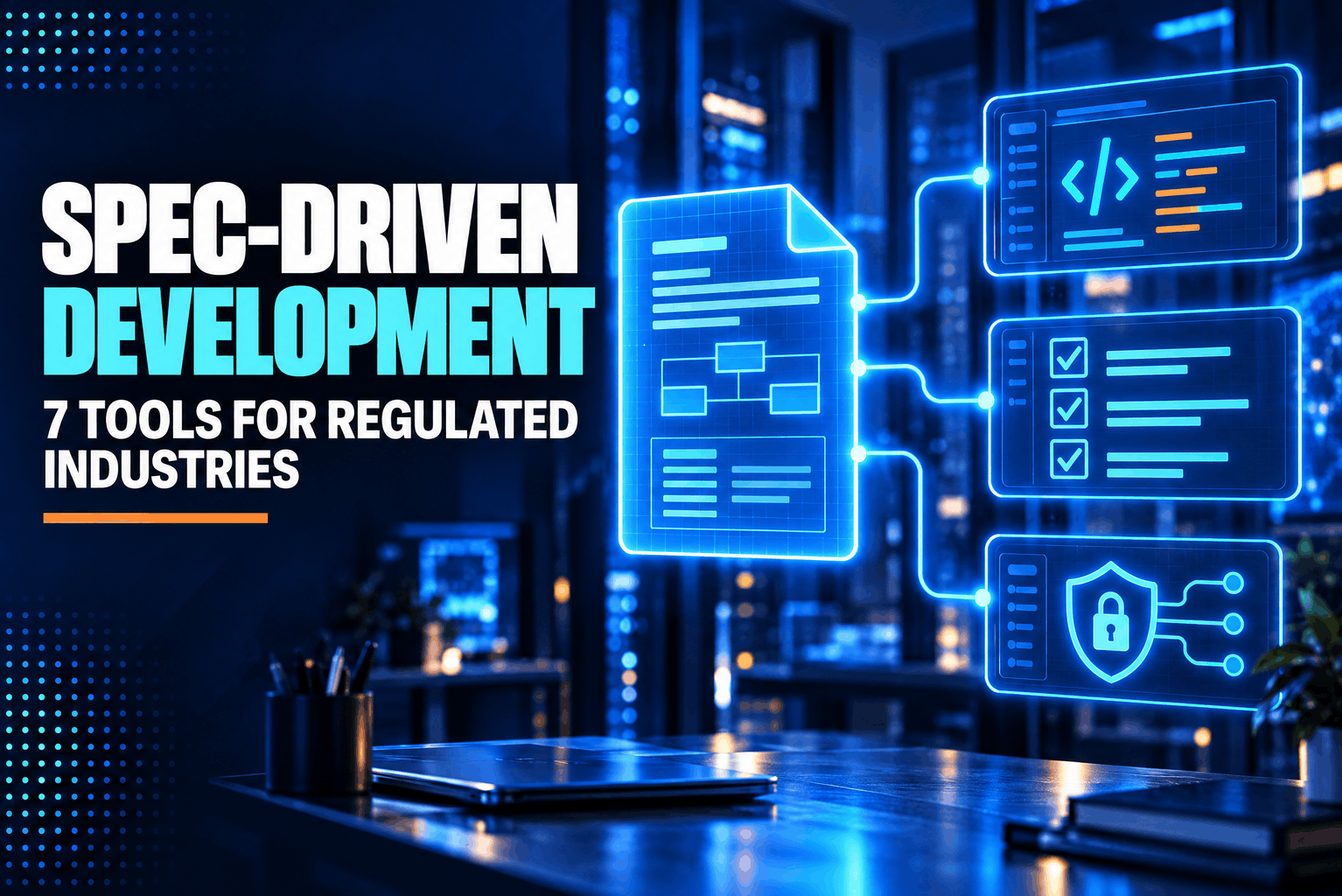
Spec-driven development tools for regulated industries help teams carry written requirements into code, tests and review. Some guide coding agents. Others manage requirements across a product lifecycle or check whether an API follows its contract. None makes a product compliant on its own. That still depends on the organization’s approval process, validation, access controls, records and release practices.
NIST SP 800-218 recommends integrating secure practices into an organization’s software lifecycle rather than expecting one product to cover every risk. Teams need to trace requirements through review, tests and release, then keep the evidence their process calls for.
How spec-driven development tools for regulated industries differ
The tools below serve different jobs. Kiro, GitHub Spec Kit, OpenSpec and Tessl’s Spec-Driven Development Tile organize work for coding agents. IBM DOORS Next and Jama Connect manage requirements and their links to design, risk and test artifacts. Specmatic checks APIs against written contracts. They can be compared by fit, but they are not interchangeable products.
For regulated work, AI coding tools for regulated industries should be treated as assistants inside a controlled process. The spec is a starting point for review, not proof that the implementation meets every obligation. Keep a person responsible for resolving ambiguous requirements, approving changes and checking test evidence.
1. AWS Kiro
Kiro turns a feature request or bug fix into a set of reviewable files. Its spec workflow can produce requirements, a design and a task list. Steering files let a team record project conventions, while hooks can run local commands or ask an agent to respond to file and tool events.
That makes Kiro useful when a team wants an AI coding assistant to work through defined stages rather than jump straight from a short prompt to a patch. A reviewer can inspect the planned work before implementation and track task status as it proceeds.
Review Kiro’s permission, model, retention and logging settings. Agents can access project files, run commands and use available credentials; a prompt log is not a complete audit record.
2. GitHub Spec Kit
Spec Kit is an open-source CLI that sets up a repository-based workflow for coding agents. Its documented stages can include a project constitution, feature specification, plan, task breakdown, implementation and a convergence check. The artifacts are Markdown files that teams can review and store with code.
It suits organisations that want to adapt templates to internal engineering rules without buying a separate specification platform. The quickstart includes optional analysis and checklist steps, while the project also documents a bundled installation path for air-gapped environments. That installation option does not prove that the chosen agent, model or full toolchain runs offline.
Spec Kit offers prompts and checks, not proof an agent followed them. Use repository controls, review, independent tests and release approval; its file history is not a tamper-resistant record of every agent action.
3. OpenSpec
OpenSpec is a local CLI for planning changes in Markdown. A typical change includes a proposal, affected specs, a design and a task list. After implementation, the team can archive the change and carry the updated requirements into later work. The project lists many coding-agent integrations.
This approach can fit an existing codebase where a team wants to document one change at a time. It also leaves the files readable without a special viewer. Git commits and pull requests can provide review history when the organization already requires them.
OpenSpec structures changes but does not enforce approvals or guarantee an agent followed the spec. Its security docs describe a local CLI and limited telemetry with opt-out; they do not describe an enterprise audit console or immutable record set. Review agent and repository controls too.
4. Tessl Spec-Driven Development Tile
The open-source Tessl Tile gives an agent steps for clarifying requirements, writing a spec, seeking approval, implementing work and reviewing the result. Its .spec.md files can link requirement statements to tests, and included scripts can check file structure and those links.
That provides a practical way to make specs part of everyday coding work. A team can begin with a single feature and check whether the agent’s output and tests still match the agreed text before merging.
Confirm which Tessl product is in scope: the public Tile differs from other Tessl offerings, and availability or controls may vary by version. Its scripts catch structural errors, not missed requirements. Verify current status, agents, data handling and audit features before purchase.
5. IBM Engineering Requirements Management DOORS Next
DOORS Next is a requirements-management application within IBM Engineering Lifecycle Management. It links requirements to development and test artefacts, records artefact revisions and supports baselines that capture a component’s state at a point in time. Teams can compare baselines and review changes across the product lifecycle.
This is a different kind of tool from an AI coding assistant. It is suited to larger engineering programmes that need requirements, design and test work connected across teams. IBM also documents link-validity states. When a linked artefact changes, the relationship may need to be checked again by a person; a trace link alone does not show that a test passed.
Organisations should verify how permissions, retention, reporting and integrations are configured in their own deployment. IBM’s stated support for industry standards is not proof that a customer’s process or product meets them.
6. Jama Connect
Jama Connect focuses on requirements, risk, tests and validation across product development. Jama describes Live Traceability as a way to connect requirements with test cases and validation results and to show where a change may affect related work.
That can help teams see whether important requirements have linked verification work and where a review is still needed. It may fit projects with many contributors, suppliers or product variants, where the cost of losing a requirement between design and testing is high.
Treat vendor security statements and materials about electronic records as product information to evaluate, not as proof of compliance. Ask how audit history is scoped, retained and exported. Confirm whether approvals and signatures match the organisation’s process, and validate any workflows before using them as regulated records.
7. Specmatic
Specmatic takes a narrower route: it uses API specifications as executable contracts. Its contract tests send requests described by the spec and check whether responses match the documented interface. The tool can also create mocks from contracts and run checks from a command line or in CI.
This is useful when teams need to catch mismatches between API providers and consumers before a release. A contract can define expected request and response shapes, while the tests show whether a service conforms to those expectations.
That result has limits. Specmatic’s documentation distinguishes contract conformance from business-logic testing, and its protocol support varies by edition. Confirm which formats are included in the version being considered. Add separate tests for business rules, security and system behaviour; a passing contract test covers only what the contract describes.
Controls to check before choosing
Map required evidence before comparing feature lists. The secure software development lifecycle may call for reviewed requirements, change history, code review, test records, approvals and release records. Ask what each tool captures, who can alter or delete records, how long they remain, and whether they can be exported.
For software development compliance, check the tool’s actual role in the process. A requirements platform can preserve links; an agent assistant can make a task list; a contract-testing product can record interface checks. None replaces risk assessment, validation or human approval. Verify the model and data path, storage location, permissions, extension access and handling of confidential material before connecting a coding agent to a repository.
Specs should also state the rules that tests can check. A system handling lead generation may need requirements for consent, data fields, retention and deletion. Write those expectations into the spec, assign an owner to review them, and add tests where the behavior can be checked automatically. For a rule that needs human judgment, record who makes the decision and where the evidence is kept. Record who reviews requirements that need human judgement, then keep the decision with test evidence.