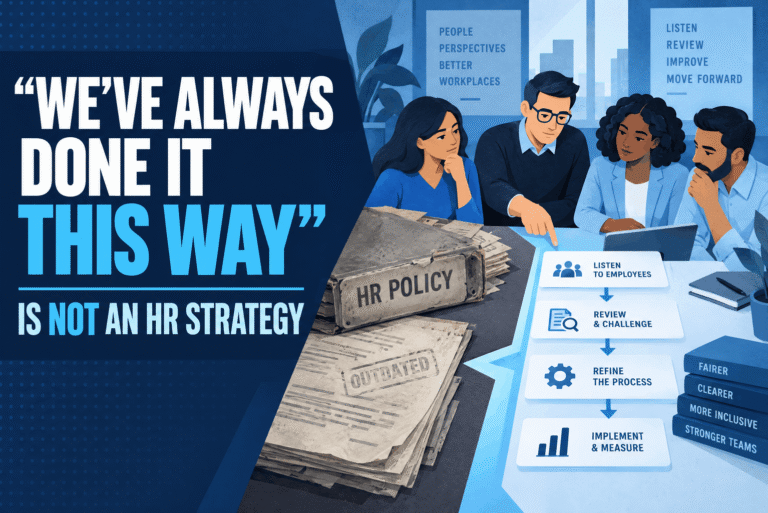
A new starter asks why every leave request needs three signatures. Nobody can explain the rule, but everyone knows the form has been around for years. That is not an HR strategy. It is a habit with paperwork attached. The phrase “we’ve always done it this way” often appears when a policy has outlived the problem it was meant to solve. HR has to find out whether the old way still serves people and the work, then decide what should change.
That question is more urgent when managers are stretched. Gallup’s 2026 workplace report says global employee engagement fell to 20% in 2025, with manager engagement at 22%, down from 31% in 2022. Those figures do not prove that stale HR routines caused the decline. They do make it harder to defend processes that waste managers’ time or leave staff unsure how decisions are made.
Why an HR strategy must question old routines
Old policies can look neutral because they apply to everyone. Their effects may not be. A rigid attendance rule, a long approval chain, or a performance review built around a once-a-year form can create different burdens across roles and teams. Some procedures exist for legal, safety, or financial reasons. Others remain because no one has been asked to test them.
Scrapping a control without understanding why it exists can create a real risk. Keeping every step because “that’s the process” creates another kind of risk: lost time, inconsistent decisions, and staff who stop raising concerns. HR should ask what the rule protects, who it helps, who must carry it out, and what evidence would justify keeping it.
Start with the people doing the task. Ask employees and managers to walk through the process, not just rate it in a survey. Where does a request wait? Which information is entered twice? What happens when someone asks for an exception? An HR team may discover that the written policy is simple while the unwritten version has grown complicated through local workarounds.
Listen before announcing change
A workplace culture change cannot be announced into existence. A new value on a poster will not undo a pattern where people are ignored, punished for raising issues, or left out of decisions that affect their work. Culture shows up in ordinary choices: who gets flexibility, how mistakes are handled, and whether a manager explains a decision or simply says no.
CIPD defines employee voice as the way people communicate their views and influence matters that affect them at work. It notes that one channel rarely does the job by itself; organisations need complementary ways for people to speak up, backed by leaders and managers who listen and respond. A pulse survey can identify a theme. It cannot tell HR why a team has stopped trusting a process. That takes follow-up conversations, and sometimes a willingness to hear an answer that makes the organization uncomfortable.
The strongest test of listening is what happens next. Tell employees what you heard, what will change, and what will not. Explain the reason for either decision. If people share feedback and never hear back, the next survey may collect fewer honest answers. Silence can be mistaken for agreement, especially when staff think speaking up will mark them as difficult.
HR should give managers a clear route for raising repeated concerns. A manager should not need to invent a workaround for every employee who cannot fit a rigid rule. Nor should informal discretion become a hidden policy that varies by who asks. Define what can be decided locally, what needs HR review, and how similar cases will be treated consistently.
Turn an employee engagement strategy into daily practice
An employee engagement strategy is not a calendar of appreciation days. It should help people understand what is expected, get the tools and support to do the job, and have a credible way to influence decisions that affect them. That sounds basic. The gap between the written promise and a Tuesday afternoon is where many plans fall apart.
Gallup’s report links the recent global engagement decline most strongly to managers: manager engagement fell by nine percentage points between 2022 and 2025, while non-manager engagement changed less over the same period. HR cannot repair that with a single workshop. It can examine workload, decision rights, manager support, and the number of routines that pull supervisors away from useful conversations with their teams.
Ask managers which administrative steps add value and which exist mainly because nobody has removed them. Take a performance check-in. If a supervisor spends the meeting reading ratings from a form, the form is taking up time that could be used to discuss obstacles, priorities, or development. Keep the record if it supports fair decisions. Change the conversation around it so employees are not reduced to a score.
This is where HR best practices need to be judged by behavior, not by whether the organization has a policy document. A listening channel needs a named owner and a visible response cycle.
Make HR change management specific and honest
Good HR change management starts with a plain account of the problem. “We need to modernize” tells staff almost nothing. “Managers are re-entering leave information in two systems, and requests take five days to reach an approver” gives them something they can check. Define the outcome before choosing a solution. Perhaps the aim is to cut duplicate entry, improve response time, or make exceptions fairer.
SHRM’s change-management checklist advises HR to define objectives, identify stakeholders, clarify roles, assess risks, plan communications and training, gather employee feedback, track progress, and review results after implementation. It is a useful sequence, but the work should not become a checklist exercise. If the proposed process fails in practice, adjust it rather than celebrating that every launch task was completed.
Communication is more than sending a launch email. SHRM’s 2026 discussion of change communication emphasizes explaining the reasoning behind decisions and listening, not only directing employees to follow a new process. People will have practical questions: Will this change my shift? Who approves an exception? What happens to work already in progress? Give managers answers before the announcement, including what is still undecided. Pretending every detail is settled can damage trust when reality catches up.
Try the revised approval path with one department or one type of request. Note how long each step takes, where people ask for help, and whether staff who need exceptions can still get them. Invite skeptical employees into the review. They may see failure points that the project group has learned to overlook.
Measure more than adoption. A high number of completed forms can mean the process is being used, not that it is working. Track wait time, repeated corrections, manager time, employee understanding, and whether outcomes differ between groups or locations. Compare against the problem you set out to solve. If the figures improve while complaints rise, investigate before calling the change a success.
Retire policies without losing accountability
Removing a rule takes more care than deleting a page from the handbook. Check whether it connects to a legal duty, a safety control, a contractual promise, or another policy. Ask the people responsible for those areas to review the change. Record who can approve the new process and how staff can challenge an inconsistent decision.
Then update the working materials employees actually use: manager scripts, onboarding notes, forms, system prompts, and team guidance. An old template can quietly restore a retired rule. Tell staff where to find the current version and when it takes effect. If an exception remains, explain who handles it and what information they need.
Review the result after launch. Ask employees whether the new path is clearer. Ask managers where the guidance still leaves room for guesswork. Check whether the intended time savings appeared in real work, not only in a project estimate. If the new process has created a fresh burden, fix it. “We changed it last year” is no better a reason to keep a poor process than “we’ve always done it this way.”