AI is transforming modern marketing, and it wasn’t possible even a couple of years ago. These days, AI can be used to create content, create ads, send emails and even engage customers in real-time interactions. This transformation posed an intriguing question regarding customers trust AI Marketing and their comfort level with interacting with brands that heavily depend on automation.
It’s not only a technology problem for small businesses. It is a trust issue and directly impacts reputation, customer loyalty and long-term growth. .
Understanding Customer Trust in AI Marketing
The key to customer trust is in clarity, consistency and honesty. As AI becomes a part of marketing, it alters the perception of the customer towards the brand’s message.
There are some customers who don’t realize that they’re already engaged with an AI system. Recommendation engines, chatbots and automated ads are a common part of our everyday digital lives. When it comes to adopting AI, many people simply do so because of the increased speed and convenience it provides.
But trust is fragile when communications are artificial or too robotic. When content is so shallow or generic, customers might not feel a connection to the brand behind the content.
That’s why, more than anything else, Customers Trust AI Marketing thanks to its usage.
How Customers Actually Respond to AI-Driven Marketing
The customer’s response to AI marketing is not 100% positive or negative. Rather, they are context dependent.
Customers feel comfortable when AI can help them find a product or quickly answer a question or give them a personalised recommendation. These experiences are seen as useful and efficient.
Meanwhile, there’s a reluctance to choose a brand when customers feel a lack of humanity in how a brand communicates. Emotional connection can be decreased with mechanical and repetitive messaging.
The same lack of trust occurs if personalization is too intrusive. Relevance is appreciated by customers but they don’t like being “watched” or tracked too much.
In general, users are not against AI marketing, but rather favor it when it is used appropriately. They do not enjoy experiences that are impersonal or intrusive.
The Small Business Reality
The situation is challenging for small businesses when it comes to AI marketing tools. They also tend to rely more on personal relationships and face-to-face communication with customers, as opposed to large corporations.
AI without proper consideration can inadvertently take away the personal touch that small businesses are known for. What used to come across as warm and caring can become robotic and impersonal.
There’s also a need to remain competitive! While AI tools are quick and efficient, small businesses need to strike a balance between the two and ensure that they remain authentic. It’s not about access to technology, it’s about maintaining identity, using the technology.
For many small businesses, it’s a challenge to know what is too much automation.
Risks That Affect Customer Trust
There are several issues that can arise when using AI too extensively in marketing and have a direct effect on the consumer perception of a brand.Using AI in too much of marketing can lead to a number of problems, which can have a direct effect on customers’ perception of a brand.
One of the problems often encountered is personality loss. A uniform and generic feel to branding can begin to occur when all messages are produced, or at least significantly influenced, by AI.
Transparency is another issue. When the customers find content created by humans, they may end up being deceived.
There is the possibility of inaccurate and/or poor-quality messaging, too. The content generated by AI tools may be incorrect or contextually inappropriate, potentially harming the credibility of the articles if not thoroughly vetted.
Most importantly, over-automating can undermine emotional connection, a factor that many customers cite as their motivating factor to remain loyal to small businesses.
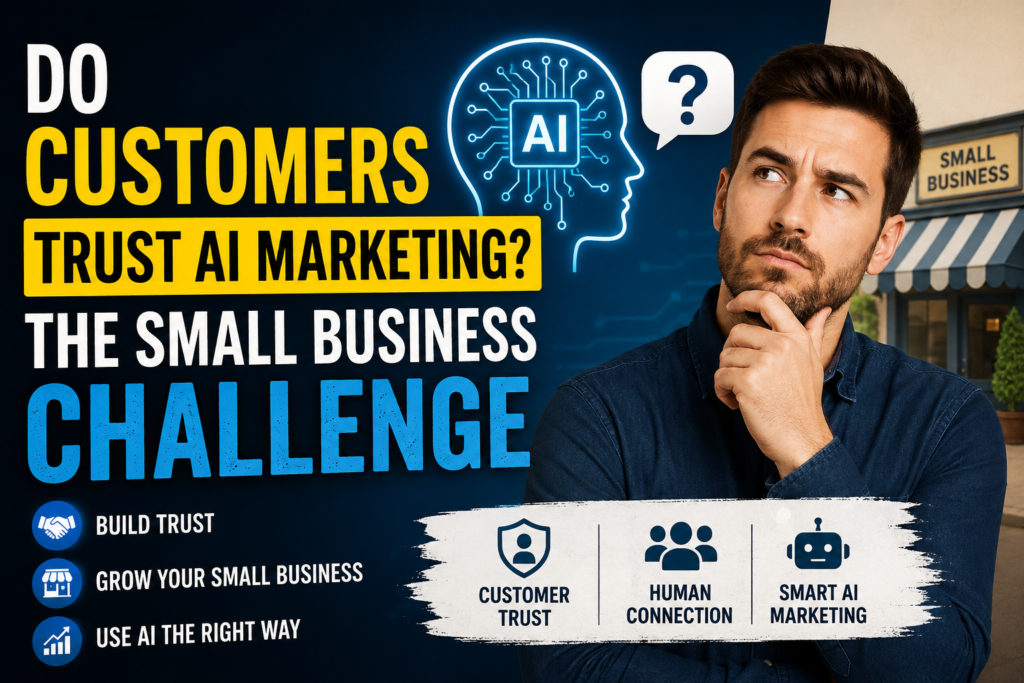
Building Trust While Using AI Marketing
AI can be leveraged to benefit small businesses without compromising customer trust, it’s just a matter of how it’s done.
The key to using AI is to use it to augment, not replace, human creativity. If your company is leveraging AI to ideate faster or make things more efficient, but then finetunes the messages with human intuition, it feels like a balance that’s easy on your customers.
It’s also crucial to adopt a unified tone of voice for your brand. AI-generated content should always be aligned with the business personality and values, even when AI is used to generate content.
When experiences are helpful, not automated, customers react positively to them. This implies quality, relevance, and clarity over quantity of content produced.
Transparency also is a factor. Technical explanations are not required, but being honest when communicating is appreciated by customers.
The combination of these makes Customer Trust AI Marketing much more powerful.
The Direction of AI Marketing and Trust
AI is poised to further embed itself in marketing systems. With time, customers will get even more accustomed to AI-generated experiences.
During this period of time, expectations will change. The usage of AI will not be a differentiating factor for the customer when making their purchasing decision, it will be how the customer uses it.
The businesses that will be able to thrive in the long run will be the ones that can pair up automation with real people interaction. Emotion, Storytelling and Trust are human domains and efficiency will be handled by AI.
It’s a balance that will be essential for the survival of small businesses in an increasingly digital landscape where automation plays a significant role.
Conclusion
People’s Trust in AI marketing is not permanent. It depends entirely on its application.
If AI improves the customer experience, customers are okay with it; if it detracts from authenticity, they’re not. So, small businesses need to rely more on artificial intelligence as a tool to assist them and not replace human interaction.
AI can be utilized to boost marketing efforts without compromising Trust when utilized correctly. The question isn’t about the trust customers have in AI marketing; it’s about how businesses can leverage AI without sacrificing the human touch.