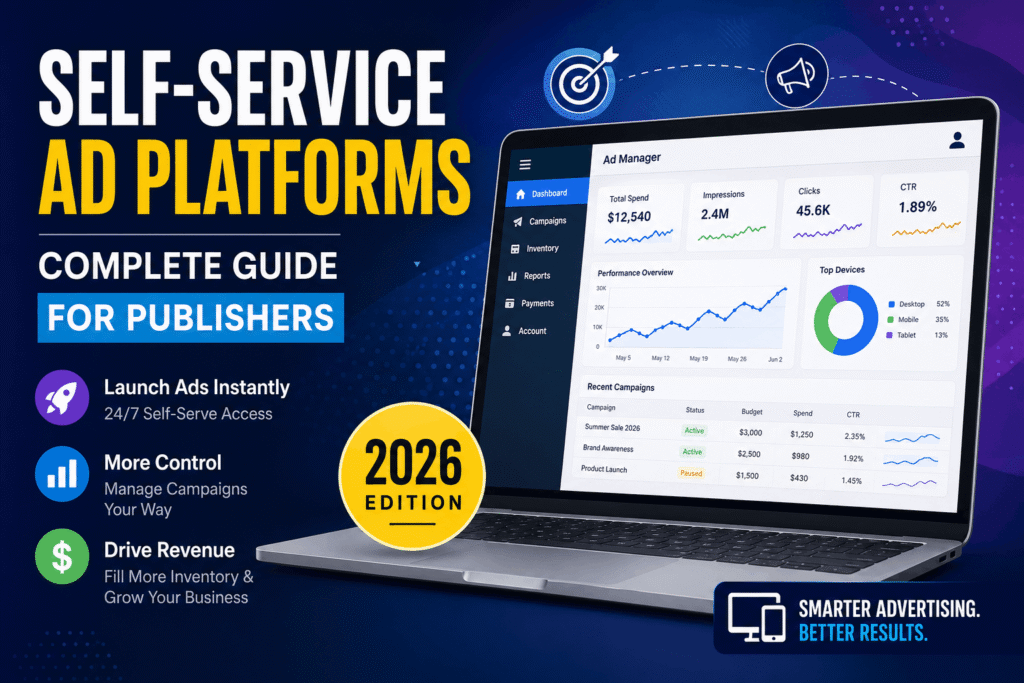
Digital advertising has changed dramatically over the last few years. Publishers no longer have to depend entirely on direct sales teams or lengthy negotiations to sell ad inventory. A modern self-service ad platform gives advertisers the freedom to create campaigns, set budgets, upload creatives, and launch ads without waiting for manual approval at every step. For publishers, that means faster campaign launches, better inventory utilization, and a scalable way to generate advertising revenue.
Whether you manage a news website, niche blog, online magazine, or media network, understanding how a self service ad platform works can help you simplify ad operations while giving advertisers the flexibility they expect. As more businesses look for quick and transparent advertising solutions, self-serve advertising is becoming a standard feature instead of a competitive advantage.
What Is a Self-Service Ad Platform?
A self-service ad platform is a web-based system that allows advertisers to manage digital advertising campaigns without relying on an account manager.
Instead of sending emails back and forth to request ad placements, advertisers can log in to a dashboard, select inventory, upload creatives, define targeting options, choose a budget, and launch campaigns whenever they want.
Publishers still maintain control over pricing, available inventory, approval workflows, and campaign policies. The difference is that routine tasks become automated, reducing manual work for both parties.
Most platforms include features such as:
- Campaign creation
- Creative uploads
- Audience targeting
- Budget management
- Real-time reporting
- Performance analytics
- Billing and payment processing
Together, these features create a smoother experience for advertisers while allowing publishers to manage hundreds of campaigns without expanding their sales team.
Why Publishers Are Moving Toward Self-Serve Advertising
Traditional advertising sales often involve multiple emails, proposal documents, contract reviews, and manual campaign setup.
That process works for large enterprise deals.
It becomes difficult when publishers receive dozens or even hundreds of smaller advertising requests each month.
Self-serve advertising removes many of these repetitive steps.
Instead of waiting for someone to configure a campaign, advertisers can complete most of the work themselves through a secure dashboard.
For publishers, the benefits go beyond convenience.
A self-service model helps:
- Accept advertising requests 24/7
- Reduce campaign launch time
- Lower operational costs
- Improve advertiser satisfaction
- Increase inventory utilization
- Generate additional revenue without increasing headcount
Smaller businesses also benefit because they can launch campaigns immediately instead of meeting minimum spending requirements often associated with managed advertising services.
Key Benefits of a Self-Service Ad Platform
Every publisher has different goals, but most adopt a self-service ad platform for one reason: efficiency.
The platform automates repetitive processes while giving advertisers more control over campaign management.
Faster Campaign Launches
Time matters in digital advertising.
An advertiser promoting a seasonal sale or product launch doesn’t want to wait several business days for campaign approval.
With a self-serve platform, campaigns can be created within minutes, reviewed automatically or manually, and launched much faster than traditional workflows.
Better Revenue Opportunities
Unsold inventory represents lost revenue.
A self-service system allows publishers to make available inventory visible to more advertisers, increasing the chances of filling ad space that might otherwise remain unused.
This creates a more consistent revenue stream throughout the year.
Reduced Manual Work
Without automation, sales and operations teams spend valuable time answering repetitive questions, collecting creative assets, preparing invoices, and configuring campaigns.
A self service ad platform automates many of these tasks, allowing teams to focus on larger partnerships and strategic growth.
Improved Transparency
Advertisers want to know where their budget is being spent.
Modern platforms provide real-time dashboards showing impressions, clicks, conversions, spending, and campaign performance.
This level of transparency builds confidence and encourages repeat business.
Easier Scaling
As advertising demand grows, publishers need systems that can handle more campaigns without increasing operational complexity.
A well-designed ad tech self serve portal allows businesses to support hundreds or even thousands of advertisers through one centralized interface.
Instead of hiring additional staff for every increase in demand, publishers can scale more efficiently while maintaining a consistent user experience.
How a Self-Service Advertising Workflow Looks
Although every platform is different, the overall process is straightforward.
A typical workflow includes:
- Advertiser creates an account.
- The advertiser selects available ad inventory.
- Campaign goals and budgets are defined.
- Creative assets are uploaded.
- Targeting options are selected.
- Payment is completed securely.
- The publisher reviews the campaign if required.
- Ads begin serving after approval.
- Performance data becomes available through a reporting dashboard.
Because most of these steps happen inside a single interface, advertisers spend less time managing campaigns and more time optimizing results.
For publishers planning to modernize their advertising operations, following the latest developments in ad technology and digital publishing can help identify the right platform features and implementation strategies. Resources available through TechHub Insight can provide valuable perspectives on emerging trends before investing in a new advertising solution.
Core Architecture of a Self-Service Ad Platform
A reliable self-service ad platform is more than a campaign dashboard. Behind the interface, several components work together to manage advertisers, inventory, payments, reporting, and ad delivery.
When these systems are connected properly, publishers can automate repetitive tasks without losing control over their advertising operations.
The core architecture usually includes:
- Advertiser dashboard
- Inventory management
- Campaign management engine
- Audience targeting tools
- Payment gateway
- Reporting and analytics
- Approval workflow
- User management
- Ad server integration
Each component plays a different role, but together they create a seamless experience for advertisers and publishers.
Advertiser Dashboard
The dashboard is the first thing advertisers see after logging in.
A clean interface helps users launch campaigns without needing support from the publisher’s sales team.
An effective dashboard should display:
- Active campaigns
- Available inventory
- Budget status
- Campaign performance
- Pending approvals
- Billing history
- Account settings
Simple navigation reduces confusion and encourages advertisers to continue using the platform instead of abandoning campaigns midway.
Campaign Management
Campaign management is the heart of every self service ad platform.
This is where advertisers define how their campaigns will run.
Typical options include:
- Campaign name
- Start and end dates
- Daily or lifetime budget
- Creative uploads
- Ad formats
- Device targeting
- Geographic targeting
- Frequency caps
Instead of relying on emails or spreadsheets, advertisers can adjust campaigns themselves whenever business priorities change.
For publishers, this reduces support requests and allows campaign updates to happen much faster.
Inventory Management
Publishers often manage multiple websites, categories, and advertising placements.
Without proper organization, inventory quickly becomes difficult to control.
Inventory management allows publishers to:
- Define available ad placements
- Set pricing
- Control availability
- Create premium inventory packages
- Reserve placements for direct sales
- Prevent overselling
This flexibility helps maximize revenue while keeping inventory organized.
Audience Targeting
Modern advertisers rarely want to reach everyone.
They want to reach the right people.
Strong audience targeting allows campaigns to focus on specific users based on factors such as:
- Country
- City
- Device type
- Browser
- Operating system
- Interests
- Language
- Time of day
Advanced self-serve advertising platforms may also support behavioral and contextual targeting, allowing advertisers to deliver more relevant messages.
Better targeting often leads to higher engagement because ads appear in front of audiences that are more likely to respond.
Budget Management and Payment Processing
Budget flexibility is one reason many advertisers prefer a self-serve platform.
Some businesses want to test campaigns with a small budget before increasing their investment.
Others manage multiple campaigns with different spending limits.
A modern platform should allow advertisers to:
- Set daily budgets
- Set lifetime budgets
- Pause campaigns
- Increase spending instantly
- Monitor remaining balance
- Receive spending alerts
Payment processing should also be straightforward.
Most publishers integrate secure payment gateways that support:
- Credit cards
- Debit cards
- Digital wallets
- Bank transfers
- Automated invoicing
Removing payment friction helps advertisers launch campaigns more quickly.
Reporting and Performance Analytics
Advertisers expect immediate access to campaign results.
Waiting for weekly reports no longer meets expectations.
A modern ad tech self serve portal should provide real-time insights that help advertisers understand campaign performance.
Useful metrics include:
- Impressions
- Clicks
- Click-through rate (CTR)
- Cost per click (CPC)
- Cost per thousand impressions (CPM)
- Conversion rate
- Spend
- Return on ad spend (ROAS)
Easy-to-read reports help advertisers identify what is working and make adjustments without contacting the publisher.
For publishers, analytics also reveal which inventory performs best, making future pricing and inventory decisions easier.
User Roles and Approval Workflows
Not every advertiser requires the same level of access.
Larger organizations often involve multiple team members who need different permissions.
A flexible self-service ad platform should support role-based access, including:
- Account owners
- Marketing managers
- Campaign editors
- Finance teams
- Read-only users
Publishers also benefit from configurable approval workflows.
Some campaigns may launch automatically, while others require manual review before going live.
Approval workflows help publishers maintain quality standards, ensure advertising policies are followed, and prevent unsuitable creatives from appearing on their websites.
For publishers exploring the latest advertising technology, platform comparisons, and implementation strategies, TechHub Insight offers practical resources that can help evaluate different solutions before investing in a long-term advertising platform.
Best Practices for Building a Successful Self-Service Ad Platform
Adding self-service features isn’t enough on its own.
The platform should be easy to use, reliable, and flexible enough to support advertisers with different goals and budgets.
Publishers that focus on usability often see higher campaign adoption and better advertiser retention.
Keep the User Interface Simple
Many advertisers using a self-service ad platform aren’t ad tech specialists.
If campaign creation feels complicated, users are less likely to complete the process.
A clean interface should guide advertisers through each step without unnecessary clicks or technical language.
Helpful features include:
- Step-by-step campaign creation
- Progress indicators
- Tooltips for unfamiliar settings
- Creative previews
- Budget calculators
- Clear error messages
Reducing friction encourages advertisers to launch more campaigns.
Offer Flexible Pricing Models
Different advertisers have different objectives.
Some focus on brand awareness.
Others prioritize clicks or conversions.
Supporting multiple pricing options makes your platform attractive to a wider audience.
Common pricing models include:
- CPM (Cost Per Thousand Impressions)
- CPC (Cost Per Click)
- CPA (Cost Per Acquisition)
- Fixed sponsorship packages
- Monthly advertising subscriptions
Providing several options gives advertisers more control over their spending.
Support Multiple Ad Formats
Digital advertising continues to evolve.
Advertisers expect more than standard banner ads.
A competitive self service ad platform should support formats such as:
- Display banners
- Native advertising
- Video ads
- Rich media
- Sponsored content
- Mobile placements
- Homepage takeovers
Offering multiple formats helps publishers maximize inventory value while giving advertisers more ways to engage their audience.
Common Challenges Publishers Face
Every advertising platform faces obstacles during implementation.
Planning ahead helps reduce long-term issues.
Maintaining Inventory Quality
Not every placement delivers the same performance.
Publishers should regularly review inventory to identify low-performing placements and improve them where possible.
Quality inventory attracts repeat advertisers.
Balancing Automation With Control
Automation speeds up campaign management.
Complete automation, however, may create quality issues.
Many publishers choose a hybrid approach where trusted advertisers receive automatic approval while first-time advertisers go through manual review.
This balance protects brand reputation without slowing down experienced users.
Managing Fraud and Invalid Traffic
Advertisers invest because they expect genuine engagement.
Publishers should monitor traffic quality and use fraud detection tools to identify suspicious clicks, bot traffic, and invalid impressions.
Building trust is just as important as generating revenue.
Providing Responsive Support
Even with a modern ad tech self serve portal, advertisers occasionally need assistance.
Offering live chat, documentation, onboarding guides, or email support improves the overall experience and encourages long-term platform adoption.
How to Choose the Right Self-Serve Platform
Not every platform fits every publisher.
Before investing, evaluate both current needs and future growth plans.
Questions worth asking include:
- Can the platform scale with increasing advertisers?
- Does it support multiple websites?
- Is reporting available in real time?
- Can advertisers manage campaigns independently?
- Does it integrate with existing ad servers?
- Are payment options secure?
- Can pricing rules be customized?
- Does it support API integrations?
A platform that works well today should also support future expansion without requiring a complete rebuild.
Future Trends in Self-Serve Advertising
Digital advertising continues to change as publisher expectations and advertiser behavior evolve.
Several trends are shaping the next generation of self-serve advertising platforms.
AI-Assisted Campaign Optimization
Many platforms now recommend budget adjustments, audience targeting improvements, and bid optimization based on campaign performance.
These recommendations help advertisers improve results without manually reviewing every metric.
Privacy-First Advertising
With increasing privacy regulations and reduced reliance on third-party cookies, publishers are investing more in first-party data strategies.
This shift allows advertisers to reach relevant audiences while respecting user privacy.
Retail Media Growth
Retail media networks continue to expand.
Brands increasingly want direct access to advertising opportunities inside retailer ecosystems through a self-service ad platform, making self-service tools more valuable than ever.
Better Cross-Channel Campaign Management
Advertisers want one dashboard for multiple channels.
Future platforms are expected to manage campaigns across websites, mobile apps, connected TV, digital audio, and other emerging formats from a single interface.
Measuring the Success of a Self-Service Ad Platform
Launching the platform is only the beginning.
Publishers should regularly measure performance to understand whether the platform is delivering business value.
Important metrics include:
- Number of advertiser registrations
- Campaign completion rate
- Revenue per advertiser
- Average campaign value
- Inventory fill rate
- Advertiser retention
- Repeat purchase rate
- Platform adoption
- Customer support requests
- Monthly recurring advertising revenue
These metrics provide a clearer picture of how advertisers use the platform and where improvements are needed.
Why Self-Service Advertising Is Becoming the Standard
The demand for faster, more transparent advertising experiences continues to grow.
Businesses no longer want to wait for proposals, manual campaign setup, or long approval cycles when they can manage campaigns themselves.
A well-designed self-service ad platform gives advertisers greater flexibility while helping publishers automate operations, improve inventory utilization, and create new revenue opportunities.
Publishers that invest in scalable technology today will be better prepared to meet advertiser expectations as digital advertising continues to evolve.
If you’re exploring advertising technology, digital publishing trends, or practical implementation guides, visit TechHub Insight for additional resources and industry insights on building modern advertising solutions.