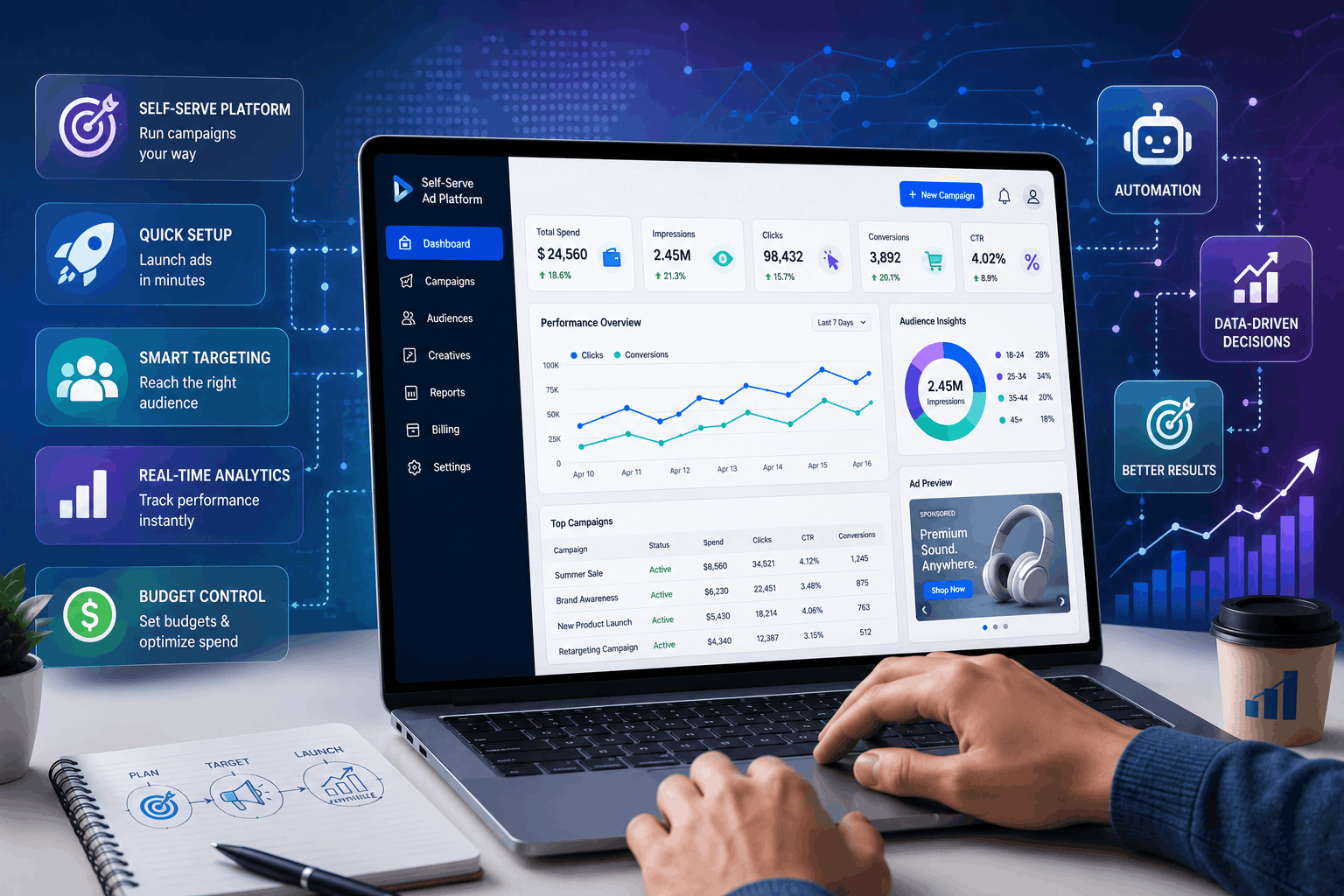
Self-serve advertising is changing the way companies of all sizes buy media. Advertisers can log in, set up, target, and launch ads in minutes without going through slow, expensive agency pitches or manual negotiations with sales teams, and have real-time management and data at their fingertips.
Self-serve advertising platforms are refreshing and empowering alternatives for anyone who has ever found themselves frustrated by waiting for approvals or paying exorbitant management fees. The model hands control back to marketers, combining automation, AI, and intuitive interfaces to make digital advertising more accessible, efficient, and effective than ever.
We will delve into the meaning of self-serve advertising, how it operates, the key benefits it offers, the major trends shaping the space today, case studies, some pitfalls to avoid, and why it is set to become a popular way to buy media in the future. As a small business owner, in-house marketer, or agency professional, understanding this change can give you a substantial competitive advantage.
What Is Self-Serve Advertising?
Self-serve advertising is the process by which advertisers develop, manage, optimize, and measure their advertising campaigns without the use of an account manager or sales representative. Sign up, upload creatives, set targeting and budget, and launch often immediately.
Unlike conventional media buying, which entails submitting RFPs and contracts, manual coordination, and more, or even managed programmatic services that involve a team of experts working for you, this is a more straightforward approach. Automated, self-serve dashboards are a key feature of self-serve models, making them ideal for performance-driven campaigns.
Common examples include:
- Google Ads and Meta Ads Manager for search, display, and social.
- Specialized networks like RichAds, PropellerAds, Taboola, or programmatic DSPs offering self-serve access.
The core idea traces back to early classifieds and has exploded with programmatic advertising, where real-time bidding (RTB) and algorithms handle inventory matching at scale. Today, self-serve extends across display, video, native, social, CTV, and even out-of-home (OOH) in some cases.
The Evolution of Media Buying: From Traditional to Automated
Media buying is a long way from its origins. It used to involve phone calls, food with a rep, and signed TV or print deals. Auctions and platforms were created in the digital age, although they were still overseen manually.
Programmatic advertising revolutionized the buying process by automating it with algorithms. Self-serve went further by making it democratic. Barriers to participation are not just technical or budgetary: some platforms have made it easy for advertisers to get started with intuitive interfaces, guided setups and AI support.
By 2026, self-serve will be a well-rounded experience. AI-driven tools handle creative variations, bid optimization, and even audience discovery. Publishers and platforms are increasingly providing direct self-service portals, eliminating the middleman, and increasing revenue and access to high-quality inventory.
This change reflects a broader shift in digital marketing technology: more data, less friction, and greater performance.
How Self-Serve Advertising Platforms Work
Getting started is straightforward on most platforms:
- Sign Up and Setup: Create an account, verify it, and connect your payment method.
- Campaign Creation: Choose objectives (awareness, traffic, conversions), upload or generate creatives, and set budgets (daily/lifetime) and schedules.
- Targeting and Bidding: Use data-driven options such as demographics, interests, behaviours, lookalikes, retargeting, and contextual signals, many of which support AI for smart suggestions.
- Launch and Optimize: Go live with real-time bidding. Monitor dashboards for performance metrics and adjust on the fly, pause, tweak bids, or swap creatives.
- Reporting and Analytics: Access detailed insights on impressions, clicks, conversions, ROI, and more. Advanced platforms offer attribution modelling and cross-channel views.
Media buying automation is the backbone. Algorithms handle bidding in auctions, while rules or AI can automate scaling winners and pausing losers. This creates a continuous-improvement loop without constant human intervention.
Key Benefits for Advertisers and Publishers
Self-serve advertising delivers compelling advantages that explain its rapid adoption.
For Advertisers:
- Greater Control and Flexibility: Make changes anytime, test ideas quickly, and respond to market shifts without approvals.
- Cost Efficiency Lower or no management fees, precise budget controls, and pay-for-performance models (e.g., CPC, CPA) reduce waste.
- Speed Launch campaigns in minutes rather than days or weeks.
- Data-Driven Targeting: Access sophisticated options for real-time advertising and hyper-personalization to improve relevance and results.
- Transparency and Insights: Real-time data empowers better decisions and higher performance marketing ROI.
- Accessibility: Small businesses and solopreneurs can compete with bigger players.
For Publishers and Platforms:
- Reduced sales and ops costs.
- Higher inventory fill rates and direct relationships.
- Scalability for long-tail or remnant inventory.
Overall, it fosters innovation in AdTech by improving alignment between supply and demand.
Current Trends Shaping Self-Serve Advertising
Several exciting developments are pushing self-serve forward in 2026:
- AI-Driven Automation and Creativity Tools now generate ad variations, optimize bids, and even suggest strategies. Agentic AI goes beyond execution to strategic recommendations.
- Hyper-Precise and Privacy-First Targeting With cookies phasing out, platforms emphasize first-party data, contextual targeting, and consented signals. This boosts data-driven advertising effectiveness.
- Growth of Programmatic and Omnichannel Self-serve extends to CTV, retail media networks, DOOH, and more, enabling seamless cross-channel campaigns.
- Advanced Analytics and Reporting: Real-time dashboards with predictive insights help maximize every dollar.
- Video and Short-Form Dominance AI-enhanced video ads and shoppable formats thrive in self-serve environments.
- Ethical AI and Transparency Platforms focus on compliance, bias reduction, and clear performance metrics to build trust.
Self-service ad platforms are also expanding choices, with niche networks for specific verticals or traffic types.
Real-World Examples and Success Stories
- Small Businesses on Meta/Google: Many e-commerce brands use self-serve to test offers rapidly, scaling winners profitably with automated rules.
- Performance Marketers on Native Networks (e.g., Taboola, Outbrain): Drive high-volume traffic cost-effectively with content recommendations.
- Enterprise Use: Larger advertisers blend self-serve with managed services for hybrid control, using platforms like DSPs for programmatic reach while maintaining in-house oversight.
Case studies often highlight 20-50% efficiency gains, faster iteration, and improved ROAS through real-time tweaks.
Challenges and Considerations
It’s not all smooth sailing. Potential drawbacks include:
- Learning Curve: Beginners may need time to master targeting and optimization.
- Ad Fatigue and Quality. Easy access can lead to lower-quality ads if not managed well.
- Data Privacy and Regulations Compliance with GDPR, CCPA, etc., requires vigilance.
- Fragmentation: Managing multiple platforms can become complex.
- Support Limitations Self-serve often means less hand-holding; choose platforms with good resources or hybrid options.
Mitigate these by starting small, leveraging platform tutorials/AI helpers, and combining with analytics tools.
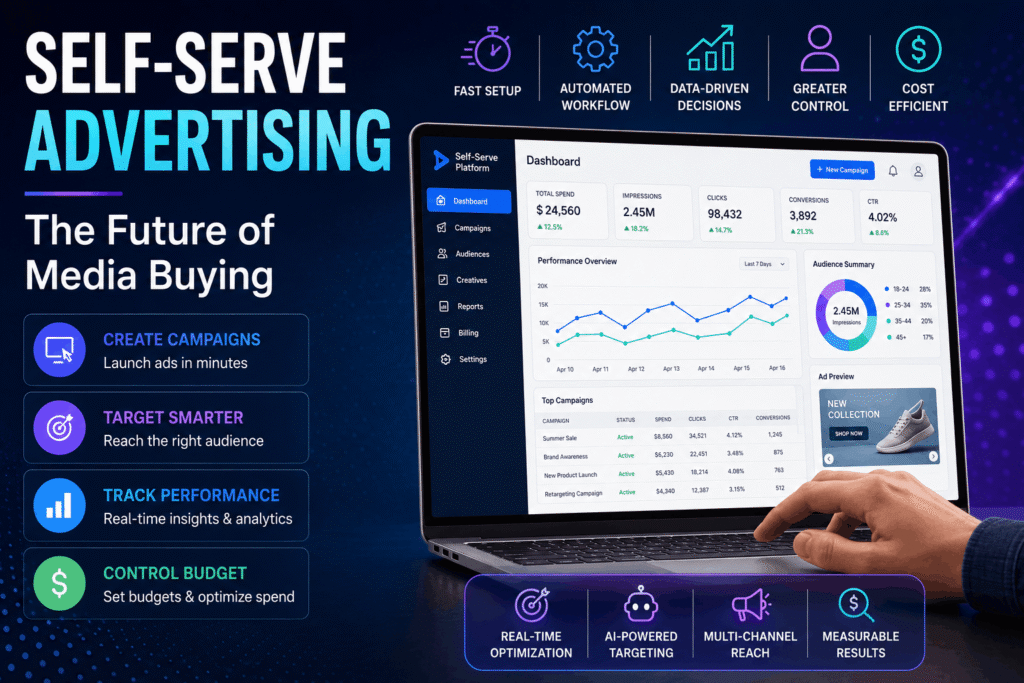
The Future of Advertising: Self-Serve at the Core
Looking ahead, self-serve advertising will likely become the default for most media buying. Expect deeper AI integration for predictive campaigns, more seamless omnichannel reports, and greater emphasis on privacy-maintaining technologies, including clean rooms.
Advertising automation will reduce manual labour, freeing marketers to focus on strategy and creativity. Retail media and social trade will blur lines, with self-serve enabling direct, measurable paths to purchase.
Publishers will invest more in self-serve portals for top-tier inventory, while advertisers benefit from exceptional agility in a fast-changing landscape.
Getting Started with Self-Serve Advertising
Ready to dive in?
- Assess your goals and budget.
- Research platforms suited to your audience (e.g., Google/Meta for broad reach, specialized ones for niche).
- Test with small budgets, analyze results, and iterate.
- Stay updated on trends through industry reports and platform updates.
Combine self-serve with strong creative, clear objectives, and ongoing optimization for the best outcomes.
Conclusion
Self-serve advertising is not just an effective trend; it is reworking media buying into a more democratic, green, and data-driven system. By embracing media automation, virtual advertising and marketing systems, and AdTech innovation, teams can gain greater control, reduce costs, and achieve stronger results in an increasingly competitive global market.
The destiny belongs to individuals who can act rapidly, target intelligently, and optimize relentlessly. Self-serve gear placed that energy in your arms. Whether you’re optimizing existing gift campaigns or building new ones, now might be the time to discover how this model fits your approach.
The media looking for revolution is right here, and it’s far from self-serve.