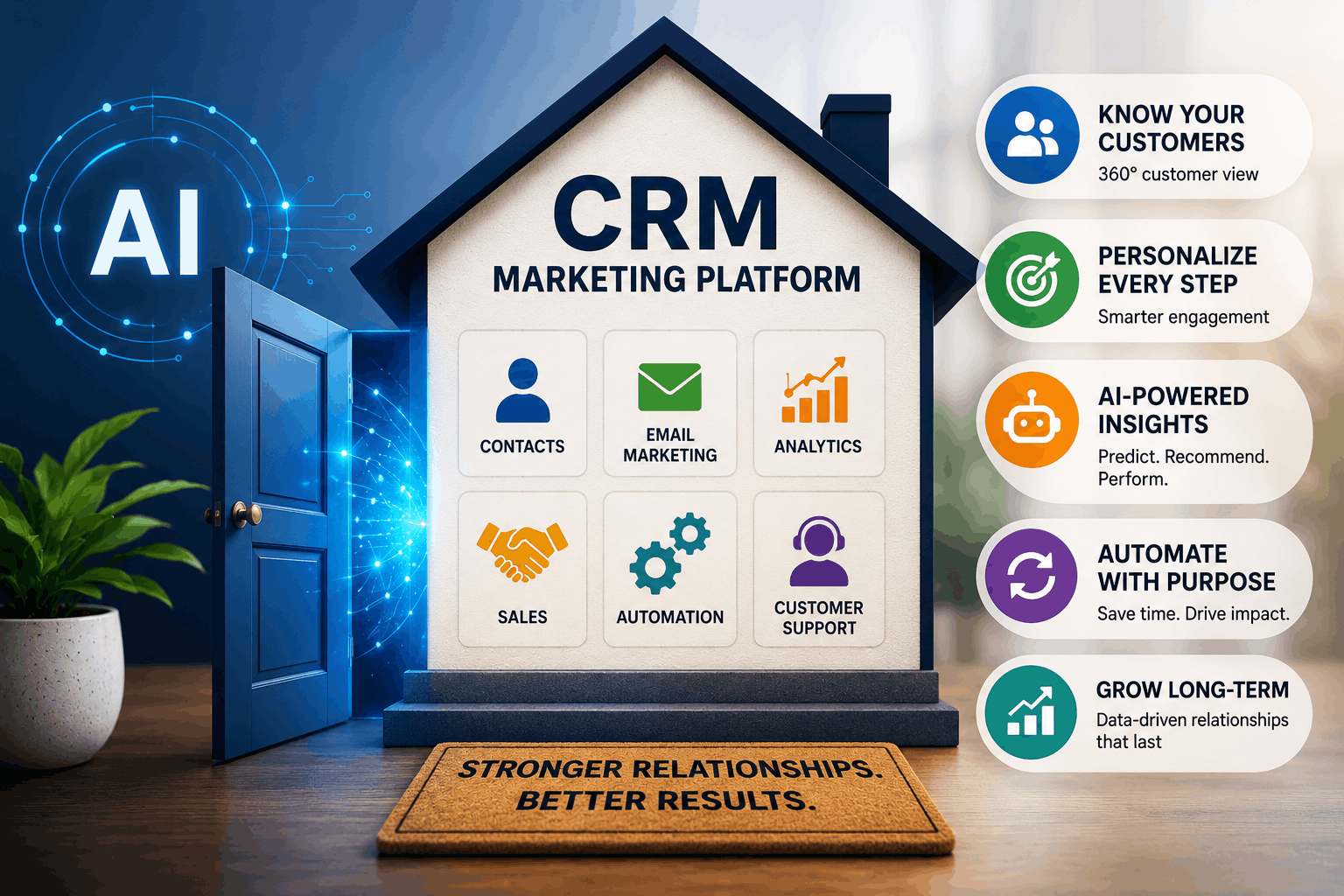
Businesses are adopting AI faster than ever, but a CRM Marketing Platform still sits at the center of successful customer engagement. AI can generate content, predict buying behavior, and automate repetitive work, yet none of those capabilities mean much without accurate customer data and a structured marketing strategy. A CRM provides that foundation by organizing customer interactions, tracking relationships, and giving marketing and sales teams a shared view of every customer journey.
Think of AI as an assistant.
It works best when it has context.
A CRM supplies that context by connecting conversations, purchase history, campaign activity, and customer preferences into one place.
Without that information, AI is simply making educated guesses.
Why CRM Still Matters in an AI-Driven World
Artificial intelligence has changed how marketers approach personalization.
Campaigns launch faster.
Emails adapt to customer behavior.
Lead scoring becomes more accurate.
Those improvements are valuable, but they all depend on reliable customer information.
That’s where Customer Relationship Management continues to play its biggest role.
Every customer interaction adds another piece to the story.
A website visit.
A product inquiry.
An email click.
A webinar registration.
A support request.
When these interactions remain connected inside one system, businesses understand customers far better than they could through isolated marketing tools.
AI enhances that understanding.
It doesn’t replace it.
Data Is the Real Competitive Advantage
Companies often invest heavily in AI while overlooking the quality of their customer data.
Outdated records.
Duplicate contacts.
Missing information.
Disconnected systems.
These problems limit even the smartest AI models.
A well-managed CRM Marketing Software environment helps solve this challenge by keeping customer information organized and accessible.
Instead of searching through spreadsheets or multiple applications, teams work from one reliable source.
The result isn’t just cleaner data.
It’s better decision-making across marketing, sales, and customer service.
AI Works Better When CRM Comes First
AI depends on patterns.
The better the data, the more useful those patterns become.
Imagine asking AI to recommend the next marketing campaign.
If customer histories are incomplete, recommendations become unreliable.
If customer preferences, purchases, and engagement history are available inside the CRM, suggestions become much more relevant.
This is why AI CRM Marketing should be viewed as an extension of CRM rather than a replacement.
CRM stores relationships.
AI identifies opportunities hidden within those relationships.
Together they create smarter marketing without sacrificing accuracy.
Every Customer Journey Creates Valuable Information
Customers rarely buy after one interaction.
Most move through several stages before making a decision.
They discover your brand.
Read articles.
Download resources.
Compare solutions.
Open emails.
Attend webinars.
Request demonstrations.
Speak with sales.
Each interaction contributes valuable information.
A CRM Marketing Platform captures those moments, allowing marketers to understand how customers move from curiosity to purchase.
AI can then analyze these journeys to identify common behaviors among successful conversions.
That insight helps businesses improve future campaigns instead of relying on assumptions.
Personalization Starts With Understanding Customers
Customers expect relevant communication.
Receiving the same generic email as everyone else rarely creates meaningful engagement.
Modern Marketing Automation Platform solutions already allow businesses to personalize campaigns based on customer behavior.
AI expands those capabilities.
Instead of creating fixed audience segments, AI identifies changing interests over time.
Someone researching product integrations today may become interested in pricing next week.
Another customer may engage more with educational content before requesting a demonstration.
These evolving patterns help marketers deliver content that feels timely rather than repetitive.
The CRM provides the customer history.
AI determines how to use it effectively.
Marketing and Sales Need the Same Information
One of the biggest challenges inside growing businesses is disconnected teams.
Sales follows up.
Customer success manages existing accounts.
Support resolves problems.
If each department works from different information, customers notice.
Questions get repeated.
Conversations lose context.
Follow-ups become inconsistent.
A strong CRM Strategy eliminates many of these issues by creating one shared customer record.
Everyone sees the same activity timeline.
Everyone understands previous interactions.
Everyone works toward the same customer experience.
AI strengthens this collaboration by highlighting important opportunities, but the CRM remains the system connecting every department.
Automation Should Improve Relationships, Not Replace Them
Automation often saves time.
It shouldn’t make communication feel mechanical.
Customers appreciate reminders.
Appointment confirmations.
Order updates.
Helpful recommendations.
They quickly recognize automated messages that ignore their interests.
Businesses using AI in CRM can automate routine communication while still keeping interactions relevant.
For example, AI may recommend sending educational resources after someone downloads a product guide instead of immediately delivering a sales pitch.
The timing feels more natural because recommendations are based on actual customer behavior.
Automation becomes more effective when it supports relationships instead of interrupting them.
Customer Trust Depends on Consistency
Trust develops through repeated positive experiences.
Every email.
Every phone call.
Every support conversation.
Every purchase.
Consistency matters.
A Customer Data Platform helps unify customer information from multiple systems, making it easier for marketing teams to deliver consistent messaging across channels.
When combined with a CRM Marketing Platform, businesses gain a more complete understanding of each customer’s journey.
Instead of treating every interaction as a new conversation, teams build on previous experiences.
That continuity strengthens relationships while giving AI better information to work with.
AI Helps Teams Work Smarter, Not Independently
Many organizations introduce AI with one goal in mind, doing more work in less time.
Speed matters.
Accuracy matters even more.
A marketing team can generate campaign ideas in minutes, but deciding which message fits a specific audience still depends on customer knowledge stored inside a CRM Marketing Platform.
That’s why successful businesses don’t separate AI from CRM.
They combine both.
The CRM provides customer history.
AI reviews patterns within that history.
Marketing teams use those insights to create more relevant campaigns without losing the personal touch customers expect.
Lead Nurturing Improves With Better Customer Context
Not every prospect is ready to buy immediately.
Some visitors compare products for weeks.
Others download guides before speaking with sales.
Many disappear and return months later.
Following every lead manually becomes difficult as databases grow.
This is where AI CRM Marketing creates practical value.
AI analyzes customer activity and identifies buying signals that may otherwise go unnoticed.
Someone who repeatedly visits pricing pages may require a product demonstration.
Another visitor reading educational content might benefit from a case study instead of a promotional email.
Because recommendations come from CRM data, communication feels more relevant and less intrusive.
Personalization Goes Beyond First Names
Adding a customer’s first name to an email isn’t personalization.
Understanding their interests is.
Modern customers expect businesses to remember previous conversations, recognize preferences, and recommend relevant information.
Using Customer Relationship Management, companies can build detailed customer profiles that grow with every interaction.
AI strengthens these profiles by identifying changing behaviors.
Perhaps a customer who previously focused on product features is now researching implementation services.
Another may shift attention toward pricing after months of reading educational content.
Recognizing these changes allows marketers to adjust communication naturally instead of relying on fixed audience segments.
A Connected Customer Experience Builds Loyalty
Customers don’t think in departments.
They simply expect every interaction to make sense.
A marketing email.
A sales conversation.
A support request.
A renewal discussion.
From the customer’s perspective, it’s one relationship.
Without connected systems, that experience quickly becomes fragmented.
A strong CRM Strategy keeps every department aligned around shared customer information.
Marketing knows which campaigns generated interest.
Sales understands previous conversations.
Support reviews purchase history before responding.
Customer success teams see the complete account journey.
AI highlights opportunities across these interactions, but CRM keeps everything connected.
Choosing the Right CRM Matters More Than Adding More AI
New AI features appear almost every month.
That doesn’t mean businesses should replace their existing systems.
The better approach is evaluating whether current CRM software already supports the organization’s long-term goals.
Questions worth considering include:
- Does the platform centralize customer information?
- Can marketing and sales collaborate easily?
- Does it integrate with existing business applications?
- Is reporting clear enough for decision-making?
- Can AI features improve existing workflows instead of replacing them?
A reliable CRM Marketing Software solution often delivers greater value than constantly adopting new tools with overlapping capabilities.
Common AI Mistakes Businesses Continue Making
AI adoption creates excitement.
It also creates unrealistic expectations.
Several mistakes appear repeatedly.
Expecting AI to Fix Poor Data
If customer records contain duplicate contacts, outdated information, or incomplete profiles, AI recommendations become less reliable.
Clean data remains essential.
Automating Every Customer Interaction
Automation should reduce repetitive work.
It shouldn’t eliminate genuine communication.
Customers still value thoughtful conversations when making important decisions.
Ignoring Human Expertise
Marketing professionals understand customer emotions, brand positioning, and business strategy.
AI supports those decisions.
It doesn’t replace them.
Adding Too Many Disconnected Tools
Introducing multiple AI applications without a clear integration plan often creates more complexity than efficiency.
A connected Customer Data Platform and CRM environment usually delivers better long-term results.
Measuring CRM Success Beyond Open Rates
Email performance remains useful.
It tells only part of the story.
Organizations using AI in CRM should evaluate customer relationships from several perspectives.
Useful metrics include:
- Customer retention.
- Lead-to-customer conversion.
- Sales cycle length.
- Repeat purchases.
- Customer lifetime value.
- Campaign engagement.
- Marketing return on investment.
- Customer satisfaction.
Looking at these measurements together provides a more accurate understanding of marketing performance than focusing on individual campaign results.
Building a Marketing System That Can Grow
Customer expectations continue changing.
New communication channels appear.
AI capabilities improve.
Marketing strategies evolve.
Businesses need systems flexible enough to grow alongside those changes.
A CRM Marketing Platform provides that stability by serving as the central location for customer relationships.
AI continues expanding what marketers can accomplish, but every recommendation becomes stronger when it’s supported by reliable customer information.
Organizations that invest in both technology and customer relationships create marketing systems that remain effective even as tools continue evolving.
Instead of chasing every new AI trend, they build on a foundation that already understands the people they serve.