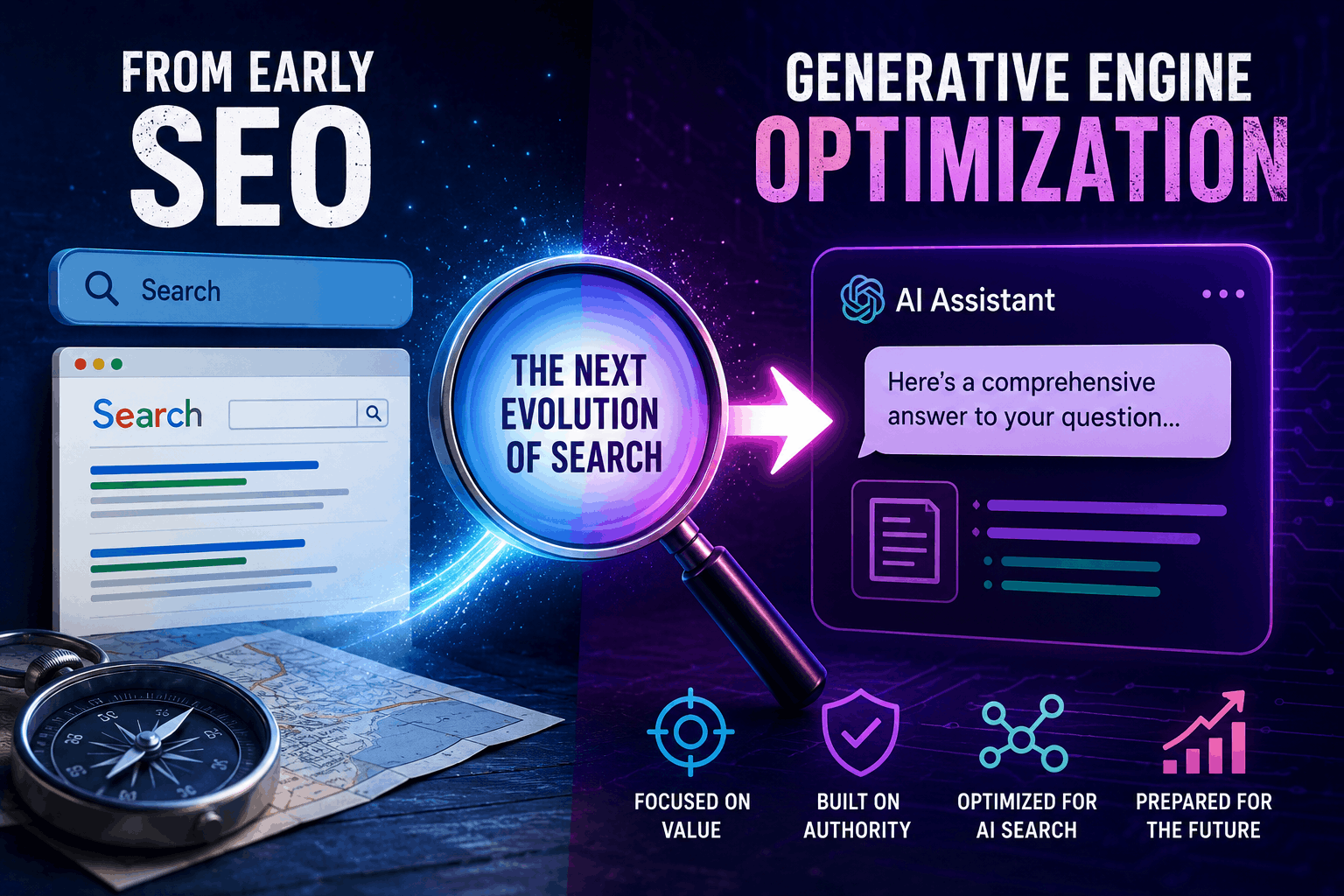
Generative Engine Optimization is becoming one of the biggest topics in digital marketing, yet it feels surprisingly familiar. If you worked in SEO during the early days, you’ve seen this pattern before. A new technology appears, marketers rush to understand it, and everyone starts searching for the formula that guarantees visibility. Some focus on shortcuts, while others build content that genuinely helps people. Over time, search platforms evolve, low-quality tactics disappear, and useful content becomes the long-term winner. That’s why many marketers believe the future of AI search will follow a similar path.
What Is Generative Engine Optimization?
Unlike traditional SEO, which aims to rank pages in search engine results, Generative Engine Optimization focuses on increasing the chances that AI-powered search platforms reference, summarize, or recommend your content.
When someone searches through an AI assistant rather than a traditional search engine, they often receive a direct answer rather than a list of blue links.
That answer still comes from somewhere.
Large language models analyze trusted sources, compare information, and generate responses based on the content they consider useful and reliable.
The goal of AI search optimization isn’t simply ranking first on Google.
It’s making your content valuable enough that AI systems consider it when generating answers.
That changes how marketers think about visibility.
Instead of asking, “How do I rank higher?”
The better question becomes, “How do I become a source worth citing?”
Why GEO Feels Like Early SEO
The first years of SEO were full of uncertainty.
Nobody completely understood Google’s ranking system.
Businesses experimented constantly.
Some published helpful articles.
Others filled pages with repeated keywords and hidden text, believing it would improve rankings.
Eventually, search engines became smarter.
Content quality mattered more than shortcuts.
Today’s GEO marketing landscape feels remarkably similar.
Nobody outside AI companies knows exactly how every language model evaluates information.
There are best practices, observations, and educated assumptions, but no guaranteed formula.
That uncertainty creates opportunity.
It also creates misinformation.
Whenever a new marketing channel appears, someone claims they’ve discovered the secret to dominating it.
History suggests those shortcuts rarely last.
AI Search Doesn’t Read Content Like Traditional Search Engines
Traditional search engines crawl websites and index pages.
AI systems approach information differently.
Instead of matching exact keywords, many models evaluate context, relationships between ideas, factual consistency, and overall usefulness.
For content creators, this changes priorities.
Repeating the same phrase twenty times doesn’t make an article more valuable.
Answering questions clearly often does.
A detailed comparison.
A practical example.
Original observations.
Clear explanations.
These elements help both readers and AI search engines better understand the topic.
That doesn’t mean keywords no longer matter.
They still help establish relevance.
They aren’t the entire strategy anymore.
Generative Engine Optimization Requires Better Content, Not More Content
Publishing five average articles every week rarely creates authority.
Publishing one genuinely useful resource often does.
That’s an important distinction.
Many businesses still measure success by output.
How many blog posts were published?
How many landing pages were created?
How many keywords were targeted?
Those numbers tell only part of the story.
AI systems increasingly evaluate whether content actually answers the user’s question.
A short article with original insights may be more valuable than a longer article that repeats information available on hundreds of other websites.
Quality becomes easier to recognize when AI compares multiple sources simultaneously.
SEO vs GEO: What’s Actually Different?
People often treat SEO and GEO as completely separate disciplines.
They aren’t.
They overlap in many ways.
Strong technical SEO still matters.
Fast websites still matter.
Logical site structure still matters.
Helpful content still matters.
The difference lies in how information is consumed.
Traditional SEO focuses on earning clicks from search results.
SEO vs GEO becomes less about rankings and more about becoming a trusted source that AI systems can confidently reference.
Think of it this way.
SEO asks:
“Can users find my content?”
GEO asks:
“Will AI trust my content enough to include it in an answer?”
Those are related questions.
They focus on different outcomes.
Authority Is Becoming More Important
Authority has always mattered in search.
Now it matters even more.
Imagine two websites covering the same topic.
One publishes original research, interviews industry experts, and regularly updates its content.
The other rewrites information already available elsewhere.
Which one is more useful?
Which one appears more trustworthy?
Which one is more likely to become part of an AI-generated answer?
The answer is usually obvious.
Building authority isn’t about claiming expertise.
It’s about demonstrating it consistently through useful content, accurate information, and real experience.
That’s one reason AI content optimization increasingly focuses on depth instead of volume.
A detailed guide with practical examples often provides more value than several shorter articles covering the same subject, each adding nothing new.
Practical Strategies to Improve AI Search Visibility
Most discussions around GEO focus on theory.
The bigger question is how businesses can actually improve AI search visibility today.
The first step is creating content that answers complete questions instead of chasing isolated keywords.
For example, someone searching for “AI CRM” rarely wants just a definition. They’re usually trying to understand the benefits, compare software options, or decide whether it’s worth implementing.
Content that covers the full topic gives AI systems more context to work with.
It also helps readers stay on the page longer because they don’t need to keep searching elsewhere.
Another effective strategy is updating existing content.
Many websites publish an article once and never revisit it.
AI search platforms value information that remains accurate and up to date. Reviewing important pages every few months helps maintain relevance while improving overall content quality.
Write for Questions, Not Just Keywords
Keyword research still matters.
People continue searching for phrases that describe their problems.
The difference is that AI-powered search often returns results for complete questions rather than isolated terms.
Instead of optimizing only for “CRM automation,” consider the questions users actually ask.
- How does CRM automation save time?
- Can AI improve lead qualification?
- Is AI CRM suitable for small businesses?
- What are the risks of using AI in CRM?
Answering these questions naturally makes content easier for both readers and AI systems to understand.
It also reduces the temptation to repeat keywords unnecessarily.
That creates a better reading experience while strengthening AI content optimization.
Build Topical Authority Instead of Chasing Individual Keywords
Many websites still publish isolated articles with little connection between them.
One week, they cover AI.
The next week is cybersecurity.
Then finance.
Then, remote work.
Search engines and AI systems often prefer websites that demonstrate consistent expertise within a specific subject.
Imagine a website covering:
- AI CRM
- Lead nurturing
- Marketing automation
- Sales automation
- Customer experience
Each article supports the others.
Internal links create clear relationships.
Readers explore additional resources.
AI systems gain stronger evidence that the website understands the topic beyond a single article.
That’s exactly how topical authority develops.
Structure Content So AI Can Understand It
Good writing isn’t only about words.
Structure matters too.
Organized content helps both readers and AI search engines quickly locate important information.
Simple improvements include:
- Clear H2 and H3 headings
- Short paragraphs
- Bullet points where appropriate
- Comparison tables
- Practical examples
- Logical section order
These elements improve readability without making the article feel mechanical.
Many AI systems also perform better when information flows logically rather than jumping randomly from idea to idea.
Original Insights Matter More Than Ever
Thousands of websites can summarize existing information.
Far fewer provide original observations.
Suppose ten articles explain what GEO is.
One article also includes practical lessons from implementing GEO across multiple client websites.
Which version offers more value?
Original examples, personal experience, industry observations, and real case studies help content stand out.
That’s something both readers and AI systems increasingly recognize.
As generative AI search becomes more advanced, simply rewriting existing content is unlikely to create long-term visibility.
Common GEO Mistakes to Avoid
Because GEO marketing is still developing, many businesses repeat the same mistakes.
Treating GEO as a Replacement for SEO
SEO hasn’t disappeared.
People continue using traditional search engines every day.
Technical optimization, website speed, internal linking, and content quality remain essential.
GEO builds on those foundations rather than replacing them.
Publishing Generic AI Content
There’s already an overwhelming amount of generic AI content online.
Articles that repeat obvious advice rarely become memorable.
Instead, focus on answering specific questions, explaining practical challenges, and sharing observations readers won’t easily find elsewhere.
Ignoring Content Updates
Technology changes quickly.
An article published today may become outdated within months.
Regular updates improve credibility and increase the likelihood of appearing in future AI search results.
Measuring GEO Success
Unlike traditional SEO, GEO doesn’t always produce straightforward ranking reports.
That doesn’t mean performance can’t be measured.
Businesses can monitor indicators such as:
- Organic traffic growth
- Referral traffic from AI platforms
- Brand mentions
- Time on page
- Content engagement
- Backlinks from authoritative websites
- Returning visitors
Over time, these metrics help identify whether content is becoming more visible across both traditional and AI-powered search experiences.
The Future of Generative Engine Optimization
Nobody knows exactly how AI search will evolve over the next few years.
History does offer some useful clues.
Early SEO rewarded experimentation.
Eventually, quality became more important than shortcuts.
The same trend is emerging with Generative Engine Optimization.
Businesses that invest in trustworthy information, practical expertise, and well-structured content are likely to remain competitive regardless of how AI platforms evolve.
Algorithms will evolve.
Ranking signals will change.
New AI search experiences will appear.
The fundamentals are unlikely to disappear.
People will continue looking for accurate information.
Businesses will continue trying to answer those questions better than their competitors.
Whether that answer appears inside a traditional search engine or an AI-generated response, the principle remains remarkably similar.
Create content that solves real problems.
Support every claim with useful information.
Build expertise in a focused topic rather than chasing every trend.
Those practices helped websites succeed during the early years of SEO, and they’re becoming just as valuable in the age of Generative Engine Optimization.