An effective AI talent strategy is no longer something businesses can postpone until the next phase of digital transformation. AI tools are already changing how employees write reports, analyze data, support customers, develop software, and make decisions. Companies investing heavily in AI often discover that technology isn’t the biggest challenge. The real challenge is preparing people to work alongside it. Without the right skills, leadership, and workforce planning, even the best AI initiatives struggle to deliver lasting value.
Many organizations assume AI adoption begins with choosing the right platform.
In reality, it begins with people.
A company can purchase advanced AI software in a matter of days, but building a workforce that knows how to use it effectively takes far longer. That’s why leading organizations are treating workforce planning as an essential part of every AI investment.
Why AI Talent Strategy Matters More Than Ever
Businesses have always adapted to new technology. Cloud computing changed IT. Automation reshaped manufacturing. Remote work transformed collaboration. AI differs because it affects nearly every department simultaneously. Marketing teams use AI to create content.
HR departments rely on AI for recruitment. Sales teams automate lead qualification.
Finance departments analyze forecasts faster. Customer support teams respond to inquiries using intelligent assistants. Every department experiences change, so it needs people with new capabilities. Without a clear AI adoption strategy, organizations often invest in software while overlooking the employees expected to use it.
That gap becomes expensive.
Projects slow down.
Adoption rates remain low.
Employees lose confidence.
The technology is blamed even though the underlying issue is usually a lack of preparation.
AI Doesn’t Replace Every Job; It Changes Every Job
One of the biggest misconceptions surrounding AI is that entire professions will disappear overnight. History suggests something different. Technology usually changes work before it replaces it. Accountants still exist despite accounting software. Designers still work despite creative tools. Developers continue writing code even with AI coding assistants. AI changes responsibilities. Routine tasks become automated. Employees spend more time solving problems, making decisions, and working directly with customers. That shift requires different skills rather than fewer people.
A strong AI workforce transformation plan recognizes this reality.
Instead of asking which jobs AI can replace, organizations ask how employees can become more effective with AI.
That approach creates far better long-term outcomes.
The Skills Every AI-Ready Workforce Needs
Teaching employees how to use a chatbot isn’t enough. Successful organizations invest in broader AI skills development that prepares people for changing workflows rather than specific software. Several skill areas continue to grow in importance.
AI Literacy
Employees don’t need to become machine learning engineers.
They do need to understand:
- What AI can do
- Where AI performs well
- Its limitations
- Privacy considerations
- Responsible use
Basic AI literacy reduces hesitation and encourages employees to experiment with confidence.
Critical Thinking
AI can generate recommendations. People still decide whether those recommendations make sense. Employees who question results, verify information, and apply business judgment become increasingly valuable. Critical thinking remains one of the most important human skills in an AI-enabled workplace.
Communication
AI generates information quickly. Explaining that information clearly still depends on people. Managers, consultants, sales professionals, and HR leaders continue relying on strong communication skills to build trust and guide decision-making.
Adaptability
The tools employees use today may look very different next year.
Organizations that encourage continuous learning adapt more easily than those relying on one-time training sessions.
Why Traditional Training Often Falls Short
Many businesses approach AI training the same way they approach compliance training.
Employees attend a workshop.
They complete an online course.
Everyone receives a certificate.
The program ends.
Several months later, very little has changed.
Employees return to familiar habits because the training wasn’t connected to their daily responsibilities.
Real AI upskilling works differently.
Learning happens alongside actual work.
Marketing teams practice creating campaigns with AI.
Recruiters learn how AI improves candidate screening.
Finance teams explore forecasting tools using real company data.
Employees develop confidence by solving genuine business problems rather than completing theoretical exercises.
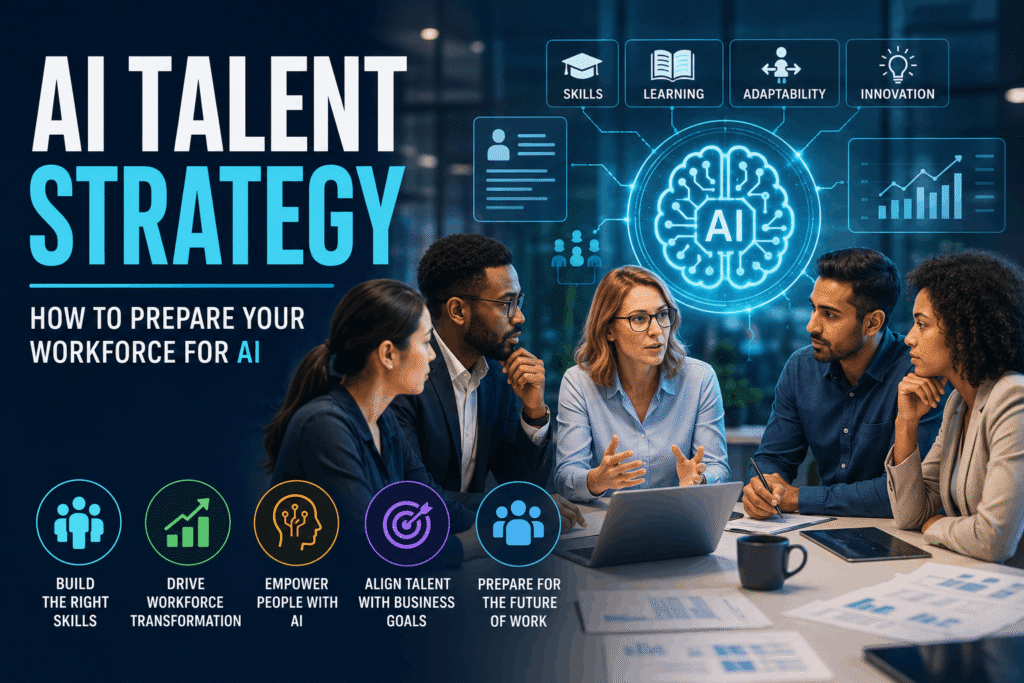
Building a Workforce AI Strategy
A successful workforce AI strategy begins with understanding existing capabilities.
Before investing in training, organizations should answer several important questions.
Which teams already use AI?
Which departments face the biggest skills gap?
Where could AI improve productivity without disrupting customer experience?
The answers rarely look the same across every business.
For example, a software company may prioritize engineering and customer support.
A manufacturing business may focus on operations and supply chain management.
A healthcare provider may emphasize documentation, scheduling, and administrative efficiency.
Understanding these differences allows leaders to invest where the impact will be greatest.
Leadership Shapes AI Adoption
Employees pay close attention to leadership behavior.
If executives encourage experimentation while accepting occasional mistakes, adoption tends to increase.
If managers discourage change or criticize early failures, employees become reluctant to explore new tools.
Successful leaders create an environment where learning becomes part of everyday work.
That doesn’t mean approving every AI experiment.
It means providing clear guidance while encouraging responsible innovation.
Regular communication also matters.
Employees want answers to practical questions.
Will AI change my role?
What skills should I develop?
How will success be measured?
Organizations that communicate openly build greater trust during periods of change.
Why AI Workforce Planning Should Start Early
Waiting until AI projects are already underway creates unnecessary pressure. By then, technology decisions have often been made, implementation schedules are fixed, and employees are expected to adapt quickly.
A better approach is to integrate AI workforce planning into the earliest stages of digital transformation. Business leaders, HR teams, department managers, and technology specialists should work together before implementation begins. Doing so makes it easier to identify future skill requirements, plan recruitment, and create realistic development programs. Preparing people before technology arrives almost always leads to smoother adoption than trying to solve workforce challenges afterward.
Hiring Alone Won’t Solve the Problem
When organizations realize they lack AI expertise, the first instinct is often to hire new talent.
Recruitment certainly plays a role, but it isn’t a complete solution.
AI skills are in high demand, and experienced professionals remain difficult to attract and retain. Competing for the same small talent pool can quickly increase hiring costs without addressing the broader skills gap across the organization.
Developing existing employees is usually the more sustainable option.
Current team members already understand the company’s products, customers, and internal processes. Adding new AI capabilities to that knowledge often delivers better results than replacing experienced employees with external hires.
That’s where AI upskilling creates long-term value. Employees gain practical skills while the business retains valuable institutional knowledge. The strongest organizations don’t choose between hiring and training. They combine both.
Creating a Culture That Supports Learning
Technology evolves far too quickly for businesses to rely on occasional training sessions.
Continuous learning needs to become part of everyday work.
That doesn’t require employees to spend hours every week in classrooms.
Small improvements often make a bigger difference.
For example:
- Weekly AI knowledge-sharing sessions
- Internal workshops focused on real business challenges
- Cross-functional collaboration between departments
- Access to trusted learning resources
- Time for employees to experiment safely
When learning becomes part of the company culture, employees are more willing to explore new tools rather than avoid them.
A successful AI workforce transformation depends just as much on culture as it does on technology.
Why AI Change Management Deserves More Attention
Even the best AI platform can fail if employees don’t understand why it’s being introduced.
This is where AI change management becomes essential.
People naturally have questions whenever new technology enters the workplace.
Will AI monitor my performance?
Will my responsibilities change?
Will my role still exist in two years?
Ignoring these concerns creates resistance.
Addressing them builds confidence.
Effective change management focuses on transparency rather than promises.
Leaders should explain:
- Why AI is being implemented
- Which problems will it solve
- How employee roles may evolve
- What training will be available
- How success will be measured
Clear communication reduces uncertainty and encourages employees to become active participants instead of reluctant observers.
Measuring Whether Your AI Talent Strategy Is Working
Training hundreds of employees means very little if business outcomes never improve.
Organizations should measure progress using practical performance indicators rather than relying solely on attendance records.
Useful metrics include:
- AI adoption rates across departments
- Employee confidence with AI tools
- Productivity improvements
- Reduction in repetitive manual tasks
- Customer satisfaction scores
- Internal process efficiency
- Employee engagement
- Time saved through automation
Tracking these metrics over time provides a clearer picture of whether an AI talent strategy is creating meaningful business value.
Common Mistakes Organizations Should Avoid
Businesses often repeat the same mistakes during AI adoption.
Recognizing them early can prevent expensive setbacks.
Treating AI as an IT Project
AI affects far more than technology teams. HR, operations, finance, sales, marketing, and customer support all experience change. An effective workforce AI strategy involves every department rather than leaving implementation solely to IT.
Focusing Only on Technical Skills
Knowing how to write prompts or operate AI software isn’t enough. Employees also need communication, analytical thinking, collaboration, and decision-making skills. Those human capabilities become even more valuable as automation increases.
Measuring Activity Instead of Impact
Some organizations celebrate the number of employees completing AI training. Completion doesn’t guarantee improvement. The more useful question is whether employees are solving problems faster, making better decisions, or delivering stronger customer experiences. Business outcomes matter more than certificates.
What Future-Ready Organizations Do Differently
Companies making steady progress with AI often share several habits.
They begin planning before introducing new technology.
They encourage experimentation while providing clear governance.
They support managers as much as frontline employees. Most importantly, they treat learning as an ongoing process rather than a one-time initiative. Instead of expecting every employee to become an AI expert, they identify where AI creates the greatest value and develop targeted learning programs around those priorities.
This approach makes change feel manageable instead of overwhelming.
The Role of HR in AI Transformation
HR teams are no longer responsible only for recruitment and employee development.
They increasingly help shape business strategy.
That makes HR a critical partner in AI workforce planning.
Responsibilities now include:
- Identifying future skill requirements
- Updating job descriptions
- Supporting leadership development
- Designing reskilling programs
- Monitoring employee readiness
- Strengthening internal mobility
As AI continues changing how work is performed, HR becomes one of the main drivers of organizational adaptability.
Preparing for the Future of Work
The conversation around AI often focuses on technology.
The bigger opportunity lies elsewhere.
Organizations that invest in people while adopting AI are better positioned to respond to future changes, regardless of which platforms become popular next year.
The future of work AI isn’t defined by replacing employees with machines.
It’s defined by helping people work more effectively alongside intelligent systems.
Businesses that recognize this early gain an advantage that’s difficult for competitors to replicate.
Software can be purchased quickly.
A skilled, adaptable workforce takes time to build.
That’s why every successful AI adoption strategy should include a long-term commitment to learning, leadership, and workforce development.
When businesses align technology investments with employee growth, AI becomes more than another software implementation. It becomes a practical tool that strengthens decision-making, improves productivity, and helps teams adapt to changing business demands with greater confidence.