Amid the difficult economic times, many companies under pressure to drive revenue growth to the next level see a logical way to do this as reducing costs through layoffs. But one HR-Tech startup chose a different route. Instead, they leveraged AI to significantly boost efficiency, with a staggering AI-boosted revenue per employee, without cutting staff, and, you got me, they did it in a cool, non-destructive way.
This inspiring success story is a testament to the fact that smart technology and human expertise can go hand in hand to achieve sustainable business growth.
The Challenge Every HR-Tech Startup Faces
As with many startup HR-Tech companies, this business faced challenges, including skyrocketing operational costs, escalating competition, and investors pushing for improved financial results. Revenue was increasing, but not really quickly enough. The most obvious solution on paper was to cut the number of employees to increase the revenue per employee.
The founders knew that their people were their most important competitive edge, however. They were not prepared to cut back on staff. Rather, they posed themselves a bigger question: how do we make each team member way more productive without exhausting them?
It was then that they saw AI as a strategic ally.
How the HR-Tech Startup Implemented AI
Their startup first focused on understanding their teams‘ time in detail. They found that repetitive processes accounted for the majority of data manipulation: manual data entry, candidate screening, report generation, answering employee queries, and rudimentary analytics.
They have gradually implemented AI-powered tools in various departments in a thoughtful way:
- Recruitment & Talent Acquisition: They implemented AI tools to screen resumes, assess candidate fit, and conduct initial interview screenings.
- Employee Management: AI systems automate routine HR processes, including leave management, payroll queries, and performance tracking.
- Sales & Customer Success: AI-powered analytics helped the sales team prioritize leads and personalize client communications at scale.
- Operations: Automated reporting and predictive insights reduced the time managers spent on manual data analysis.
Importantly, they didn’t replace people with AI. They used AI to remove boring, repetitive work so their talented team could focus on high-value, creative, and strategic activities.
The Remarkable Results: 50% AI Boosted Revenue Per Employee
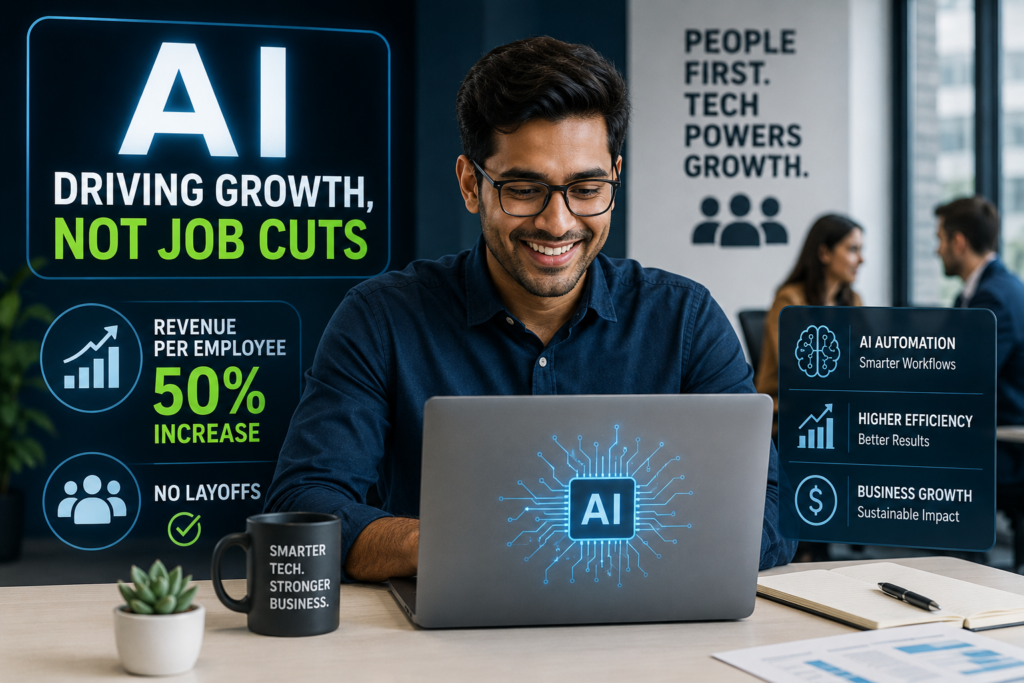
Within nine months of strategic AI implementation, the results were impressive. The company achieved an AI-boosted revenue per employee increase of nearly 50%. Here’s how it broke down:
- Sales teams closed deals faster because they spent more time building relationships and less time on administrative work.
- HR professionals shifted from repetitive tasks to strategic initiatives such as leadership development, culture-building, and improving the employee experience.
- Customer success teams delivered more personalized support, leading to higher retention rates and more upsell opportunities.
Most importantly, employee morale actually improved. Team members reported feeling more fulfilled because they were doing meaningful work instead of getting buried in paperwork and routine processes.
Why This Approach Worked So Well
The key to their success wasn’t just adopting AI; it was implementing it with a human-first mindset. Here are the main reasons this HR-Tech startup succeeded where many others struggle:
1. Clear Strategy Before Technology
They didn’t chase every shiny AI tool. They first identified business bottlenecks and then chose AI solutions that directly addressed those problems.
2. Employee Involvement
Instead of imposing AI from the top, they involved team members in the selection and implementation process. This reduced resistance and increased adoption rates.
3. Proper Training
The company invested time in training employees to work alongside AI tools. People learned how to use AI as a powerful assistant rather than fearing it as a replacement.
4. Gradual Implementation
They rolled out AI in phases, starting with low-risk areas. This allowed them to learn, adjust, and build confidence before expanding to more critical functions.
Key Benefits They Experienced
The AI-boosted revenue per employee wasn’t the only positive outcome. The startup also enjoyed several additional benefits:
- Higher Employee Retention: Talented people stayed because they felt their skills were being better utilized.
- Improved Decision Making: Real-time AI insights enabled leaders to make faster, smarter business decisions.
- Better Work-Life Balance: Automation significantly reduced overtime and weekend work.
- Stronger Company Culture: With less administrative burden, teams had more time for collaboration, innovation, and team-building activities.
Lessons Other Companies Can Learn
This HR-Tech startup’s journey offers valuable lessons for businesses across industries:
- AI should enhance human work, not replace it.
- Revenue growth doesn’t always require headcount reduction.
- Strategic AI adoption can deliver impressive returns while protecting company culture.
- Investing in AI-boosted revenue per employee is often more sustainable than aggressive cost-cutting.
Many traditional companies still view AI and layoffs as connected. This case study clearly shows they don’t have to be.
The Future of AI in HR-Tech and Beyond
Further into 2026, more businesses will understand that this metric, AI-Boosted Revenue Per Employee, is one of the savviest to monitor. The victor will not be the company with the deepest pockets in AI, but rather the one that leverages AI strategically to maximize the capabilities of its current workforce.
This HR-Tech startup is proof that it is far from impossible to grow the bottom line and treat employees as assets that need to be nurtured.
Final Thoughts
This HR-Tech startup is a breath of fresh air in a world that frequently champions aggressive cost-cutting. They didn’t just save jobs; they created better jobs.
They’ve shown that technology and humanity can coexist, having increased revenue per employee by almost 50% without any job cuts. This balance is where the future lies with the companies.
When you are under pressure to increase revenue, try this inspiring question: “How can we support our people to reach more?” instead of “Who can we let out?”
The outcome may come as a shock – just like it did for this progressive HR-Tech startup.