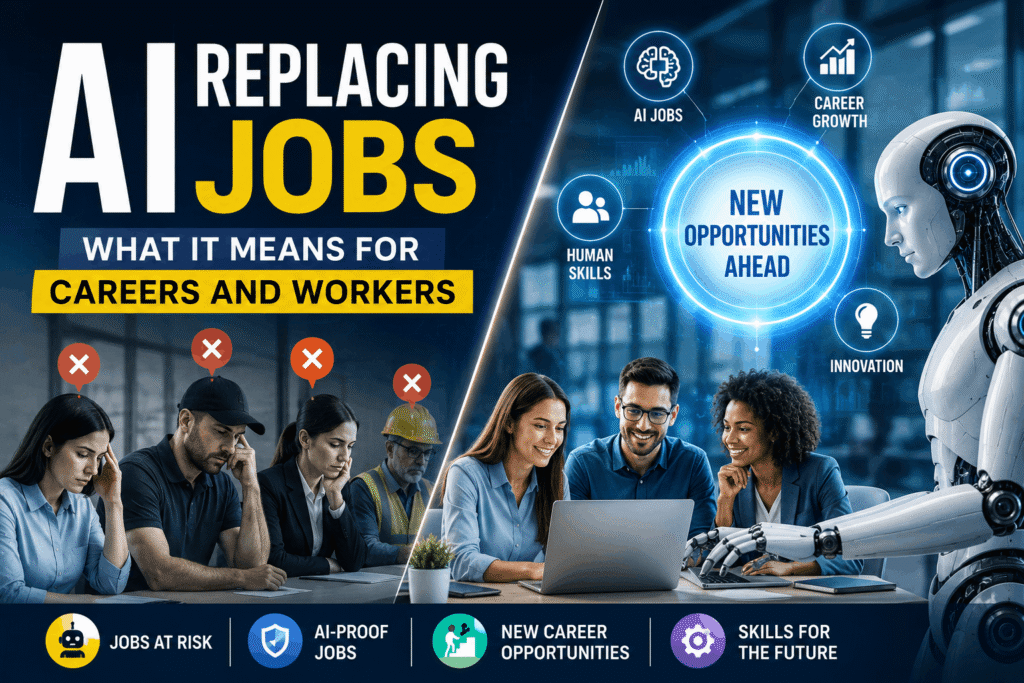
A customer service employee spends the morning answering routine questions, updating account records, and sending the same three types of emails. An AI system can already handle parts of that workload. That doesn’t automatically mean the employee disappears. It does mean the job can change—and that is the real issue behind ai replacing jobs.
The argument is often reduced to one frightening question: “Will AI take my job?”
That’s too simple.
Some jobs will lose tasks. Some roles will shrink. New positions will appear around AI systems, data, security, training, sales, and technical support. Other jobs may stay largely human because they depend on physical work, judgment, trust, negotiation, or situations that don’t follow a script.
For workers in the United States, the more useful question is different:
Which parts of my work are becoming easier to automate, and which parts are becoming more valuable?
AI Replacing Jobs Is Really About Tasks
A job title can hide what a person actually does all day.
Take an accounting assistant.
The role might include entering invoices, checking figures, answering vendors, preparing reports, and handling unusual billing questions.
AI may handle parts of the first three tasks. That doesn’t mean every accounting assistant position vanishes.
The person may spend more time reviewing exceptions, communicating with vendors, checking unusual transactions, or helping managers understand financial information.
This is why discussions about artificial intelligence and jobs need to look beyond job titles.
Two people with the same title can have very different exposure to automation.
One might spend 80% of the day on repetitive computer-based tasks.
Another might spend most of the day talking with customers, resolving problems, and making decisions.
The technology affects them differently.
Which Jobs Face More Pressure From AI?
Work tends to be easier to automate when the steps are predictable and the required output follows a recognizable pattern.
That can include certain forms of:
- Data entry
- Basic customer support
- Routine document processing
- Simple content production
- Transcription
- Scheduling
- Basic administrative reporting
- Repetitive spreadsheet work
That doesn’t mean every job in these areas will disappear.
A company may use software to handle the first pass while employees deal with exceptions.
That distinction matters.
A support team, for example, might use an AI assistant to answer a straightforward “Where is my order?” question. A customer whose shipment is missing, damaged, or stuck at a distribution center may still need a person who can investigate the situation and decide what to do next.
The routine part is easier to automate.
The messy part is not.
Why Some Jobs Are Harder to Replace
Some work depends heavily on physical surroundings, human relationships, or decisions that cannot be reduced to a clean set of instructions.
A plumber arriving at an old house doesn’t know exactly what problem will be waiting behind the wall.
A nurse has to respond to a patient whose condition may change during a shift.
A construction supervisor deals with weather, materials, workers, safety issues, and unexpected site conditions.
A sales professional may spend months building trust before a customer signs a major contract.
These jobs aren’t immune to AI.
They can still use AI for scheduling, documentation, research, forecasting, or paperwork.
But the core work involves more than producing information from a prompt.
That makes the idea of ai proof jobs useful only as a rough way of thinking about careers. There is no permanent list of jobs that technology can never touch.
A better target is work where human judgment remains central.
AI Jobs Are Growing Around the Technology
There is another side to the story that gets less attention.
Companies adopting AI need people who can make those systems useful inside an actual business.
That creates demand for ai jobs across several areas.
Some positions are highly technical, such as machine learning engineering and AI research.
Others are much closer to ordinary business operations.
Companies may need people to evaluate AI outputs, manage AI-enabled workflows, write and test prompts, review data, monitor risks, train employees, or connect AI applications with existing software.
A person doesn’t necessarily need to become a machine learning engineer to work around AI.
A marketing professional who understands customer data and AI tools may move into an AI-focused marketing role.
A human resources specialist may work with AI-assisted recruiting systems.
A cybersecurity professional may focus on threats involving AI-generated attacks.
The technology creates work around itself.
Career Opportunities in Artificial Intelligence Aren’t Limited to Programmers
Searches for career opportunities in artificial intelligence often produce lists dominated by engineers.
That’s only part of the market.
A growing AI team also needs people who understand the industry where the technology is being used.
A hospital needs healthcare knowledge.
A bank needs financial expertise.
A retailer needs people who understand customers and merchandising.
A law firm needs professionals who understand legal work.
AI knowledge becomes more useful when combined with experience in a specific field.
That’s an important point for workers who are worried that they are “not technical enough.”
You don’t necessarily have to start over.
A person who already understands a business process can become valuable by learning how AI can, and cannot, be used within that process.
What Employers May Actually Look For
Hiring managers don’t only need people who can use an AI chatbot.
They need employees who can tell when the output is wrong.
That sounds obvious.
It isn’t.
An AI system can produce a polished answer containing a factual error. Someone still has to check the source, spot the problem, and decide what should happen next.
This puts more value on skills such as:
- Critical thinking
- Clear writing
- Domain knowledge
- Problem solving
- Communication
- Data literacy
- Quality checking
- Decision-making
Technical skills matter too, particularly in roles that involve building or managing AI systems.
But knowing how to question an AI result can be just as useful as knowing how to generate one.
The U.S. Job Market Won’t Change at the Same Speed Everywhere
A software company in San Francisco may introduce AI tools much faster than a small manufacturer in Ohio.
A national bank can spend heavily on automation.
A local healthcare practice may adopt one AI documentation tool and stop there.
Industry, company size, regulation, budget, and the nature of the work all affect adoption.
That makes sweeping claims about ai replacing jobs difficult to apply to every American worker.
A role may change slowly for years and then shift quickly after a company introduces a new system.
For workers, watching what is happening inside their own industry can be more useful than following every headline about AI.
Pay attention to the tasks employers are automating.
Look at the skills appearing in new job postings.
Notice which responsibilities are being removed from existing roles and which ones are being added.
Those signals tell you much more about your career than a prediction that “AI will replace millions of jobs.”
Which Skills Become More Valuable as AI Takes Over Routine Work?
If software handles more repetitive tasks, workers still need something useful to do after those tasks disappear.
That usually means moving closer to decisions, customers, problems, and specialized knowledge.
Consider a marketing analyst.
If AI can produce a basic weekly performance report, the analyst may spend less time copying numbers into spreadsheets. The harder work remains: figuring out why sales changed, questioning an unusual result, and explaining what the numbers mean to a business owner.
The same pattern can appear in finance, healthcare, sales, recruiting, and operations.
The task changes.
The need for good judgment doesn’t.
AI Skills Can Matter Even Without an AI Job Title
You don’t need “AI” in your job title to need AI skills.
A recruiter may use AI to sort applications.
A lawyer may use it to review documents.
A salesperson may use it to research accounts.
A teacher may use it to prepare lesson materials.
A project manager may use it to summarize meetings and track follow-up work.
These workers aren’t necessarily moving into ai jobs. They’re adding AI-related skills to the careers they already have.
That distinction is useful for anyone planning a career change.
Instead of asking, “How do I get an AI job?” it may be worth asking, “Where is AI entering the work I already know?”
That can lead to a much smaller, and more realistic, learning curve.
Are There Really AI Proof Jobs?
The phrase ai proof jobs sounds reassuring, but it can create the wrong expectation.
No career comes with a permanent guarantee against technology.
Jobs that look safe today may change as hardware, software, robotics, and AI improve.
Still, some types of work have characteristics that make full automation harder.
These include jobs involving:
- Physical work in unpredictable environments
- High-stakes human decisions
- Negotiation and persuasion
- Personal care
- Leadership and conflict resolution
- Skilled trades
- Complex customer relationships
- Work requiring accountability for difficult decisions
A home health aide, for example, isn’t simply following a checklist. The person has to notice changes, communicate with family members, respond to unexpected situations, and provide physical assistance.
AI can support parts of that work.
It doesn’t easily reproduce the whole situation.
That’s a better way to think about ai proof jobs: look for careers where technology can assist the worker without easily taking over the central responsibility.
New Career Opportunities in Artificial Intelligence
The demand for AI-related workers isn’t limited to people building large language models.
Businesses also need people who can put these systems into practical use.
That is creating new career opportunities in artificial intelligence across different departments.
A company might hire people to:
- Test AI-generated content
- Review model responses
- Manage AI workflows
- Train employees on approved AI tools
- Monitor AI-related risks
- Prepare and evaluate business data
- Connect AI tools with existing applications
- Develop internal AI policies
Some of these positions will require programming.
Others won’t.
A person with strong knowledge of customer service, finance, HR, marketing, or operations may have an advantage when a company needs someone who understands both the technology and the business process.
That combination is harder to replace than knowledge of a tool alone.
What Workers Can Do Before Their Job Changes
Waiting until a company announces layoffs is a bad time to start thinking about new skills.
Workers can watch their own jobs for signs of change.
Start with the weekly routine.
Which tasks take the most time?
Which ones are repetitive?
Which involve copying information between systems?
Which require a person to make a judgment?
Which depend on talking to another person?
The repetitive tasks are the obvious candidates for AI assistance.
The judgment-heavy tasks are where a worker may be able to build more value.
For example, an HR coordinator might spend hours scheduling interviews and organizing candidate information. Learning how to automate parts of that workflow could free up time for candidate communication, hiring coordination, and employee support.
That’s a more practical response to artificial intelligence and jobs than simply trying to predict which occupation will disappear.
Employers Will Have to Rethink Some Roles
The change isn’t only the worker’s responsibility.
Employers also need to decide what happens after AI takes over a task.
If software cuts four hours of administrative work from an employee’s week, does the company eliminate the position?
Or does that employee take on more valuable responsibilities?
The answer will vary by company.
Some businesses will use automation mainly to reduce headcount.
Others may use it to increase what existing teams can handle.
That difference could shape how quickly particular occupations shrink.
Two companies can have access to exactly the same AI technology and make completely different decisions about their workers.
AI Doesn’t Make Human Skills Less Important
There is a strange assumption in many discussions about automation: if a machine gets better at producing information, human knowledge becomes less valuable.
In many workplaces, the opposite can happen.
When information becomes cheap, knowing what to do with it matters more.
A sales manager doesn’t need another automatically generated summary of every customer call.
They need to know which customer is likely to leave and what the sales team should do about it.
A doctor doesn’t simply need another medical summary.
They need to decide what applies to the patient sitting in front of them.
A business owner doesn’t need 20 AI-generated forecasts.
They need to decide which assumptions are believable before committing money.
Those decisions require context.
Choosing a Career in an AI-Heavy Job Market
For someone entering the U.S. workforce, the safest approach isn’t to chase every new AI job title.
Job titles change quickly.
Skills travel better.
Someone who understands a particular industry, communicates clearly, works with data, and knows how to use AI responsibly has more options than someone who knows one AI tool and nothing about the business using it.
That is also why career opportunities in artificial intelligence extend beyond technical departments.
A healthcare professional can learn AI applications in healthcare.
A marketer can specialize in AI-assisted marketing.
A financial analyst can learn AI-supported forecasting and research.
A teacher can explore AI-assisted education tools.
The useful combination is often AI knowledge + something else.
What the Next Few Years May Look Like for Workers
The biggest employment change may not arrive as a dramatic moment when a company announces that an entire profession has been replaced.
It may happen gradually.
One task disappears.
Then another.
A team handles more customers with the same number of employees.
A new software system changes how work is assigned.
Job descriptions are rewritten.
New skills appear in hiring requirements.
Some entry-level tasks may become harder to find because they were once used to train new employees.
That last point deserves attention.
If AI handles many beginner-level tasks, companies may need to rethink how young workers gain experience.
Someone still has to learn the business.
Someone still has to make mistakes and learn from them.
Someone still has to progress from basic work to complicated decisions.
How employers handle that transition could become just as important as the technology itself.