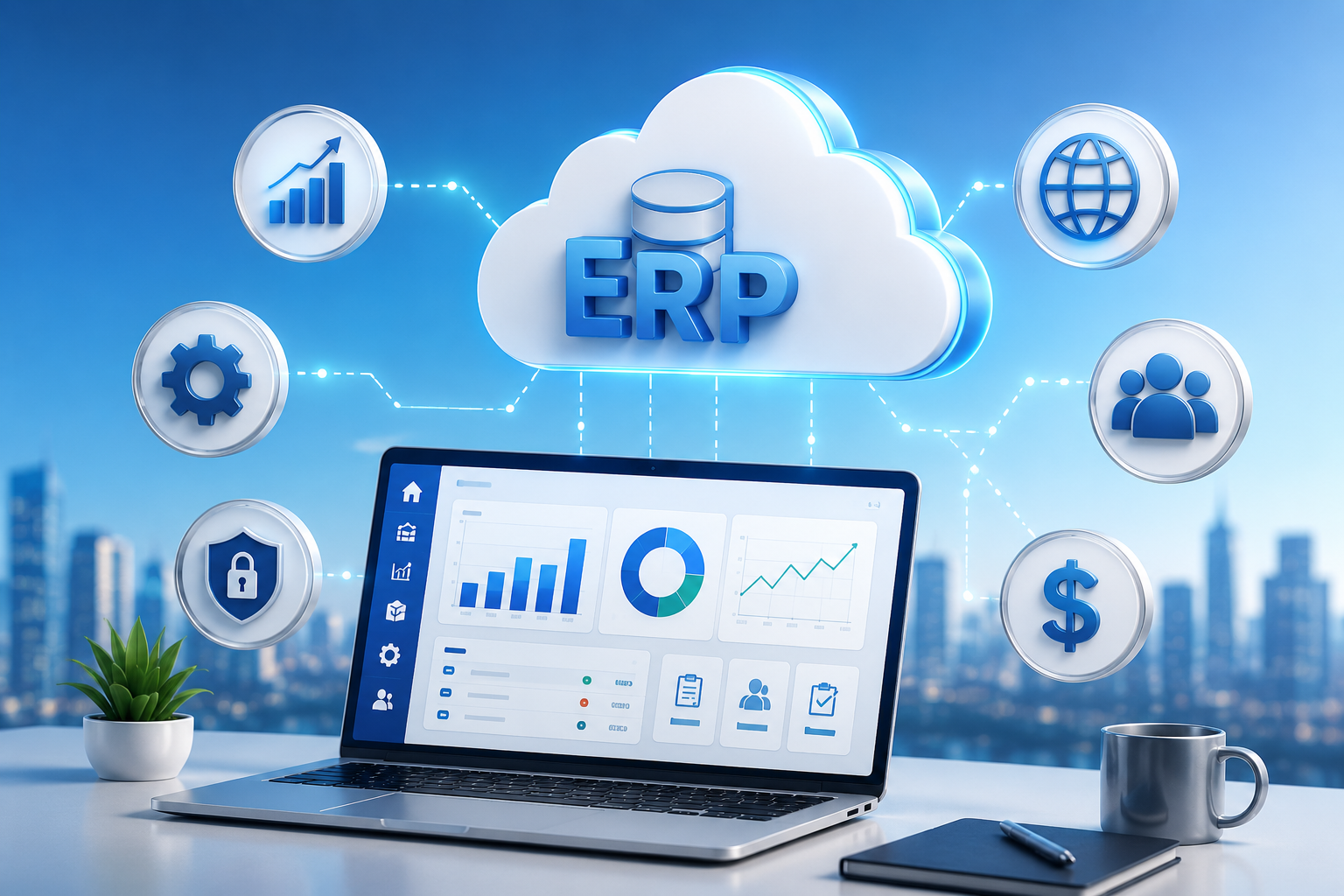
The unanticipated shift in the company’s environment in 2026 means effective operations are no longer sufficient. It needs agility, real-time stats and less premature investment.” This is why every modern firm needs a Cloud ERP System. In today’s environment, groups are encountering increasing difficulties in managing their diverse stock, human resources, and supply chains. Traditionally, on-premises solutions are becoming increasingly limited. A cloud-based ERP System is a better, more flexible solution that fully meets the requirements of today’s distributed, dynamic work environment.
There are many benefits for organizations to move to a Cloud-Based ERP System. They can react faster to market changes, reduce operational costs and provide a better employee and customer experience. We will look into why moving to a Cloud-Based ERP System is not just an option but a strategic need in 2026.
Understanding What a Cloud-Based ERP System Really Means
A cloud-based ERP System is an enterprise resource planning program delivered as a service in the Cloud. But rather than customers having to install hefty software on their own computers, they can use the entire platform through their web browser and/or mobile app. The service provider handles all infrastructure, security, updates, backups, and maintenance, so businesses can use the system without running it.
In traditional on-premise ERP System deployments, the firm owns the hardware, IT staff, and routine software patching. This strategy shifts the responsibility to the Cloud. The Cloud-Based ERP System can deliver vital business information from anywhere. It is a preferred option for growing firms in 2026, especially as remote and hybrid working has become a reality.
The Growing Problem of Traditional ERP Limitations
Many companies still use legacy on-premise ERP systems. These systems are quite expensive due to the cost of servers and infrastructure. These also require dedicated IT teams for patching, maintenance and troubleshooting. Remote access typically requires a complex VPN setup, which can be problematic for today’s distributed teams.
These outdated systems become hard to scale as companies grow into several offices or e-commerce practices. When businesses are developing and want to expand or start selling online, a problem can arise with legacy systems. Adding users or modules can be costly and time-consuming. However, a Cloud-Based ERP System overcomes these barriers. It provides quick scalability, automatic updates, and seamless access, making it ideal for enterprises looking to scale up in 2026 and beyond.
Main Benefits of Using a Cloud-Based ERP System
One of the biggest advantages of using a cloud-based ERP system is accessibility. All team members can log in securely from any Internet-enabled device. The Sales Manager is on the road, the Accountant works from home, or the Operations staff needs real-time inventory data. No complex preparations needed. This flexibility supports today’s hybrid working environment and improves overall productivity.
Another big benefit is automatic upgrades and maintenance. With cloud-based ERP systems, companies don’t need to worry about disruptive upgrades every few years. The provider can roll out new features, security patches and improvements without a hitch. That means firms can always be confident they’re running the latest version, with added capabilities such as artificial intelligence for better forecasting and automation.
Cost is one of the biggest advantages of a Cloud-Based ERP System. Companies are paying predictable monthly or annual subscription fees rather than upfront capital costs for gear and software licensing. This is because the move from a capital expense to an operational expense stream makes financial planning easier. The total cost of ownership is much lower over time, since there is no maintenance expense for servers, cooling, power, or regular refreshes.
Scalability is another big benefit. A Cloud ERP System Grows With Your Business. Added more users, expanded markets, and added modules rapidly, with minimal infrastructure adjustments. This flexibility is especially useful for seasonal firms or businesses that are growing quickly. Even if you have 10 or hundreds of employees, you can customize the system to your needs.
Most cloud adoption also fits well with better security and compliance capabilities. Most in-house IT teams lack the sophisticated security mechanisms, regular penetration testing, and compliance certifications that leading providers invest in. The data is encrypted to enterprise-grade security and protected by automatic backups. As the threat of cyber attacks increases in 2026, this built-in security function provides peace of mind.
Another added advantage of a Cloud-Based ERP System is Better Integration. API-first designs facilitate integration with CRM, e-commerce, payment gateways and marketing platforms, all of which are vital for modern platforms. This creates a seamless environment where data can move easily between departments, reducing manual labour and errors.
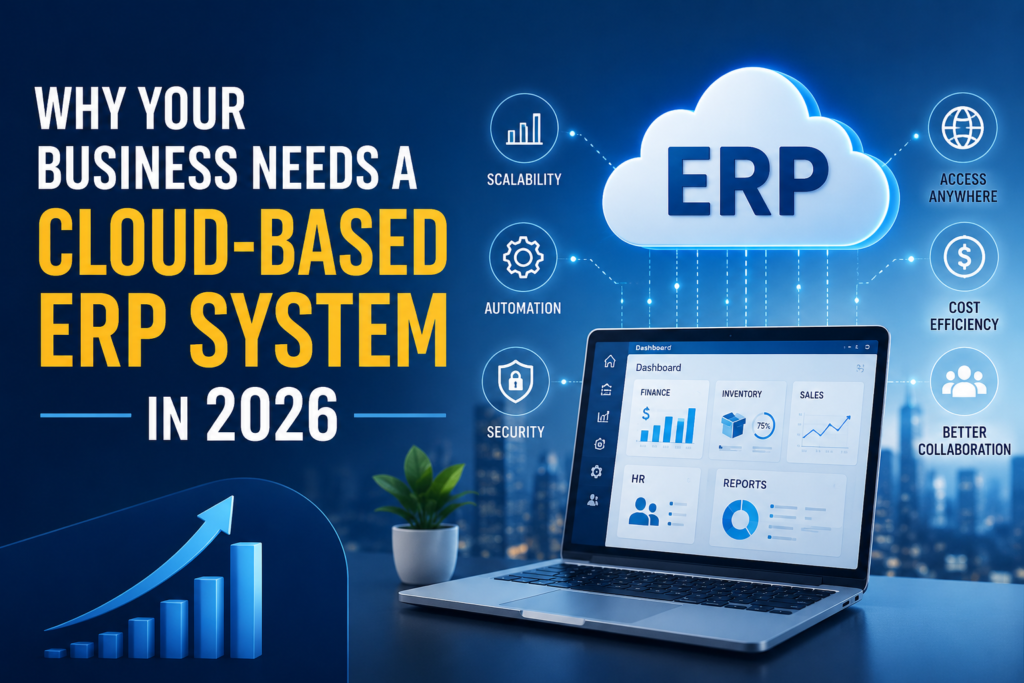
How Cloud ERP Systems Can Enhance Business Efficiency
A Cloud-Based ERP System can improve decision-making and provide real-time, actionable insights. Dashboards and reporting tools give you a real-time view of financial trends, stock levels, project status and customer patterns. Managers may make a quick, informed decision rather than waiting for stale reports.
Another area where a Cloud-based ERP System is especially good is automation. Routine tasks such as billing, payroll processing, stock reconciliation, and compliance reporting can be automated. This allows staff to concentrate more on strategic projects, leading to increased productivity and job satisfaction.
This is much the same with teamwork, too. Accurate, real-time information across all departments and sites. This avoids version-control issues and reduces the potential confusion that can develop in companies with disconnected systems.
As firms grow, multi-entity support becomes a must. A Cloud ERP Solution will handle many subsidiaries, currencies and compliance standards with utmost ease. This supports the effective execution of expansion plans and global growth initiatives.
Frequently Asked Questions About Cloud ERP
Many company leaders are still worried about data security and their dependence on the Internet. But there is proof that most providers of the Cloud-Based ERP System are more secure than most on-premises systems. They have the means to recruit specialized security professionals and to deploy advanced threat detection that smaller IT departments don’t.
The Internet has also become more reliable. Backup connectivity options are plentiful, and small disruptions are acceptable in comparison to the shutdown that would result from a failure of on-premises equipment. Most companies offer high uptime, often exceeding 99.9 percent.
Another frequent problem is the anxiety of not being in control. The truth is, businesses still have 100% control over their data, operations and user permissions. What they lose is the need for the infrastructure team to handle infrastructure so that the in-house team can focus on core business.
Real World Impact and Future Outlook 2026
Companies that have already transitioned to a Cloud-Based ERP System see considerable improvements in operational efficiency, cost reductions and rapid growth. They have strong financial controls and are agile enough to respond quickly to changes in market and consumer demand.
The shift to cloud solutions will continue to increase for the rest of 2026 and beyond. Predictive analytics and intelligent automation will become critical for early adopters to obtain a significant competitive advantage with today’s ERP systems driven by artificial intelligence and machine learning.
Companies that have not yet upgraded their on-premises solutions risk being less efficient, less inventive and less scalable. The Cloud-Based ERP System is not just an upgrade but an investment in your organization’s future.
How To Choose The Best Container For Your Business.
When choosing an ERP system in the Cloud, consider your current needs, future growth plans, and business goals. Find a platform that has strong security features, solid integration possibilities, a user-friendly interface, and dependable customer service.
It’s necessary to change over, but now it’s smoother with skilled changeover partners and migration roadmaps. A lot of them have put in place mechanisms that guarantee some day-to-day operations don’t stop.
The proof, finally, is conclusive. Corporate success in 2026 will be characterized by the seamless accessibility, scalability, safety, and affordability of a Cloud-Based ERP System. This epoch’s mix primes organizations to flourish in tough conditions, enabling them to make knowledge-based decisions to attain environmental excellence.
Cloud computing is the future of commercial enterprise companies’ management. The discussion is not about whether you want a Cloud-Based ERP system; it’s about how you can leverage it to reflect your company’s capabilities accurately.