Most marketing teams already have access to AI. They use it to draft emails, brainstorm campaign ideas, summarize meetings, or generate social media posts. Yet many of those same teams still struggle to produce work that stands out. That’s where an AI Marketing Strategy matters. The tool isn’t the deciding factor anymore. The way you use it is.
Companies often rush to test the latest AI platform because everyone else is doing it. The result is a collection of disconnected prompts, inconsistent content, and campaigns that lack a clear direction. AI can speed up work, but it doesn’t decide what deserves attention or why a customer should care.
Why AI Marketing Strategy Matters More Than Another AI Tool
There’s a noticeable difference between marketers who treat AI as an assistant and those who expect it to solve every problem.
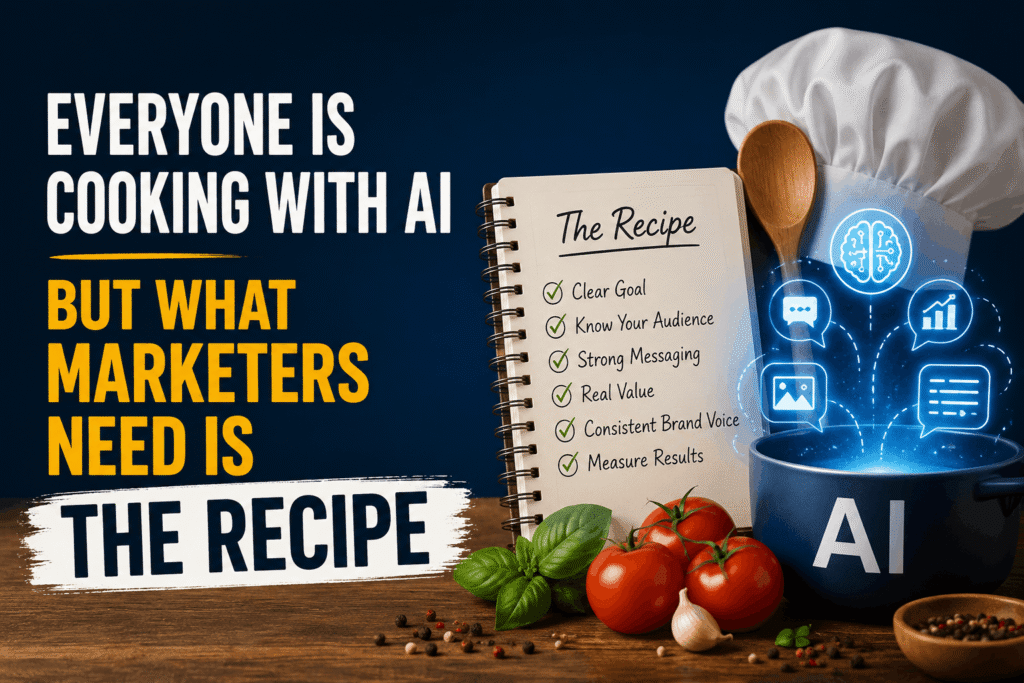
Think about a professional kitchen. Every chef has access to sharp knives, quality cookware, and fresh ingredients. Those tools help, but they don’t create a memorable meal on their own. The recipe, timing, and experience of the chef make the difference.
Marketing works much the same way.
Without a clear AI Marketing Strategy, every prompt becomes another isolated task. One person writes product descriptions, another creates blog outlines, and someone else generates ad copy. The output may look polished, but it rarely sounds like it came from the same brand.
Customers notice that inconsistency even if they can’t explain why.
More AI Doesn’t Automatically Mean Better Marketing
Many businesses measure success by the number of AI tools they’ve purchased. That’s a poor benchmark.
Adding another platform won’t fix unclear messaging or weak campaign planning. If a brand doesn’t know who it’s trying to reach, AI simply produces more content aimed at the wrong audience.
The better question is straightforward:
How does this tool fit into the existing marketing process?
That answer should come before anyone starts writing prompts.
Where AI in Marketing Actually Saves Time
Some marketing jobs repeat every day. These are often the best candidates for AI support.
For example, AI can help with:
- Drafting email subject lines
- Creating first versions of blog outlines
- Summarizing customer interviews
- Rewriting social media posts for different platforms
- Organizing research notes
- Producing content briefs
These tasks consume hours each week. Automating the first draft allows marketers to spend more time reviewing ideas, improving messaging, and checking facts.
That’s a smarter use of AI in Marketing than asking AI to produce an entire campaign without human input.
The Biggest Mistake Marketers Make With Generative AI Marketing
Speed can become a distraction.
Because AI responds in seconds, teams often publish content after only minor edits. The article sounds smooth, but it also sounds familiar. Similar phrases appear across dozens of websites because everyone started with nearly identical prompts.
Readers don’t remember generic content.
They remember original observations, useful examples, and clear opinions.
That’s why experienced marketers treat AI as a starting point rather than the finished product.
A Good AI Content Strategy Starts With Questions
Before opening any AI tool, answer a few basic questions.
- Who is this content for?
- What problem are they trying to solve?
- What information do they already know?
- What should they do after reading?
Those answers shape every prompt that follows.
Without them, AI produces words instead of useful communication.
Why Human Editing Still Matters
AI can organize information quickly.
It can’t replace firsthand experience.
Suppose a company recently reduced customer onboarding from two weeks to four days after changing its support process. That detail gives readers something concrete to remember.
A sentence like “customer onboarding became faster” doesn’t have the same impact.
Small details create credibility. They’re also much harder for AI to invent accurately.
Build an AI Marketing Strategy Before You Add Another Tool
Many teams buy software first and figure out the process later. That order creates more work, not less.
Start by looking at the marketing tasks that take the most time. Content research, campaign planning, email drafts, and reporting are usually good places to begin. Once those jobs are clear, decide where AI can shorten the workload without changing the quality of the final output.
This approach keeps your AI Marketing Strategy focused on solving real problems instead of chasing the latest feature.
Where AI Marketing Tools Deliver Real Value
Every marketing department has repetitive work. AI fits naturally into those routines, but not every task should be automated.
A balanced workflow might look like this:
- Use AI Marketing Tools to organize research from multiple sources.
- Generate a rough outline before writing a blog post.
- Rewrite existing copy for different channels.
- Turn webinar transcripts into social media snippets.
- Summarize customer feedback collected from surveys.
- Prepare the first version of monthly performance reports.
The final review should always belong to a person. AI can organize ideas quickly, but it doesn’t know whether a claim is accurate or whether a message reflects your brand.
A Brand Voice Doesn’t Come From a Prompt
Ask five people to describe the same company, and you’ll probably get five different answers.
That’s why brand guidelines matter.
If your content sounds friendly one week and overly formal the next, readers start noticing the inconsistency. It may seem like a small issue, but trust is built through repetition.
Before using AI for content creation, create simple writing rules.
Decide how the company speaks.
Choose the words you use often.
List the phrases you never use.
Those details help every piece of content sound like it belongs to the same brand instead of looking like it came from different writers.
Why Marketing AI Needs Human Judgment
AI can compare data, summarize reports, and identify patterns in seconds.
It can’t explain why customers ignored a campaign after opening every email.
That answer usually comes from experience.
Maybe the offer arrived too late. Maybe the landing page asked for too much information. Maybe the message solved the wrong problem.
Numbers tell part of the story. Marketers supply the missing context.
The strongest teams combine both instead of choosing one over the other.
Don’t Measure Success by Content Volume
Publishing more articles doesn’t automatically increase traffic.
Neither does creating hundreds of AI-generated social posts.
Instead, watch the numbers that actually affect the business.
These include:
- Organic traffic from search engines.
- Time visitors spend reading important pages.
- Newsletter sign-ups.
- Qualified leads.
- Conversion rate.
- Returning visitors.
If those metrics don’t improve, creating more content won’t solve the problem.
How AI for Marketers Changes Daily Work
The biggest shift isn’t replacing marketers.
It’s changing how they spend their time.
Instead of staring at a blank page for an hour, writers can begin with an outline. Instead of manually sorting hundreds of customer comments, they can review an organized summary. Instead of rewriting the same announcement for four social platforms, they can edit one AI-generated draft.
That leaves more time for interviews, customer research, testing headlines, and improving campaigns.
Those activities still depend on human decisions.
Keep Your AI Content Strategy Grounded in Real Customer Problems
Search engines reward content that answers specific questions.
Readers do the same.
Before publishing anything, ask whether the article helps someone make a decision or solve a problem.
If the answer is unclear, adding more words won’t help.
A stronger AI Content Strategy starts with customer conversations, support tickets, product reviews, and sales calls. Those sources reveal the language people actually use. AI can organize that information, but the insights come from real experiences.
Marketing Automation AI Works Best Behind the Scenes
Some of the most useful AI applications aren’t visible to customers at all.
Businesses use Marketing Automation AI to score leads, schedule email campaigns, recommend products, organize customer data, and trigger follow-up messages based on user behavior.
Customers rarely notice these systems.
What they notice is receiving relevant information at the right time instead of generic messages that feel disconnected from their needs.
That’s where automation quietly supports better marketing without replacing the people responsible for the strategy.