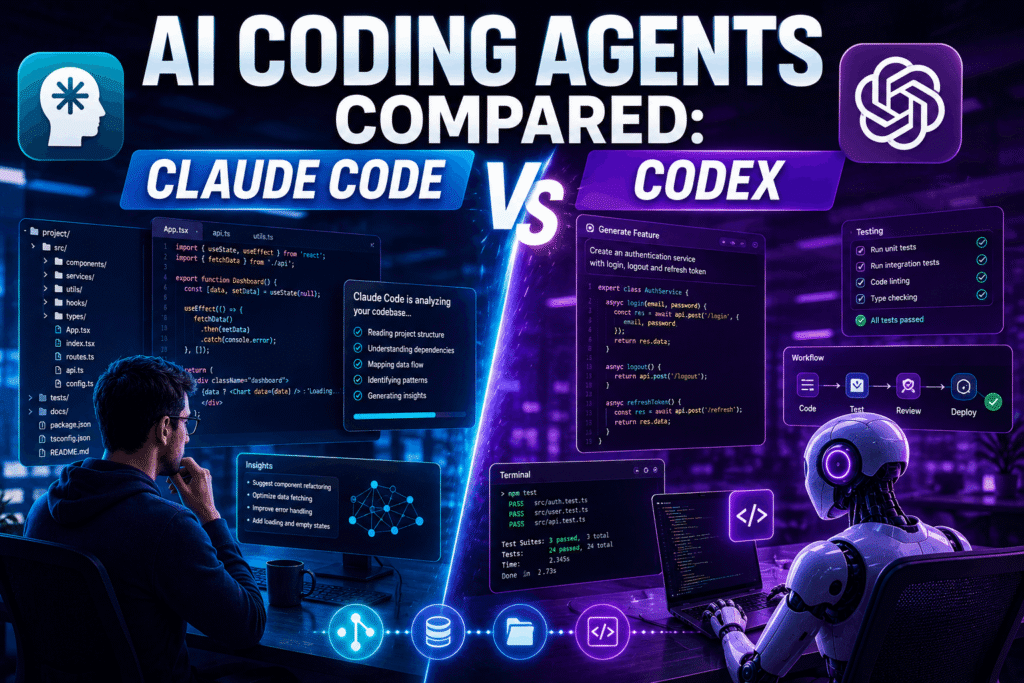
AI coding agents are changing how developers build, test, and maintain software. Instead of acting as simple code completion tools, modern agents can understand project structure, edit multiple files, explain unfamiliar code, and automate repetitive development tasks. Two of the biggest names in this space are Claude Code and Codex. While both help developers write software faster, they take different approaches to solving everyday programming challenges. Choosing the right one depends on your workflow, team size, and the type of projects you build.
Not long ago, AI tools mainly suggested the next line of code.
Today’s coding agents go much further.
They can inspect repositories, refactor existing code, create documentation, identify bugs, and even complete multi-step programming tasks with minimal guidance.
That shift is changing how developers think about productivity.
Instead of asking an AI to generate a single function, many teams now expect it to assist throughout the entire development lifecycle.
What Are AI Coding Agents?
An AI coding agent is software designed to complete programming tasks with greater independence than a traditional autocomplete tool.
Rather than responding to one prompt at a time, these systems understand project context, maintain conversations, and perform multiple development steps before returning results.
Depending on the platform, they can:
- Generate new code
- Edit existing files
- Explain complex functions
- Create unit tests
- Debug errors
- Refactor applications
- Produce documentation
- Navigate large repositories
This broader capability makes them valuable AI developer tools rather than simple writing assistants.
For individual developers, that means spending less time on repetitive work.
For engineering teams, it can reduce development cycles while improving consistency across projects.
Meet Claude Code and Codex
Although both products belong to the same category, their strengths differ.
Claude Code is designed to help developers understand large codebases and work through complex programming tasks. It focuses heavily on reasoning, repository awareness, and maintaining context during longer development sessions.
Codex, on the other hand, emphasizes rapid code generation and developer assistance across a wide variety of programming tasks. It integrates naturally into coding workflows where developers need quick suggestions, edits, or automation.
Neither platform is universally better.
Each performs well in different situations.
Understanding those differences helps developers choose the tool that best matches their workflow, rather than simply selecting the newest platform.
Feature Comparison
| Feature | Claude Code | Codex |
| Repository awareness | Excellent | Very Good |
| Multi-file editing | ✅ | ✅ |
| Code explanation | Excellent | Very Good |
| Code generation | Very Good | Excellent |
| Long-context understanding | Excellent | Good |
| Refactoring support | Excellent | Very Good |
| Documentation generation | Excellent | Good |
| Learning curve | Moderate | Easy |
The table highlights an important point.
Both tools cover the same core responsibilities.
The difference lies in how they approach those tasks.
Workflow Matters More Than Features
Many developers compare AI tools by counting features.
In practice, workflow often matters more.
Imagine joining a project with hundreds of existing files.
Understanding architecture becomes more important than generating another function.
In that situation, Claude Code often feels like a technical partner who explains relationships between components before suggesting changes.
Now consider a developer creating a new application from scratch.
Fast code generation, quick edits, and responsive suggestions may become higher priorities.
That’s where Codex often fits naturally.
The best choice depends less on feature lists and more on how developers spend their time each day.
Understanding the Development Process
Modern AI programming tools support far more than writing code.
A typical development workflow includes:
- Understanding project requirements
- Exploring the existing codebase
- Writing new features
- Testing functionality
- Fixing bugs
- Reviewing code quality
- Updating documentation
- Deploying changes
Both platforms contribute throughout this process, but not always in the same way.
Some stages require deeper reasoning.
Others benefit from rapid code generation.
Recognizing where each tool performs best helps teams create more efficient workflows.
Beyond an AI Coding Assistant
Many developers still think of these systems as AI coding assistants that write code when asked.
That description no longer captures their full capabilities.
Today’s agents help developers investigate unfamiliar repositories, explain architectural decisions, identify inconsistencies, recommend improvements, and automate repetitive maintenance tasks.
Instead of replacing developers, they reduce the time spent on routine work.
That allows engineers to focus more on solving technical problems, improving software quality, and designing better systems.
As development environments become increasingly complex, this type of assistance is becoming less of a convenience and more of a practical part of everyday software engineering.
Coding Performance in Real Development Projects
The biggest difference between Claude Code and Codex becomes apparent in everyday development rather than in simple coding demonstrations.
Generating a short function is relatively easy for both tools.
Working through a large project with dozens of interconnected files is a different challenge.
When developers need to understand an unfamiliar repository, explain existing logic, or refactor multiple components, Claude Code often performs well because it maintains context throughout longer conversations. Instead of focusing on one file at a time, it can connect relationships across different parts of the project.
Codex excels when speed becomes the priority.
Developers creating new features, writing helper functions, or automating repetitive coding tasks often appreciate its fast responses and efficient code generation.
For many teams, the decision isn’t about choosing the “best” tool.
It’s about selecting the one that aligns with daily development habits.
Coding Agent Comparison
| Category | Claude Code | Codex |
| Understanding existing projects | ⭐⭐⭐⭐⭐ | ⭐⭐⭐⭐☆ |
| New feature development | ⭐⭐⭐⭐☆ | ⭐⭐⭐⭐⭐ |
| Repository navigation | ⭐⭐⭐⭐⭐ | ⭐⭐⭐⭐☆ |
| Refactoring complex code | ⭐⭐⭐⭐⭐ | ⭐⭐⭐⭐☆ |
| Documentation support | ⭐⭐⭐⭐⭐ | ⭐⭐⭐⭐☆ |
| Code generation speed | ⭐⭐⭐⭐☆ | ⭐⭐⭐⭐⭐ |
| Long development sessions | ⭐⭐⭐⭐⭐ | ⭐⭐⭐⭐☆ |
| Beginner-friendly experience | ⭐⭐⭐⭐☆ | ⭐⭐⭐⭐⭐ |
This comparison doesn’t suggest one platform is superior in every category.
Each has strengths that appeal to different development styles.
How Autonomous Coding Agents Are Changing Development
Earlier AI coding tools depended almost entirely on user prompts.
Modern autonomous coding agents can complete multiple related tasks before asking for additional instructions.
For example, an agent might:
- Inspect a repository
- Identify outdated code
- Recommend improvements
- Generate replacement code
- Create unit tests
- Update documentation
Completing several connected tasks reduces context switching for developers.
Instead of manually guiding every step, engineers review the proposed changes and decide what should be accepted.
This workflow saves time while allowing developers to retain control over technical decisions.
Security and Repository Awareness
AI tools are increasingly integrated into business-critical applications.
That makes security just as important as coding performance.
Before introducing any coding agent into a development workflow, teams should evaluate:
- Repository access controls
- Data privacy policies
- Permission management
- Code review requirements
- Integration with existing development tools
Regardless of whether a team chooses Claude Code or Codex, AI-generated code should still pass through standard review processes.
Experienced developers continue to validate architecture, test functionality, and verify security before deployment.
AI improves development speed.
It doesn’t replace engineering responsibility.
Pricing and Value
Pricing often influences software decisions, but it shouldn’t become the only deciding factor.
A lower subscription cost means very little if developers lose time working around limitations.
Instead, teams should evaluate overall value.
Questions worth asking include:
- Does the tool reduce repetitive work?
- Can it understand large projects?
- Does it improve collaboration?
- Will developers actually use it every day?
- Does it fit existing workflows?
The platform delivering the greatest productivity improvement often provides the best long-term return, even if the monthly subscription appears higher.
Which Teams Benefit Most?
Different development teams solve different problems.
That means their AI requirements vary as well.
| Team | Recommended Choice | Why |
| Startup developers | Codex | Fast feature development and rapid iteration |
| Enterprise engineering teams | Claude Code | Better repository understanding and long-context reasoning |
| Freelance developers | Either | Depends on project complexity |
| Product engineering teams | Claude Code | Strong support for maintaining large applications |
| Rapid prototyping teams | Codex | Efficient code generation and quick experimentation |
The table highlights an important reality.
Choosing the right platform depends less on popularity and more on how software is actually built inside an organization.
Improving Developer Productivity
The real benefit of modern coding agents isn’t writing more code.
It’s helping developers spend more time solving meaningful problems.
Searching through documentation.
Tracing dependencies.
Writing repetitive boilerplate.
Creating test cases.
Updating documentation.
These routine activities consume hours every week.
Reducing that workload allows engineers to focus on architecture, performance optimization, security, and user experience.
That’s where developer productivity improves most.
Rather than replacing programming skills, AI strengthens the work developers already do.
As AI coding agents continue evolving, the distinction between coding assistant and development partner becomes increasingly small.
Whether a team chooses Claude Code or Codex, the long-term advantage comes from integrating AI into existing engineering practices instead of expecting it to replace sound software development principles.