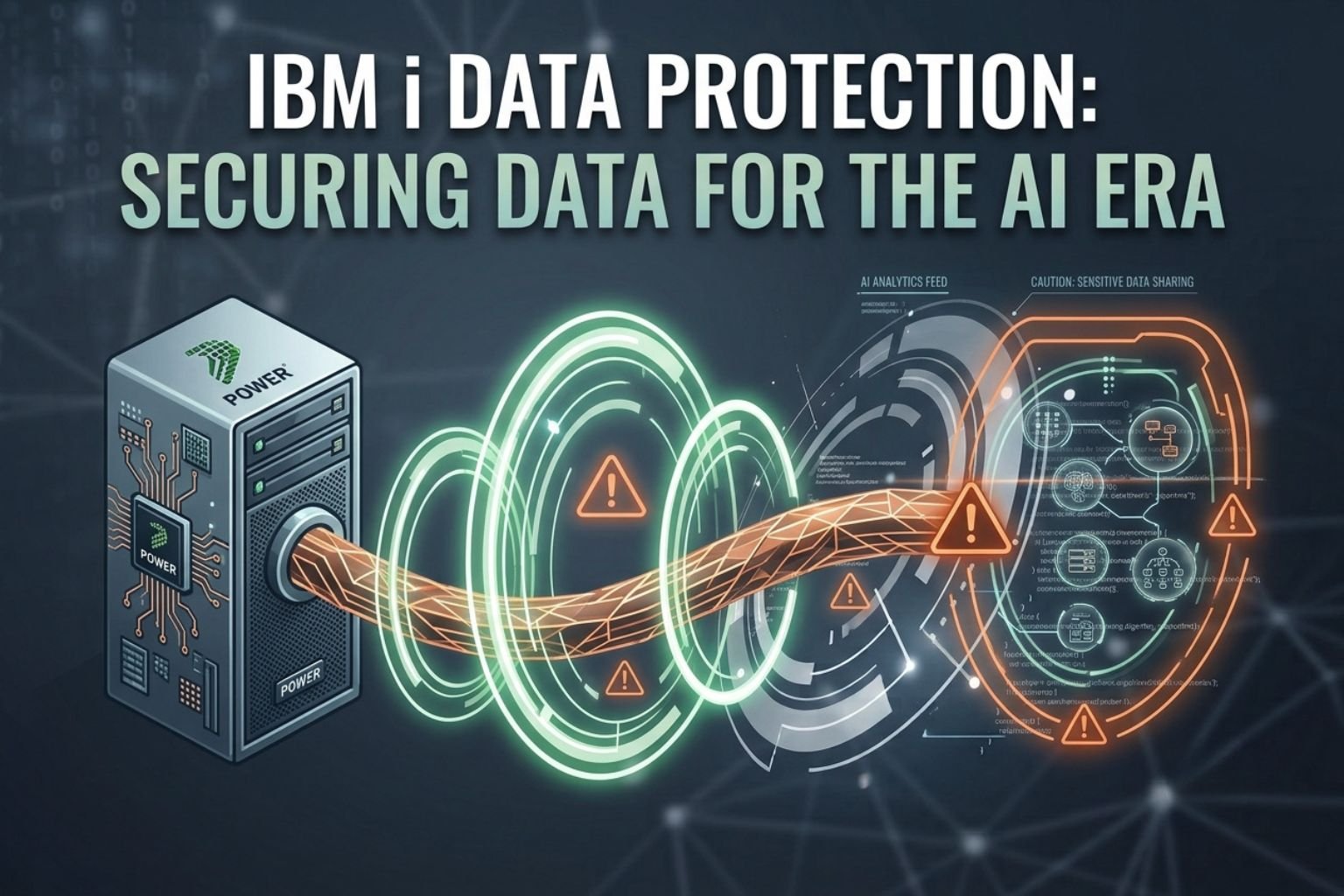
IBM i data protection matters more as companies connect older business systems to analytics, automation, and AI tools. An IBM i environment may hold years of customer records, financial transactions, inventory data, payroll information, order history, and other records that the business cannot afford to lose. When that data starts feeding newer applications, the cost of an outage or security incident gets even higher.
The IBM i platform has a reputation for reliability, but reliability should not be confused with immunity. A system can run for years without a major incident and still have gaps in backup procedures, access controls, monitoring, or recovery planning.
That is why data protection needs to be treated as an ongoing IT responsibility, not something checked only after a problem occurs.
Why IBM i Data Protection Needs More Attention
Many organizations still run critical workloads on IBM i because their applications work, their teams understand the environment, and replacing those systems would be expensive and disruptive.
That creates an interesting security situation.
The platform may be stable, but the surrounding IT environment keeps changing.
Employees connect through more devices. Applications exchange data through APIs. Cloud services sit alongside on-premises workloads. Development teams may copy production data into other systems. And AI projects create another reason to move valuable business information between systems.
The result is a much larger data path than the IBM i server itself.
Good IBM i security therefore has to look beyond the operating system. It needs to account for users, applications, connected systems, backup copies, network access, and the places where IBM i data goes after it leaves the core environment.
The Data Problem Gets Bigger With AI
AI projects need data.
That sounds simple until you ask where that data comes from.
A company might want to use historical sales records to improve forecasting. Another may want an AI assistant that can answer questions about inventory or customer orders. A manufacturer might combine production records with other operational information to identify patterns.
Those projects can create valuable business use cases, but they also create new copies and new paths for sensitive information.
This is where IBM i data protection for AI becomes important.
Before data is connected to an AI application, security teams need to know what information is being shared, who can access it, where copies are stored, and how long those copies remain available.
An AI project should not quietly become a new route around existing security controls.
What Strong IBM i Data Security Should Cover
Protecting an IBM i environment involves more than making a backup every night.
A practical approach covers several areas.
Access Controls
Start with the people and applications that can access critical data.
User privileges should match actual job responsibilities. Accounts that no longer need access should not remain active indefinitely. Administrative access deserves particular attention because a compromised privileged account can cause far more damage than a standard user account.
Regular access reviews can uncover old accounts, excessive permissions, and shared credentials.
Data Encryption
Sensitive information needs protection while it moves and while it is stored.
Encryption does not solve every security problem, but it reduces the damage caused when protected data is intercepted or exposed.
Organizations should examine where encryption is being used across production systems, backups, file transfers, APIs, and other connections around the IBM i environment.
Monitoring and Audit Trails
A security team cannot investigate activity it cannot see.
Logs can help identify unusual login attempts, unexpected access to sensitive objects, changes to permissions, and other activity that deserves attention.
Monitoring is particularly useful when IBM i systems exchange information with newer applications. A sudden change in data access may have nothing to do with the IBM i server itself and everything to do with a compromised connected application.
Why IBM i Backup Is Still a Security Control
Backup is sometimes treated as an IT housekeeping task.
That is a mistake.
A usable backup can be the difference between restoring business operations and spending days trying to reconstruct lost information.
A serious IBM i backup plan should answer a few basic questions:
- How often is business data backed up?
- Where are backup copies stored?
- Are copies isolated from the production environment?
- How quickly can critical applications be restored?
- Has the recovery process actually been tested?
- Who is responsible for starting recovery?
The last question is often overlooked.
A backup that exists but has never been tested is not the same as a recovery plan that the IT team knows will work.
Keep Recovery Copies Away From Production
If attackers gain control of an environment and can also reach its backup copies, the recovery option can disappear along with the production data.
That is why backup isolation matters.
Separate credentials, restricted access, offline or otherwise isolated copies, and clearly defined recovery procedures can make a major difference during a serious incident.
Preparing IBM i for Modern AI Workloads
IBM i modernization does not necessarily mean replacing the platform.
For many organizations, modernization means connecting established applications to newer tools while keeping the systems that already run the business.
That can include APIs, cloud services, analytics platforms, web applications, and AI systems.
The security question changes as those connections grow.
An IBM i environment that once had a relatively small number of access paths may now exchange information with several external systems. Each connection needs to be understood and controlled.
This is where AI data security becomes part of the wider IBM i security conversation.
Before sending IBM i information into an AI workflow, teams should identify:
- What data is being transferred
- Whether the data contains sensitive information
- Which application receives it
- Who can access the AI system
- Where prompts, files, or outputs are stored
- Whether data is retained after processing
- How access is revoked when an employee or application no longer needs it
These questions are practical, not theoretical.
A spreadsheet exported from an IBM i application can become a security problem just as easily as a database connection can.
Building IBM Power Security Around the Data
IBM Power security should be considered across the complete environment rather than as a single product or setting.
The IBM i operating environment, applications, network controls, identities, backups, and connected services all contribute to the overall security posture.
That means security teams should regularly review:
- User privileges
- Network exposure
- Administrative access
- Application interfaces
- Backup protection
- Logging
- Patch and software management
- Third-party connections
- Recovery procedures
This approach also helps when preparing for audits or internal security reviews because teams can show how controls work together instead of relying on one security feature.
Protecting IBM i Against Ransomware
Ransomware remains a serious concern for organizations holding valuable operational data.
IBM i ransomware protection should start with the assumption that prevention alone is not enough.
Access controls, monitoring, network segmentation, endpoint protection around connected systems, and secure backups all have a role.
The recovery side deserves equal attention.
If an attacker compromises a workstation that can reach IBM i applications, the incident may spread through connected systems even when the IBM i server itself was not the original target.
That makes the surrounding environment part of the IBM i security boundary.
A practical ransomware plan should therefore cover both sides:
Reduce the chance of compromise.
Make recovery possible when prevention fails.
Turning IBM i Data Into AI-Ready Data
AI projects work better when the underlying information is trustworthy.
That makes AI-ready data more than a data science concern.
If records are duplicated, poorly governed, incomplete, or exposed through uncontrolled exports, the AI application inherits those problems.
Before using IBM i information for AI, organizations should establish clear rules for data ownership, access, retention, quality, and protection.
The best starting point may be surprisingly simple: know what data you have, know where it is going, and know who can retrieve it.
From there, security teams can build controls around the actual flow of information instead of trying to secure an abstract AI project.
For companies planning IBM i modernization, that foundation becomes increasingly important as APIs, analytics, cloud applications, and AI tools are added around core business systems.