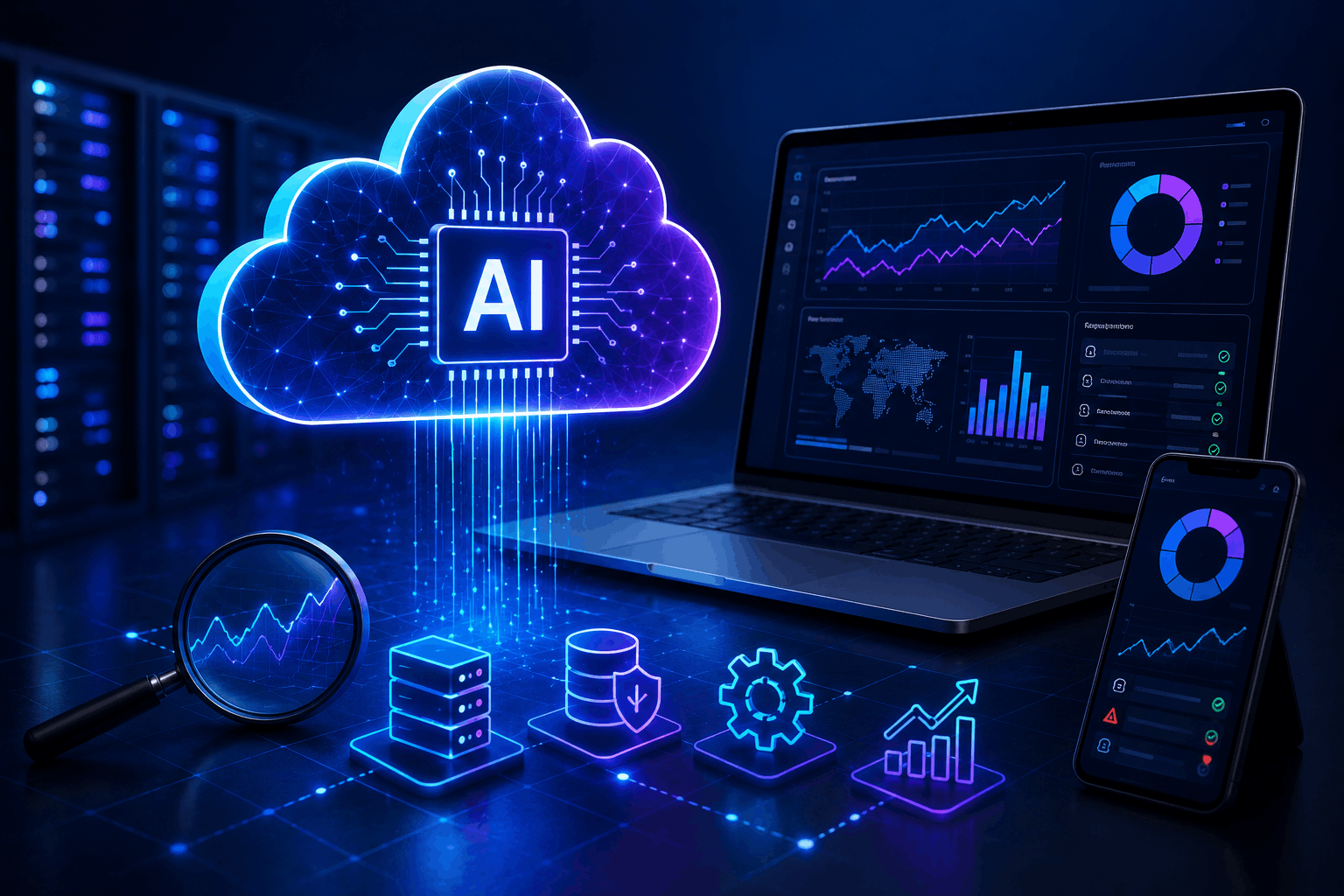
AI observability is unexpectedly turning into a sport-changer in cloud operations. As corporations race to set up state-of-the-art AI fashions, retailers, and generative applications, traditional cloud tracking tools are suffering to preserve up with the specific demanding situations these systems present. This surge in complexity is driving unheard of demand for advanced AI observability cloud monitoring solutions that supply deeper visibility, faster trouble detection, and smarter optimization across sprawling cloud environments.
If you are dealing with cloud infrastructure these days, you’ve got in all likelihood felt the strain: exploding telemetry volumes, unpredictable AI workloads, and the want for real-time insights that move far past fundamental metrics. In this newsletter, we will discuss what AI observability clearly approaches, why it is fueling growth in cloud monitoring answers, key developments shaping the gap in 2026, benefits for organisations, real-international applications, demanding situations, and how to get started. Whether you’re an IT chief, DevOps professional, or cloud architect, information this shift is important for staying ahead.
What Is AI Observability?
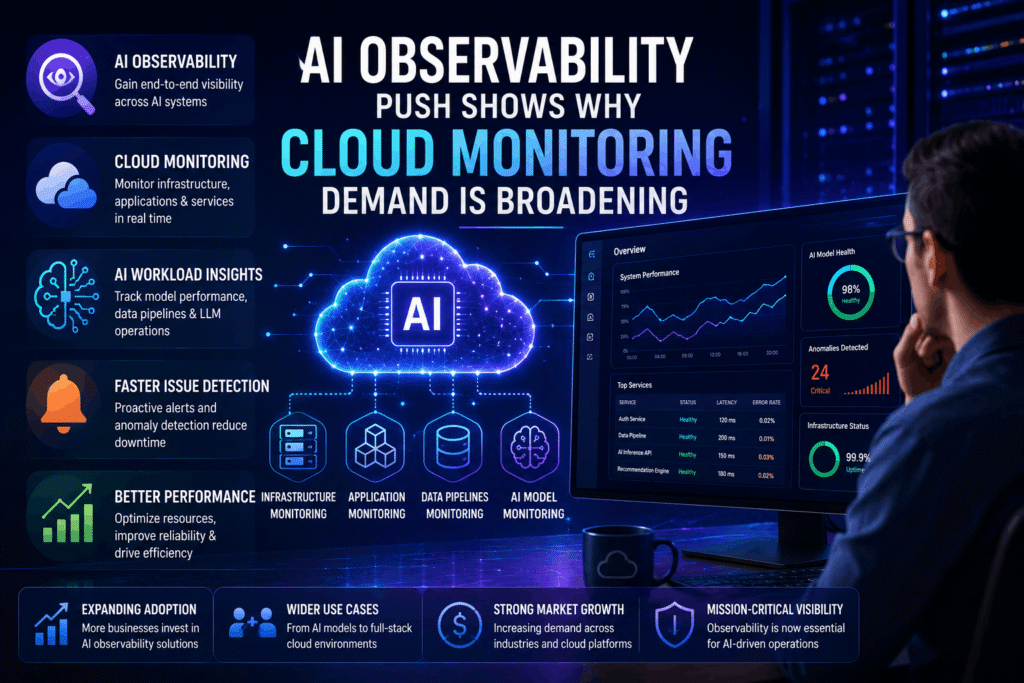
AI observability extends traditional observability logs, metrics, and lines by adding specialized monitoring for AI systems. It makes a speciality of the precise behaviours of machine mastering fashions, huge language fashions (LLMs), AI agents, and their supporting infrastructure. This consists of tracking model performance, facts waft, hallucinations, token utilization, GPU usage, inference latency, and greater.
Unlike general utility tracking, AI observability treats AI additives as dynamic, non-deterministic systems that require behavioural telemetry alongside infrastructure fitness metrics. It provides cease-to-cease visibility throughout the full stack: from underlying cloud assets to the AI workloads running on them.
This capability is tightly intertwined with cloud performance tracking and AI infrastructure monitoring, creating unified structures that cope with each conventional IT and modern-day AI demands.
Why AI Is Driving Explosive Demand for Cloud Monitoring
The adoption of AI is transforming cloud environments in ways that traditional monitoring can’t handle:
- Massive Telemetry Growth: AI workloads generate enormous volumes of data. GPU clusters, inference requests, and agent interactions produce signals that overwhelm legacy tools.
- New Failure Modes: Models can hallucinate, drift silently, or consume unexpected resources. Agentic AI introduces unpredictable decision paths that demand proactive oversight.
- Multi-Cloud and Hybrid Complexity: Organizations run AI across AWS, Azure, Google Cloud, and on-prem, requiring seamless visibility into cloud operations.
- Performance and Cost Pressures: AI infrastructure is expensive. Without proper monitoring, costs spiral due to inefficient resource use, while downtime risks high-stakes business outcomes.
As a result, demand for cloud monitoring solutions that incorporate AI observability is surging. Budgets for observability are holding steady or increasing, with many organizations consolidating tools into unified platforms that can handle both AI and traditional workloads.
How AI Observability Enhances Cloud Monitoring
Modern observability platforms integrate AI-specific capabilities into broader cloud monitoring:
- Unified Telemetry Collection: Gather metrics from GPUs, containers, models, and applications in one place.
- AI-Powered Analytics Use machine learning for anomaly detection, root cause analysis, and predictive insights.
- Real-Time Optimization Monitor token consumption, latency, and resource allocation to balance performance and costs.
- End-to-End Tracing follows requests from user input through AI agents to infrastructure responses.
- Automated Remediation: AI-driven alerts and suggestions that reduce mean time to resolution (MTTR).
This convergence supports AI workload management, IT operations analytics, and AI performance optimization at scale.
Key Trends Shaping AI Observability and Cloud Monitoring in 2026
Several powerful trends are accelerating adoption:
- AI-Driven Intelligence in Observability Platforms now use AI for automated insights, generative summaries, and agentic remediation. GenAI helps explain issues in plain language.
- Tool Consolidation and Open Standards Organizations are moving to unified platforms and embracing OpenTelemetry for vendor-agnostic data collection.
- Focus on AI Infrastructure Monitoring. Specialized tracking for GPUs, TPUs, vector databases, and model serving layers.
- Predictive and Autonomous Operations: Shifting from reactive monitoring to proactive, self-healing systems.
- Cost Management Integration Observability tools now double as FinOps solutions, helping control AI-related cloud spend.
- Privacy, Governance, and Reliability Emphasis on explainable AI, compliance, and monitoring for agentic systems.
These trends highlight how monitoring and observability are evolving to support the AI era.
Benefits for Businesses
Adopting robust AI observability cloud monitoring delivers tangible advantages:
- Faster Issue Detection and Resolution: Spot anomalies before they impact users, dramatically reducing downtime.
- Improved AI System Reliability Monitor to detect drift, bias, and performance degradation, maintaining trustworthy outputs.
- Cost Optimization: Identify inefficient workloads and right-size resources in real time.
- Enhanced Operational Visibility Unified views across cloud, applications, and AI layers empower better decision-making.
- Scalability for Enterprise Monitoring: Handle growing complexity without proportional increases in team size.
- Better AI Workload Management: Optimize inference, training, and agent performance for superior business outcomes.
Many organizations report significant ROI through reduced MTTR, lower cloud bills, and higher confidence in AI deployments.
Real-World Examples and Use Cases
- E-commerce Giants: Use cloud analytics and AI observability to monitor recommendation engines in real time, ensuring low latency during peak seasons.
- Financial Services: Track model accuracy and compliance for fraud detection systems with full audit trails.
- Tech Companies Running LLMs: Platforms like New Relic, Dynatrace, Datadog, and Splunk help monitor token usage, GPU health, and agent behaviours across hybrid environments.
- Kubernetes-Based AI Workloads: Tools provide visibility into containerized inference serving and data pipelines.
Success stories frequently cite 30-50% faster troubleshooting and measurable cost savings.
Challenges and Considerations
While promising, implementing AI observability comes with hurdles:
- Data Volume and Costs: High telemetry ingestion can get expensive without smart filtering and retention policies.
- Integration Complexity Connecting diverse AI tools and cloud providers requires careful planning.
- Skill Gaps: Teams need expertise in both cloud ops and AI-specific metrics.
- Explainability and Trust: Ensuring monitoring insights are actionable and unbiased.
- Vendor Fragmentation: Choosing between specialized tools and full-stack platforms.
Start with pilot projects on critical AI workloads and leverage platforms with strong AI assistants to ease the transition.
The Future of Cloud Operations
Looking in advance, AI observability will become table stakes for any excessive cloud method. Expect tighter integration amongst cloud monitoring, AIOps, and enterprise results, with extra self sufficient systems that self-optimize. As agentic AI proliferates, observability for reliability, safety, and governance becomes an increasing number of vital.
Businesses that make investments now in comprehensive cloud overall overall performance monitoring advanced by the use of AI will benefit a huge competitive aspect via resilient, green, and modern operations.
Getting Started with AI Observability Cloud Monitoring
Ready to enhance your setup?
- Assess present day tracking gaps in AI workloads.
- Evaluate systems like Dynatrace, New Relic, Datadog, Splunk Observability, or open-deliver alternatives with AI extensions.
- Prioritize OpenTelemetry for future-proofing.
- Focus on excessive-effect regions: value control, essential packages, and compliance.
- Train groups and combine into gift cloud operations workflows.
Conclusion
AI observability cloud tracking is not most effective a technical beautify, it’s miles a strategic necessity riding the subsequent wave of cloud tracking demand. By providing extraordinary insights into AI infrastructure, general performance, and reliability, those solutions assist agencies navigate complexity, control costs, and unfastened up the whole potential in their AI investments.
In a technology in which AI powers the whole lot from purchaser tales to middle operations, sturdy observability guarantees you live on top of factors. The destiny of company corporation monitoring is smart, unified, and AI-nearby, and it’s miles expanding .
Embrace the ones gear these days to collect extra resilient, inexperienced, and modern cloud environments the next day.