A small factory owner runs a metal parts unit. 22 workers. Two production lines. One quality inspector who catches defects by eye. Last year, he installed a vision system that catches flaws in milliseconds. Defect rates dropped by nearly half. That single change showed him what AI and automation in MSMEs can actually do.
Not theory. Not hype. Real results on a real factory floor.
MSME manufacturing runs on tight margins. Every wasted material, every rework cycle, every hour of downtime eats into profit. AI and automation address those problems directly. They don’t need massive budgets or dedicated IT teams. They need the right tools applied to the right problems.
Here’s how that works.
Why MSMEs are adopting AI and automation now
Three things changed.
First, costs dropped. AI-powered manufacturing tools that once required enterprise budgets are now affordable. Cloud-based platforms. Subscription pricing. No massive upfront investment.
Second, complexity decreased. Automation for MSMEs no longer requires programming expertise. Modern systems learn from data. They adapt to your production patterns. Setup takes days, not months.
Third, competition increased. Larger manufacturers already use smart manufacturing for MSMEs technologies. Small suppliers that don’t keep up lose contracts. Buyers expect data. They want traceability. They demand consistent quality.
AI in MSME manufacturing isn’t about replacing workers. It’s about giving them better tools. A machine operator with AI-assisted quality checks catches more defects. A production planner with predictive scheduling avoids more bottlenecks.
The result? Manufacturing automation becomes accessible to businesses that couldn’t afford it five years ago.
What AI and automation actually look like on the factory floor
Let me give you concrete examples.
Predictive maintenance. Machines break down. That’s a fact. But they usually give warning signs first. Vibration changes. Temperature spikes. Unusual sounds.
AI-driven manufacturing systems monitor those signals. They predict failures before they happen. A pump that would fail next Tuesday gets flagged on Friday. Maintenance happens over the weekend. No production loss.
Quality inspection. Human inspectors get tired. They miss things. Especially on repetitive tasks.
Vision systems powered by AI check every part. Every time. They catch cracks, discolorations, dimensional errors. They don’t get bored. They don’t get distracted.
Production scheduling. Manufacturing technology now includes AI schedulers. They analyze orders, machine capacity, material availability, and worker shifts. They create optimal schedules automatically. When something changes, they recalculate instantly.
Inventory management. Digital transformation for MSMEs starts with visibility. AI tracks raw materials and finished goods. It predicts when you’ll run out. It flags slow-moving stock. It reduces the cash tied up in inventory.
Energy optimization. Factories consume power. AI and automation monitor usage patterns. They identify waste. They adjust equipment settings. Energy bills drop without affecting output.
These aren’t futuristic concepts. They’re available now. Small manufacturers use them every day.
The productivity gains MSMEs actually see
Numbers matter. Here’s what AI in MSME manufacturing delivers.
Higher output per worker. Automation handles repetitive tasks. Workers focus on judgment and problem-solving. Output increases without adding headcount.
Lower defect rates. AI inspection catches errors earlier. Rework drops. Scrap decreases. Material costs fall.
Less downtime. Predictive maintenance prevents unexpected failures. Machines run longer between service intervals. Production schedules stay on track.
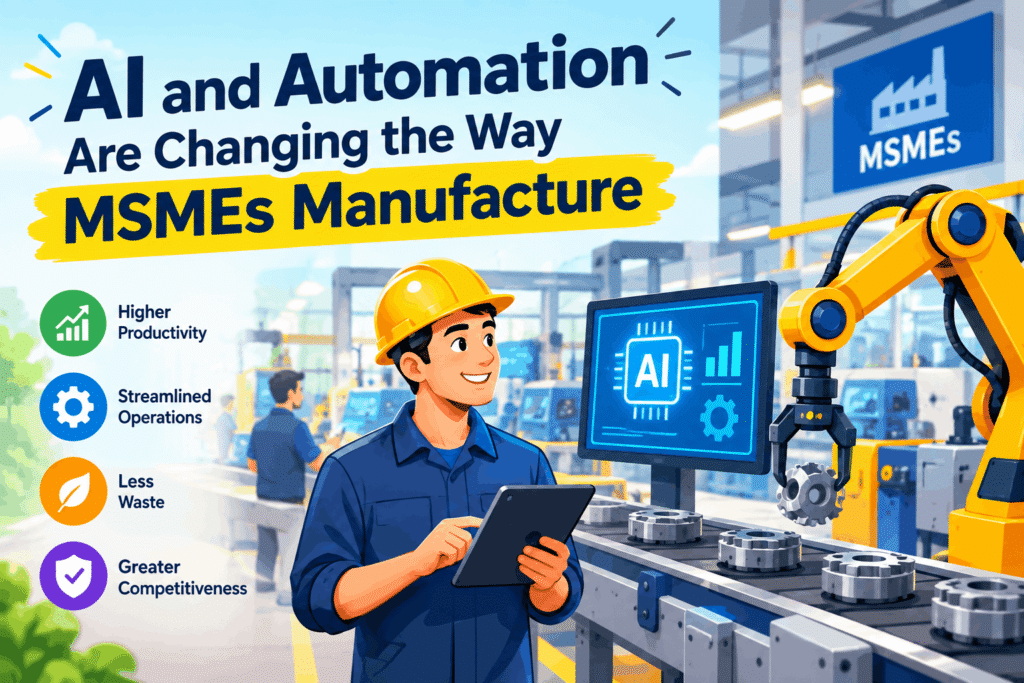
Faster changeovers. Automation in manufacturing reduces setup time. Switching between product variants takes minutes instead of hours. Small batch production becomes profitable. Better planning. AI forecasting improves demand prediction. Production aligns with actual orders. Inventory levels optimize. Cash flow improves.
AI for small manufacturers delivers these gains without requiring massive scale. The tools work for a twenty-person shop. They work for a two-hundred-person operation. The principles stay the same.
What holds MSMEs back
I’ve talked to dozens of small manufacturers. The same concerns come up.
“We don’t have the budget.” Automation costs money. But so does inefficiency. Start with one problem. Solve it. Use the savings to fund the next project.
“Our team doesn’t have technical skills.” Modern manufacturing automation tools are designed for non-technical users. Dashboards. Alerts. Simple interfaces. Training takes days, not months.
“Our processes are too unique.” Every factory thinks this. But the underlying patterns are similar. Quality control. Maintenance. Scheduling. Inventory. AI handles these common problems across industries.
“We tried software before and it failed.” This is the real barrier. Failed implementations create skepticism. The fix is starting smaller. Pick one process. Prove value. Expand.
“We’re worried about data security.” Cloud platforms invest heavily in security. They protect data better than most small businesses can on their own. Digital transformation for MSMEs includes security as a foundation, not an afterthought.
AI and automation in MSMEs works when you address these concerns directly. Not with dismissals. With practical solutions.
How to start without disrupting operations
Here’s a path that works.
Step one: Identify your biggest pain point. Is it quality defects? Machine downtime? Inventory waste? Pick one. Don’t try to solve everything at once.
Step two: Measure the current state. You can’t improve what you don’t measure. Track defect rates. Downtime hours. Inventory turns. Establish a baseline.
Step three: Start with a pilot. Choose one production line. One process. One shift. Implement AI-powered manufacturing tools there. Learn what works.
Step four: Involve your team early. Workers on the floor know where problems hide. Ask them. Their input shapes better solutions.
Step five: Measure results. Compare against your baseline. Calculate the savings. Use those numbers to justify expansion.
Step six: Scale what works. Apply successful pilots to other areas. Build momentum. Create a culture of continuous improvement.
Smart manufacturing for MSMEs isn’t a one-time project. It’s an ongoing journey. Start small. Learn fast. Expand gradually.
The competitive advantage AI creates
AI and automation changes what’s possible for small manufacturers.
They can compete on quality now. AI inspection delivers consistency that matches larger competitors. Buyers notice.
They can compete on speed. AI-driven manufacturing reduces lead times. Faster delivery wins contracts.
They can compete on cost. Automation reduces waste. Energy optimization cuts bills. Predictive maintenance avoids expensive failures.
They can compete on flexibility. Manufacturing technology enables small batch production. Custom orders become profitable.
Automation for MSMEs levels the playing field. Small manufacturers gain capabilities that were once reserved for large enterprises.
The gap between small and large manufacturers narrows. That’s good for competition. Good for customers. Good for the economy.
AI in MSME manufacturing isn’t about catching up. It’s about leapfrogging. Small businesses adopt new technology faster than large ones. They don’t have legacy systems holding them back.
That’s the opportunity. That’s why AI and automation in MSMEs matters.
What the future looks like
The trajectory is clear.
AI and automation will become standard in manufacturing. Not optional. Expected.
MSME manufacturing will look different in five years. Fewer manual processes. More connected systems. Better data. Smarter decisions.
AI in MSME manufacturing will get easier to adopt. Lower costs. Simpler interfaces. More integration.
Manufacturing automation will handle more complex tasks. Not just repetitive work. Judgment calls. Quality decisions. Planning.
Smart manufacturing for MSMEs will become the baseline. Not a differentiator.
The manufacturers who start now will lead. They’ll learn faster. They’ll build better systems. They’ll gain competitive advantage.
The ones who wait will scramble to catch up.
Digital transformation for MSMEs is happening. The question is whether you’ll be part of it.
AI for small manufacturers is available today. It’s affordable. It works.
The factory owner I mentioned earlier? He’s already planning his next project. Inventory optimization. Same approach. Small pilot. Measure. Scale.
That’s how AI and automation in MSMEs becomes real. One problem at a time. One improvement at a time.
That’s how manufacturing changes.
That’s how small businesses win.