

A marketer finds a keyword with 20,000 monthly searches and immediately puts it into the editorial calendar. Sounds sensible. Then the article gets published, ranks for a while, and attracts people who were never likely to buy anything, contact the company, or even need its service. This is where content briefs can go wrong.
The problem isn’t keyword research itself. Keywords are useful. They show what people type into search engines and can reveal language worth using in a piece of content.
But a keyword doesn’t tell you the whole story.
It doesn’t tell you why someone searched.
It doesn’t tell you what happened five minutes before the search.
And it certainly doesn’t tell you what the person needs after reading the first answer.
A better content planning process starts there.
Why Content Briefs Should Start With the Reader
Imagine an accounting firm deciding to write about “fiscal year.”
The term may have search demand, but a person looking for a basic definition isn’t necessarily looking for an accountant. They may simply want a quick answer that an official government source can provide.
That creates a poor match between the reader and the business.
chasing broad search volume can pull specialist businesses into topics where they have little reason to be the preferred source.
A useful content brief asks a harder question:
Who are we trying to help, and what situation caused them to look for this information?
That question changes the article before a writer types the first sentence.
A business owner approaching the end of the financial year has a different problem from a student learning accounting terminology.
Same general subject.
Different person.
Different reason for searching.
Different content.
Build an Audience-Focused Content Brief
An audience-focused content brief gives the writer more than a keyword and a word count.
It explains the person behind the search.
Maybe the reader is a small-business owner who has just hired their first employee.
Maybe they’re a marketing manager trying to explain declining organic traffic to a CEO.
Maybe they’re a customer who has tried three solutions already and is looking for something that actually works.
Those details matter.
They affect the examples you choose, the questions you answer, the vocabulary you use, and even the point where the article should stop.
This is where audience research becomes useful.
You don’t always need another expensive research project.
Talk to the people already hearing customer questions.
Sales teams know what prospects ask before buying.
Support teams know where customers get stuck.
Account managers hear complaints that rarely appear in keyword tools.
Those conversations can produce better article ideas than a spreadsheet filled with search volumes.
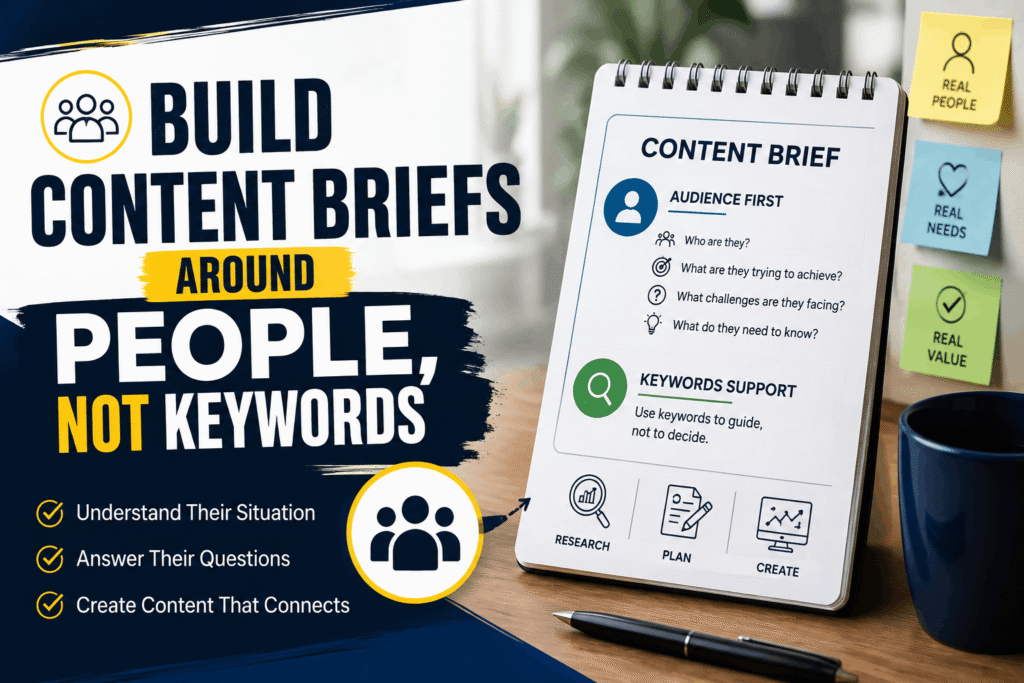
The MarTech article recommends getting input from teams that interact directly with the audience, particularly sales and support.
Use the 7 W’s Before Choosing the Angle
The article uses seven questions work on category entry points:
Why?
When?
Where?
While?
With whom?
With or for what?
How feeling?
Together, these questions force the team to describe the situation around the search instead of treating the search phrase as the entire problem.
Take a simple topic such as “CRM software.”
That phrase alone is almost useless for a writer.
Now add context.
Why are they looking? Their sales team has outgrown spreadsheets.
When? After adding five new sales reps.
Where? A small U.S. business with remote employees.
With whom? A sales manager and three account executives.
How are they feeling? Frustrated because customer information is scattered across different files.
Now the SEO content brief has something to work with.
The article can discuss migration, shared customer records, permissions, reporting, and the problems caused by disconnected spreadsheets.
The keyword still matters.
It just isn’t running the meeting.
Where Keyword Research Fits
There is no reason to throw keyword research away.
That would be an overreaction.
Use it after you understand the audience situation.
Look for related searches.
Check the language people use.
Find questions that belong in the article.
Review competing pages to see what information searchers are already being given.
Then bring those findings into the content strategy.
The order matters.
If the keyword comes first, the team can end up asking, “How can we write something that ranks for this?”
If the person comes first, the better question becomes:
“What does this person need to know before they can make a decision?”
That second question usually produces a more useful brief.
And a more useful article.
What Should Go Into a Content Brief?
A useful content brief template doesn’t need 20 fields.
It needs the information a writer actually needs to understand the assignment.
Start with the seven audience questions:
Why are they looking for this?
When does the situation happen?
Where are they?
While doing what?
With whom are they involved?
With or for what are they trying to accomplish?
How are they feeling?
Then add the practical details.
What type of content is this? Is it informational, consideration-stage, or transactional? What should the reader understand by the end? Which products, services, or internal pages are relevant? What existing content already covers the subject?
The original MarTech article also recommends recording who supplied the audience information. That small detail can be surprisingly useful when someone later asks, “Where did this assumption come from?”
A brief becomes much easier to defend when the answer is:
“Our support team heard this question repeatedly over the last six months.”
That’s stronger than:
“The keyword has 8,000 searches.”
Give Writers a Situation, Not Just a Keyword
Compare two assignments.
Brief A:
Keyword: project management software
Word count: 1,500
Include benefits and features.
Brief B:
The reader manages a 12-person remote team. Projects are being tracked across spreadsheets, email, and chat. Deadlines are being missed because nobody knows which version of a task is current. They’re researching software because the team is adding five more people next quarter.
The second writer has somewhere to go.
They know the problem.
They know what triggered the search.
They know what the reader is worried about.
They can still use keyword research to identify related searches, terminology, and questions. But the article has a reason for existing beyond getting a phrase onto a page.
That’s the difference between an SEO assignment and a useful editorial assignment.
Let Sales and Support Shape the Brief
Your best content research may already be sitting inside your company.
Sales calls.
Support tickets.
Customer emails.
Onboarding conversations.
Product reviews.
These sources reveal language that search tools don’t always capture.
A customer may never search for “workflow inefficiency caused by fragmented project communication.”
They might say:
“We keep losing track of who is doing what.”
That sentence can become a much better starting point for audience-focused content.
It sounds like a person.
Because it came from one.
The MarTech framework specifically recommends using people who regularly interact with customers, including sales, support, and other public-facing employees, to identify the situations behind content topics.
Test People-First Briefs Against Keyword-First Briefs
There’s no need to turn this into a philosophical argument with your SEO team.
Run an experiment.
Create one traditional brief based primarily on keyword research.
Create another using the seven audience questions and a specific customer scenario.
Give both to writers.
Compare the resulting articles.
Look at whether the pieces answer different questions, use different examples, or make different assumptions about the reader.
Then test the pages where possible.
Track things such as scroll depth, interactions, impressions, and other meaningful engagement signals.
The original article recommends this kind of comparison when leadership is skeptical of changing the briefing process.
You may discover that the people-first article doesn’t immediately win every SEO metric.
That’s okay.
The point isn’t to pretend keywords don’t matter.
It’s to find out whether understanding the person produces content that is more useful, more relevant, and easier for your audience to act on.
Keywords Still Have a Job
A people-first approach doesn’t mean deleting SEO from the brief.
Keep the primary keyword.
Keep related terms.
Review search intent.
Look at competing pages.
Identify unanswered questions.
Use internal linking opportunities.
Just don’t confuse those inputs with an audience strategy.
A keyword can tell you that someone wants information about a topic.
The audience situation helps explain why they want it now.
That difference can change the entire article.
It can change the headline.
It can change the examples.
It can change which objections you address.
It can even change whether the topic deserves an article at all.
That last decision is often overlooked.
Sometimes the best content strategy isn’t finding a better keyword.
It’s realizing that your audience has a more important problem worth solving.









2 Responses