A strange thing is happening in the U.S. workplace. Companies are spending heavily on AI, yet HR jobs aren’t simply disappearing. In some organizations, HR teams are getting bigger because someone still has to handle hiring, employee relations, workforce planning, compliance, training, and the practical mess that comes with introducing new technology.
That makes the usual “AI replaces office workers” story harder to accept.
If software can write documents, summarize meetings, screen information, and handle repetitive administrative work, shouldn’t HR need fewer people?
Sometimes, yes.
But HR isn’t just paperwork.
A company introducing AI creates new questions for the people department almost immediately.
Who should use it?
What information can employees put into an AI tool?
Which jobs will change?
What skills will workers need?
How should managers evaluate AI-assisted work?
Who is responsible when an automated system makes a bad recommendation?
Those questions need people.
Why HR Jobs Are Growing Even as Companies Buy More AI
The first mistake is treating an HR department as if every employee spends the day doing repetitive administrative work.
They don’t.
An HR team may include recruiters, employee-relations specialists, compensation professionals, benefits experts, HR business partners, learning teams, workforce analysts, and people managers.
AI can assist with parts of those jobs.
It doesn’t automatically remove the responsibility behind them.
Take recruiting.
Software can help sort resumes, schedule interviews, write job descriptions, or organize candidate information. But a hiring decision still involves people, particularly when a company is hiring for a complicated role where experience, communication, judgment, and team fit matter.
Someone has to question the shortlist.
Someone has to speak with the candidate.
Someone has to work with the hiring manager.
And someone needs to notice when the system’s recommendation doesn’t make sense.
That’s where the story gets interesting.
AI Creates More HR Work Before It Removes HR Work
Imagine a 5,000-person U.S. company introducing AI across several departments.
The technology team handles the technical side.
But who explains the change to employees?
Who updates policies?
Who works with managers whose teams are being reorganized?
Who identifies jobs that may require new skills?
Who helps employees learn those skills?
Who deals with concerns about monitoring, privacy, bias, or job security?
HR is likely to be involved in many of those conversations.
This doesn’t mean every AI project creates additional permanent HR positions. It means AI adoption can create more work for HR teams, particularly while companies are figuring out how the technology fits into existing jobs.
That transition takes time.
And people are usually involved in the transition.
The HR Department Is Becoming Part of the AI Conversation
There was a time when a company could treat technology adoption as mainly an IT decision.
AI makes that harder.
A new AI system can affect how employees are hired, trained, evaluated, promoted, scheduled, and managed.
Those are HR concerns.
Suppose a company introduces an AI tool that helps managers write employee reviews.
The HR team now has to think about questions that have nothing to do with writing.
Does the tool use appropriate employee information?
Can managers blindly accept its suggestions?
How should employees challenge an inaccurate assessment?
Could the system introduce unfair patterns?
What records should the company keep?
Those aren’t software questions alone.
They’re people questions.
HR Professionals Still Handle the Parts AI Can’t Easily Standardize
An employee doesn’t usually come to HR with a neat, predictable problem.
Someone may be unhappy with a manager.
A team may be fighting over responsibilities.
An employee may need workplace accommodation.
A manager may be struggling with a difficult performance issue.
A new hire may have a completely different experience from what the job description promised.
These situations don’t fit neatly into a template.
They require conversation and context.
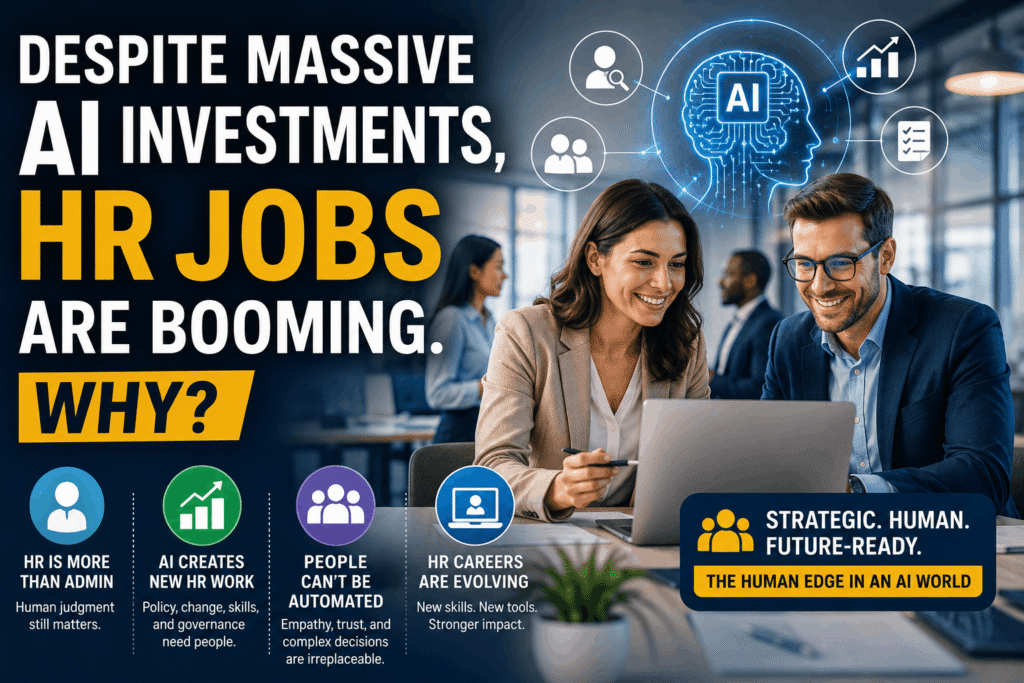
That’s one reason AI and HR jobs aren’t simply moving in opposite directions.
AI can handle certain pieces of HR work while increasing the need for people who can deal with situations that don’t have obvious answers.
The value isn’t in keeping every old task.
It’s in deciding which tasks should be automated and which should remain firmly in human hands.
AI Adoption Also Creates a Skills Problem
There is another reason HR may remain busy.
Companies don’t just need AI software.
They need employees who know how to use it properly.
That creates a workforce-planning problem.
A marketing employee may need to learn new AI tools.
A finance team may change how it prepares reports.
Customer service workers may spend less time answering routine questions and more time handling complicated cases.
Managers may need to supervise teams whose work now involves AI-assisted systems.
HR often sits in the middle of this shift.
It can help identify which skills are missing, where training is needed, and how job descriptions should change.
That work doesn’t disappear because the company bought an AI subscription.
In some cases, the purchase creates more of it.
AI Is Changing What HR Teams Spend Time On
The more useful question isn’t whether AI will remove HR work.
It’s which HR work will remain after AI takes over the repetitive pieces.
Consider an HR coordinator who once spent hours preparing reports, moving employee information between systems, and answering routine questions.
If software handles some of that work, the coordinator has a choice.
The company can reduce the role.
Or the person can spend more time on employee communication, manager support, workforce data, and problems that require context.
The outcome depends on how the employer uses the time that automation creates.
That’s an important distinction when discussing the future of HR jobs.
Technology doesn’t make the staffing decision.
Management does.
HR Hiring May Shift Toward Different Skills
The HR department itself is also likely to look for different capabilities.
Someone who understands AI tools but doesn’t understand people management isn’t automatically a great HR candidate.
Likewise, an experienced HR professional who refuses to learn new technology may eventually find parts of the job harder to handle.
The interesting candidates sit somewhere between those extremes.
They understand HR.
They can work with data.
They know how to question an AI-generated answer.
And they can explain complicated workplace issues without turning every conversation into a technical discussion.
That combination could become increasingly useful as AI in human resources moves from experiments into ordinary workplace processes.
HR Business Partners May Have Even More to Do
A large company doesn’t introduce AI in exactly the same way across every department.
Sales may use one set of tools.
Engineering may use another.
Customer service may automate different tasks altogether.
Someone needs to understand how those changes affect the workforce.
That’s where HR business partners can become important.
They may work with department leaders on staffing plans, new skills, role changes, team structures, and employee concerns.
The job isn’t simply “use AI.”
It’s figuring out what happens to people when the way they work changes.
That is a much harder problem.
Compliance Is Another Reason HR Isn’t Disappearing
Employment rules don’t vanish because a company starts using AI.
If anything, new technology can create additional questions.
Can an AI system be used to screen applicants?
How should employers document automated decisions?
What employee information can be entered into an external AI service?
How should workers be informed about AI-assisted processes?
The answers can vary depending on the situation, industry, and applicable laws.
For U.S. employers, these questions can become part of HR, legal, privacy, and compliance discussions.
That means organizations may need people who can understand both the technology and the workplace implications.
The Entry-Level HR Problem Is Worth Watching
There is one uncomfortable issue hidden inside all of this.
AI may reduce some of the routine work that traditionally helped junior employees learn HR.
An entry-level worker might once have spent hours preparing reports or organizing employee records.
Those tasks weren’t exciting.
But they taught the person how the organization worked.
If software handles much of that activity, employers have to think about how new HR professionals gain practical experience.
You can’t become a good HR business partner simply by reading policy documents.
You need exposure to managers, employees, hiring decisions, workplace disputes, and the small details that don’t appear in a database.
Companies may need to rethink the path from junior HR work to more senior responsibilities.
HR Jobs Won’t All Grow at the Same Rate
Saying HR jobs are growing doesn’t mean every HR position will see the same demand.
Some administrative work is easier to automate.
Some recruiting tasks can be handled by software.
Payroll and benefits platforms can reduce manual processing.
Routine employee questions can increasingly be answered through self-service systems.
Meanwhile, demand may remain stronger for roles involving workforce strategy, employee relations, organizational planning, specialized recruiting, HR technology, and AI-related governance.
The mix matters.
A company could have fewer people doing basic administration while adding specialists in areas created by new technology.
Looking only at the total number of HR employees can hide that change.
What This Means for People Building HR Careers
Someone starting an HR career in the U.S. shouldn’t assume that AI makes the field a bad choice.
But learning traditional HR processes alone may not be enough.
Understanding employment practices is still important.
So is knowing how businesses make hiring and workforce decisions.
Add data skills.
Learn how common HR software works.
Understand where AI can produce useful results and where human review is necessary.
And pay attention to the risks.
A future HR professional may spend less time entering information and more time checking whether the information being produced by automated systems is accurate, fair, and appropriate.
That is a different job.
Not necessarily a smaller one.
The Question HR Leaders Should Be Asking
The most useful question for an HR leader isn’t:
“How many HR employees can AI replace?”
It’s:
“What work should our HR team stop doing, and what work should we be doing more of?”
That forces a more honest discussion.
If a chatbot can answer a routine benefits question, let it handle the routine question.
If software can prepare a report in seconds, stop making an HR professional spend an afternoon building it manually.
Then use the saved time where a machine is less useful: talking to employees, helping managers, handling difficult cases, planning workforce needs, and making decisions that carry real consequences.
That’s where the story around HR jobs in the AI era gets more complicated than the usual replacement narrative.
AI can remove tasks.
It can also create new responsibilities.
And for HR, the second part may be one reason the department isn’t shrinking as quickly as many people expected.