Running a cleaning business today involves far more than assigning crews and checking completed jobs. Customers expect quick responses, accurate quotes, consistent service, and detailed reports. That’s why AI for Cleaning Businesses is becoming part of everyday operations for local and regional contractors. Instead of replacing employees, AI helps businesses organize work, reduce repetitive tasks, and make better decisions with the information they already collect.
Many owners hear the term artificial intelligence and picture expensive software designed for large corporations. The reality is much different. Most companies are already using AI in one form or another through scheduling platforms, customer service tools, reporting systems, and estimating software without realizing it.
Why Local Cleaning Companies Should Pay Attention
Large national contractors often have dedicated teams handling scheduling, customer communication, quality inspections, and reporting.
Smaller businesses don’t.
A local company might rely on one office manager to answer calls, prepare estimates, coordinate staff, invoice customers, and respond to service requests, all before lunch.
That workload creates bottlenecks.
AI helps reduce administrative pressure by automating routine work while allowing employees to spend more time helping customers.
For many Building Service Contractors, improving daily operations creates a bigger competitive advantage than simply adding new clients.
AI Doesn’t Replace Experience
Cleaning services depend on trust.
Customers notice clean floors, spotless restrooms, and well-maintained offices.
They also notice reliability.
No AI system can replace an experienced supervisor walking through a building before handing it back to a client.
Instead, Cleaning Business AI works behind the scenes.
It organizes schedules.
Flags missed tasks.
Summarizes customer requests.
Tracks recurring maintenance.
Suggests efficient routes for mobile crews.
Employees still make decisions.
AI simply removes many of the repetitive administrative tasks that slow the day down.
AI for Cleaning Businesses Starts With Everyday Tasks
Companies don’t need to redesign their entire operation before using AI.
The easiest improvements usually come from routine activities already happening every day.
For example:
- Automatically sorting customer emails.
- Scheduling recurring cleaning visits.
- Sending appointment reminders.
- Tracking employee arrival times.
- Preparing service reports.
- Organizing inspection records.
- Managing recurring invoices.
These small improvements often save several hours every week without changing how field crews perform their work.
Scheduling Is One of the First Places AI Makes a Difference
Scheduling sounds simple until several customers request last-minute service on the same morning.
One employee calls in sick.
Traffic delays another crew.
A commercial client needs emergency cleaning before opening.
Office staff suddenly begin rearranging schedules manually.
This is where AI in Commercial Cleaning becomes practical.
Modern scheduling platforms evaluate multiple factors at once.
Crew availability.
Travel distance.
Job duration.
Equipment requirements.
Customer priority.
Instead of moving appointments one by one, AI recommends schedules that reduce travel time while keeping commitments on track.
That means supervisors spend less time adjusting calendars and more time managing operations.
Estimating Jobs Becomes More Consistent
Creating accurate quotes takes experience.
Square footage matters.
Floor types matter.
Cleaning frequency matters.
Special requests matter too.
Many businesses rely on spreadsheets or handwritten notes when preparing estimates.
Over time, those methods produce inconsistent pricing.
Using AI Cleaning Software, contractors can review previous jobs, compare similar properties, and generate estimates based on historical project data.
The final decision still belongs to the estimator.
AI simply provides a stronger starting point.
That reduces pricing mistakes while making estimates more consistent across the business.
Customer Communication Doesn’t Have to Be Manual
Customers appreciate fast responses.
They don’t necessarily expect every reply to come directly from an employee.
Simple questions often repeat throughout the week.
“What time will the crew arrive?”
“Can I reschedule tomorrow’s visit?”
“Has the inspection report been completed?”
AI-powered communication tools can answer many routine questions immediately while forwarding more complex requests to office staff.
For local companies managing dozens of commercial properties, this reduces interruptions without lowering customer service standards.
The office spends less time repeating the same information and more time solving problems that actually require human attention.
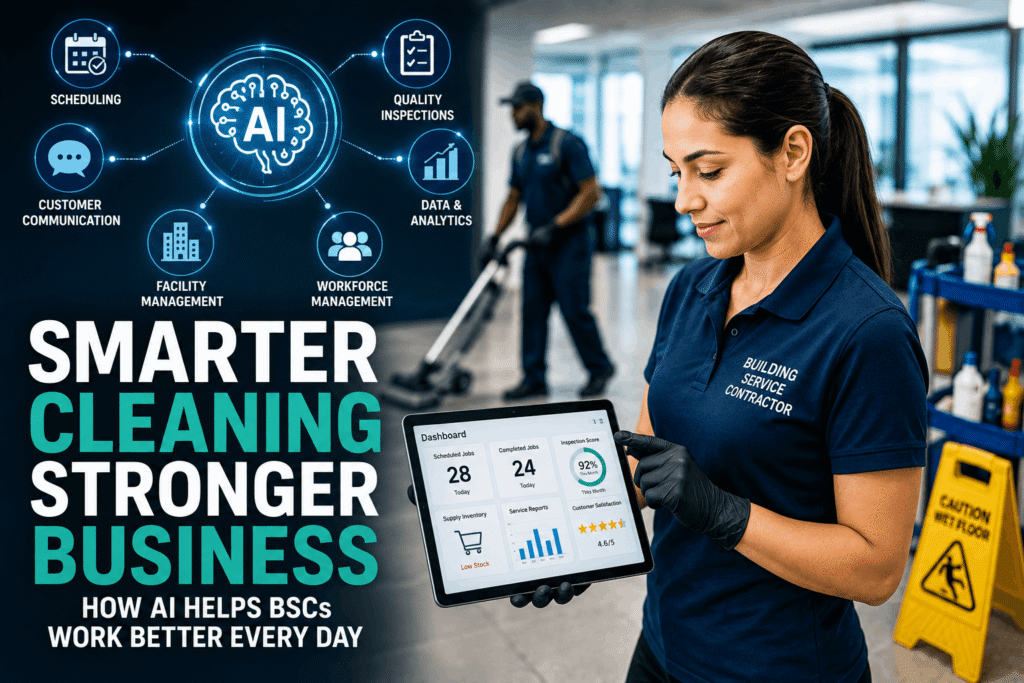
Reporting Takes Less Time
Many commercial contracts require proof that work has been completed.
Supervisors often collect inspection forms, photographs, maintenance notes, and employee reports before preparing documents for clients.
That process can consume hours every week.
Modern Commercial Cleaning Technology helps organize this information automatically.
Photos connect to the correct property.
Inspection results appear inside customer records.
Completed work orders generate reports with minimal manual input.
Instead of spending evenings compiling paperwork, managers can review reports before sending them to customers.
Better Decisions Start With Better Information
Every cleaning company collects data.
Some businesses simply don’t use it.
Job completion times.
Supply usage.
Employee attendance.
Customer feedback.
Inspection scores.
Equipment maintenance.
Viewed individually, these numbers offer limited value.
Combined, they reveal patterns.
Businesses using AI for Facility Management can identify locations requiring extra attention, customers requesting additional services, or recurring scheduling issues before they become larger problems.
That allows managers to make decisions based on measurable trends instead of assumptions.
Small Changes Usually Deliver the Biggest Results
Some owners delay adopting AI because they expect a complicated implementation.
Most successful projects begin much smaller.
One automated schedule.
One reporting tool.
One communication assistant.
After employees become comfortable, businesses gradually expand into other areas.
That approach reduces disruption while allowing staff to see practical improvements in their daily work.
For many Building Service Contractors, steady progress produces better results than trying to modernize everything at once.
Workforce Management Becomes Easier With AI
Finding reliable employees remains one of the biggest challenges for cleaning companies.
Managing them efficiently is another.
Supervisors often spend hours checking attendance, adjusting schedules, approving leave requests, and making last-minute phone calls when someone is unavailable.
This is where AI for Cleaning Businesses starts saving time every day.
Instead of reacting after problems appear, AI can identify scheduling conflicts before shifts begin. It reviews employee availability, certifications, travel distance, and previous assignments to recommend practical adjustments.
That doesn’t replace a manager’s judgment.
It simply gives them better information before making decisions.
For companies serving multiple commercial buildings across different locations, even small scheduling improvements can reduce overtime and unnecessary travel.
Quality Inspections Become More Consistent
Every customer expects the same standard of cleaning, regardless of which crew visits the property.
Maintaining that consistency becomes difficult as businesses grow.
Digital inspection tools powered by Cleaning Business AI allow supervisors to document completed work with photographs, inspection checklists, notes, and service records.
Instead of keeping paper reports in filing cabinets, everything stays connected to the customer account.
Managers can quickly identify recurring issues.
Perhaps one building consistently reports restroom complaints.
Another location regularly requires additional floor maintenance.
Rather than waiting for contract renewals to discover these patterns, businesses can respond immediately.
Inventory Doesn’t Have to Be Guesswork
Cleaning supplies disappear quickly.
Paper products.
Chemicals.
Trash liners.
Disinfectants.
Equipment parts.
Running out during a scheduled visit creates unnecessary delays.
Ordering too much increases storage costs.
Many AI Cleaning Software platforms monitor supply usage automatically.
By reviewing historical purchasing patterns and upcoming schedules, they estimate future demand more accurately than manual calculations.
Office staff spend less time checking inventory while reducing unnecessary purchases.
Choosing Software That Fits the Business
Every software demonstration promises faster growth and greater efficiency.
Not every platform delivers those results.
Local companies should evaluate technology based on practical business needs instead of impressive feature lists.
Questions worth asking include:
- Does it connect with existing accounting software?
- Can office staff learn it without weeks of training?
- Does it support mobile crews?
- Will customers benefit from using it?
- Can reports be customized for commercial contracts?
The best Commercial Cleaning Technology often feels simple because employees spend less time learning the system and more time using it.
Common AI Mistakes Cleaning Companies Should Avoid
Many implementation problems have nothing to do with the software itself.
They’re caused by unrealistic expectations.
One common mistake is trying to automate every process immediately.
Employees become overwhelmed.
Managers struggle to monitor several new systems at once.
Starting with one department usually produces better results.
Another mistake involves poor data.
Customer addresses.
Building access instructions.
Service frequencies.
Inspection records.
If this information isn’t accurate, AI recommendations become less reliable.
Technology works best when the information feeding it is clean and current.
Ignoring employee feedback creates another problem.
Field crews often notice practical issues that office staff never see.
Listening to those observations improves both operations and future AI recommendations.
Measuring Results Beyond Cost Savings
Saving money matters.
It’s only one part of the picture.
Businesses adopting AI for Facility Management should also monitor improvements affecting customers and employees.
Useful measurements include:
- Response times for service requests.
- Schedule accuracy.
- Customer retention.
- Inspection scores.
- Employee productivity.
- Repeat service contracts.
- Average quote turnaround time.
- Complaint resolution speed.
Tracking these numbers over several months provides a clearer picture of whether new technology is improving everyday operations.
Customers Notice Better Service Before They Notice AI
Clients rarely ask which software manages their cleaning schedule.
They notice different things.
Crews arrive on time.
Reports arrive faster.
Questions receive quicker responses.
Recurring issues disappear.
Invoices contain fewer mistakes.
Those improvements often come from behind-the-scenes automation rather than visible technology.
That’s why AI in Commercial Cleaning delivers its biggest value through better service instead of flashy features.
Customers remember consistent performance far longer than they remember the tools used to deliver it.
The Next Step Doesn’t Have to Be a Major Investment
Many owners assume adopting AI means replacing every existing system.
In practice, most businesses grow into it gradually.
A scheduling assistant today.
Smarter reporting next month.
Automated inspections after that.
Each improvement builds on the last without disrupting daily operations.
For Building Service Contractors, this steady approach makes adoption more manageable while allowing employees to adjust naturally.
Over time, these individual improvements create a more organized business, one that’s easier to manage, easier to scale, and better prepared to meet growing customer expectations.