Cloud adoption has solved plenty of business problems. It has also introduced new security challenges.
An organization might use Microsoft 365 for collaboration, AWS for application hosting, Azure for analytics, and Google Cloud for machine learning. Each environment has its own security risks, making it difficult to protect everything with a single tool.
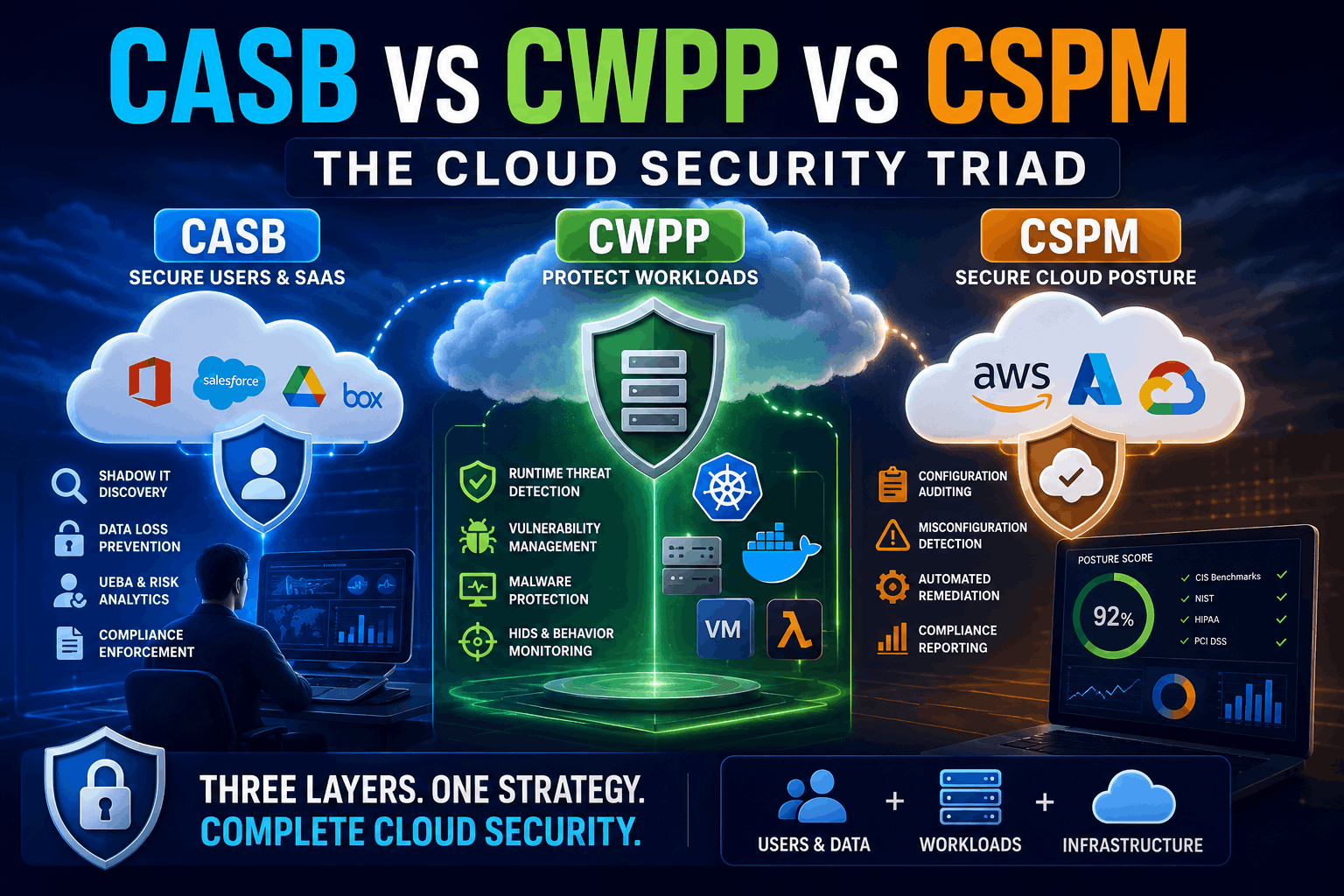
This is where the comparison of CASB vs CWPP vs CSPM becomes important. These three technologies protect different parts of a cloud environment rather than competing with one another. Together, they form the cloud security triad, helping organizations secure SaaS applications, runtime workloads, and cloud infrastructure across multiple providers.
Understanding where each solution fits makes it easier to build a security strategy that closes gaps instead of creating unnecessary overlap.
The Growing Complexity of Multi-Cloud Security
A decade ago, protecting a corporate network mostly meant securing on-premises servers and employee devices.
Today’s environments look very different.
A single application might rely on Kubernetes running in AWS, authenticate users through Microsoft Entra ID, store files in Amazon S3, and integrate with Salesforce. Employees connect from home offices, airports, and personal devices.
Every connection creates another security consideration.
Attackers no longer target only traditional networks. They look for exposed storage buckets, excessive IAM permissions, vulnerable containers, compromised SaaS accounts, and misconfigured cloud resources.
Because cloud environments are distributed, security must also be distributed.
No single platform can effectively protect every layer.
Why Traditional Security Tools Fall Short
Traditional firewalls and endpoint protection still play an important role.
They simply weren’t designed for today’s cloud-native infrastructure.
For example:
- A firewall cannot detect an employee uploading confidential files to a personal Google Drive account.
- Antivirus software cannot identify an AWS storage bucket that has been accidentally exposed to the public internet.
- Endpoint security alone cannot continuously monitor Kubernetes containers running across multiple cloud providers.
Modern cloud environments require visibility beyond the network perimeter.
Organizations now need specialized tools that understand SaaS applications, cloud workloads, and cloud configurations.
What Is the Cloud Security Triad?
The cloud security triad is a practical way to understand three complementary security technologies.
Each focuses on protecting a different layer of a cloud environment.
| Security Layer | Primary Technology | Main Focus |
| SaaS & Data | Cloud Access Security Broker (CASB) | User access, cloud applications, and sensitive data |
| Runtime Workloads | Cloud Workload Protection Platform (CWPP) | Virtual machines, containers, Kubernetes, and serverless workloads |
| Cloud Infrastructure | Cloud Security Posture Management (CSPM) | Cloud configuration, IAM policies, compliance, and misconfigurations |
Rather than replacing one another, these solutions work together.
Think of them as specialists.
A CASB understands user activity.
A CWPP protects applications while they are running.
A CSPM continuously checks whether the cloud environment itself has been configured securely.
That separation is one reason many enterprises deploy all three technologies.
Deep Dive: Cloud Access Security Broker (CASB)
A cloud access security broker sits between users and cloud services, enforcing security policies before data reaches SaaS applications.
As organizations adopted cloud software, security teams lost visibility into how employees were using external services.
Sensitive documents could be uploaded to personal storage accounts.
Unauthorized SaaS applications appeared across departments.
Employees accessed corporate data from unmanaged devices.
A CASB restores that visibility without disrupting legitimate business activity.
What Does a Cloud Access Security Broker Protect?
Unlike infrastructure security tools, CASB focuses on cloud applications and the information moving between users and those services.
Typical protected platforms include:
- Microsoft 365
- Google Workspace
- Salesforce
- Dropbox
- Box
- ServiceNow
- Slack
Instead of protecting servers, CASB protects the data people interact with every day.
Core Capabilities of CASB
Although features vary between vendors, most enterprise CASB solutions provide several core capabilities.
Shadow IT Discovery
Employees frequently adopt cloud applications without IT approval.
This is known as Shadow IT.
A CASB identifies these applications, measures their risk level, and helps security teams decide whether they should be approved, restricted, or blocked.
Data Loss Prevention (DLP)
One of the biggest concerns in cloud environments is accidental data exposure.
CASB platforms inspect files moving into or out of SaaS applications.
If someone attempts to upload confidential customer records, financial information, or regulated data, predefined policies can block or restrict that action.
API-Based Visibility
Modern CASB platforms don’t always rely on proxy deployments.
Many integrate directly with cloud applications through APIs.
This approach allows security teams to:
- Scan stored files
- Detect risky sharing permissions
- Monitor user activity
- Identify sensitive information
- Apply security policies without affecting user performance
API integration has become especially valuable for organizations managing hundreds of SaaS applications.
User and Entity Behavior Analytics (UEBA)
Not every attack begins with malware.
Sometimes attackers simply steal valid user credentials.
CASB platforms use User and Entity Behavior Analytics (UEBA) to establish normal user behavior and identify unusual activity.
Examples include:
- Logging in from unexpected countries
- Downloading unusually large amounts of data
- Accessing sensitive files outside normal business hours
- Multiple failed authentication attempts
Instead of relying only on predefined rules, UEBA helps identify behavior that doesn’t match established patterns.
When Should Organizations Prioritize CASB?
CASB is often the first cloud security investment for organizations that depend heavily on SaaS applications.
It becomes especially valuable when businesses:
- Support remote or hybrid employees
- Allow Bring Your Own Device (BYOD)
- Store sensitive information in cloud applications
- Need stronger data loss prevention
- Want greater visibility into cloud application usage
For organizations building a broader cloud security strategy, understanding Cloud Access Security Broker architecture provides a strong foundation before evaluating workload and infrastructure protection platforms.
Deep Dive: Cloud Workload Protection Platform (CWPP)
If CASB protects users and SaaS applications, cloud workload protection focuses on what runs inside your cloud environment.
Applications don’t run on their own.
They rely on virtual machines, containers, Kubernetes clusters, operating systems, and serverless functions. Each workload introduces another attack surface, and every new deployment creates another opportunity for attackers.
That’s where a Cloud Workload Protection Platform (CWPP) fits into the cloud security triad.
Instead of monitoring user behavior, CWPP protects workloads while they’re running.
What Does Cloud Workload Protection Secure?
A CWPP is designed for runtime environments across public and private clouds.
Typical assets include:
- Linux servers
- Windows servers
- Virtual machines
- Docker containers
- Kubernetes clusters
- Amazon ECS
- Amazon EKS
- Azure Kubernetes Service (AKS)
- Google Kubernetes Engine (GKE)
- Serverless functions such as AWS Lambda and Azure Functions
As organizations adopt microservices and containerized applications, protecting workloads becomes just as important as protecting user identities.
Core Capabilities of CWPP
Although vendors differ, most cloud workload protection platforms include several key security controls.
Runtime Threat Detection
Traditional vulnerability scans identify problems before deployment.
CWPP continues monitoring after deployment.
If ransomware begins encrypting files or an attacker launches a malicious process inside a container, runtime detection identifies suspicious behavior immediately.
Vulnerability Management
Cloud workloads constantly change.
New software packages introduce new vulnerabilities.
CWPP continuously scans workloads for:
- Outdated software
- Missing security patches
- Known CVEs
- Weak system configurations
- Unsupported operating systems
Security teams can prioritize remediation based on actual business risk instead of manually reviewing thousands of findings.
Malware Protection
Malware hasn’t disappeared simply because applications moved to the cloud.
Modern workloads still face threats such as:
- Cryptominers
- Remote access trojans
- Fileless malware
- Rootkits
- Ransomware
CWPP platforms monitor workload behavior to identify malicious activity before it spreads across production environments.
Host Intrusion Detection (HIDS)
Many enterprise CWPP solutions include Host-based Intrusion Detection Systems.
These systems monitor:
- File integrity
- Unauthorized privilege escalation
- Unexpected process execution
- Configuration changes
- Suspicious system activity
This visibility helps security teams detect attacks that traditional network security tools might miss.
When Should Organizations Deploy CWPP?
Organizations usually prioritize CWPP when they:
- Run Kubernetes in production
- Host customer-facing applications in AWS, Azure, or Google Cloud
- Deploy containerized applications frequently
- Use DevOps or DevSecOps pipelines
- Operate large numbers of cloud servers
Without runtime protection, workloads remain exposed even if cloud infrastructure itself is configured correctly.
Deep Dive: Cloud Security Posture Management (CSPM)
Not every cloud security incident begins with malware.
Many begin with simple configuration mistakes.
An exposed storage bucket.
An overly permissive IAM role.
A forgotten development server connected directly to the internet.
These mistakes are surprisingly common.
Cloud Security Posture Management (CSPM) focuses on finding those weaknesses before attackers do.
Unlike CWPP, CSPM doesn’t monitor running applications.
Instead, it evaluates cloud infrastructure itself.
What Does Cloud Security Posture Management Protect?
A CSPM platform continuously assesses cloud environments for configuration risks.
Typical resources include:
- AWS accounts
- Microsoft Azure subscriptions
- Google Cloud projects
- IAM policies
- Security groups
- Virtual networks
- Storage buckets
- Databases
- Identity permissions
- Encryption settings
Rather than protecting workloads, CSPM protects the environment where those workloads operate.
Core Capabilities of CSPM
Continuous Configuration Auditing
Cloud environments change constantly.
Developers deploy resources.
Administrators modify permissions.
Automation scripts create infrastructure.
CSPM continuously checks whether those changes introduce security risks.
Instead of waiting for scheduled audits, organizations receive immediate visibility into configuration drift.
Misconfiguration Detection
Misconfigurations remain one of the leading causes of cloud data exposure.
A CSPM solution automatically detects issues such as:
- Publicly accessible storage buckets
- Open management ports
- Weak IAM permissions
- Disabled encryption
- Missing multi-factor authentication
- Overly permissive security groups
These findings allow security teams to respond before attackers discover them.
Compliance Monitoring
Many industries must demonstrate compliance with security frameworks.
Modern CSPM platforms continuously evaluate cloud environments against standards including:
- CIS Benchmarks
- NIST Cybersecurity Framework
- HIPAA
- PCI DSS
- ISO 27001
- SOC 2
Instead of preparing for annual audits, organizations maintain continuous compliance visibility.
Automated Remediation
Identifying problems is only part of the process.
Many CSPM platforms also automate remediation.
Examples include:
- Closing unnecessary firewall rules
- Enabling encryption
- Removing excessive permissions
- Disabling public storage access
- Applying recommended cloud security policies
Automation reduces response time while minimizing human error.
When Should Organizations Choose CSPM?
CSPM becomes essential when organizations:
- Operate across multiple cloud providers
- Need continuous compliance monitoring
- Manage large IAM environments
- Deploy infrastructure through Infrastructure as Code (IaC)
- Require better visibility into cloud configurations
It is especially valuable for enterprises managing hundreds or thousands of cloud resources.
CASB vs CWPP vs CSPM Comparison Table
| Feature | CASB | CWPP | CSPM |
| Primary Focus | SaaS applications and cloud data | Runtime workloads | Cloud infrastructure |
| Protects | Users, SaaS, sensitive data | VMs, containers, Kubernetes, serverless | AWS, Azure, GCP configurations |
| Operating Layer | Application Layer | Runtime Layer | Control Plane |
| Primary Threat | Data loss and Shadow IT | Malware and runtime attacks | Misconfigurations and compliance drift |
| Deployment | API or Proxy | Host Agent or Agentless | Agentless API |
| Typical Users | Security Operations | DevOps and DevSecOps | Cloud Security and Compliance Teams |
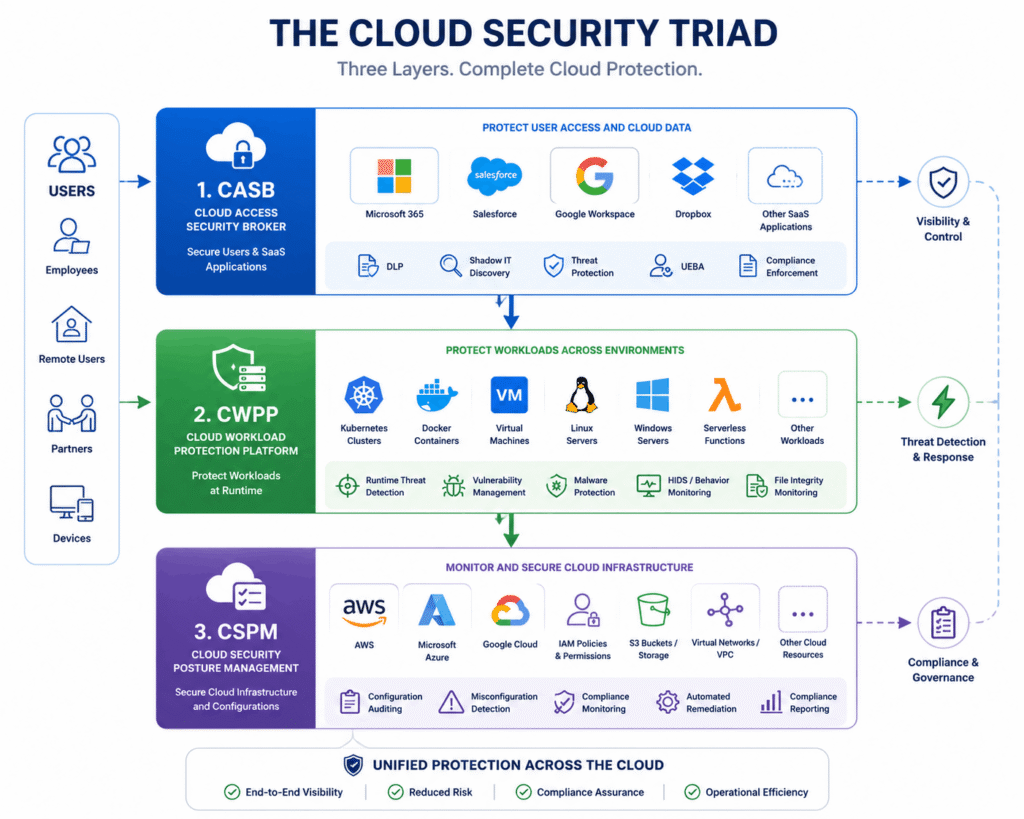
Architecture of the Cloud Security Triad
CLOUD SECURITY TRIAD
Users
│
▼
┌─────────────────────────────┐
│ CASB │
│ SaaS • User Access • DLP │
│ Microsoft 365 • Salesforce │
└─────────────────────────────┘
│
▼
┌─────────────────────────────┐
│ CWPP │
│ VMs • Containers • Docker │
│ Kubernetes • Serverless │
└─────────────────────────────┘
│
▼
┌─────────────────────────────┐
│ CSPM │
│ AWS • Azure • Google Cloud │
│ IAM • Storage • Compliance │
└─────────────────────────────┘
Do CASB, CWPP, and CSPM Overlap?
There is some overlap, but not enough for one platform to replace the others.
A CASB may detect risky user behavior.
A CWPP may identify malware running inside a Kubernetes cluster.
A CSPM may discover that the cluster itself was deployed with insecure permissions.
Each tool answers a different question:
- CASB: Who is accessing cloud services, and what are they doing?
- CWPP: Are workloads secure while they’re running?
- CSPM: Is the cloud environment configured securely?
Viewed together, the three technologies create a layered defense strategy rather than three competing products.
Real-World Enterprise Scenarios: When Do You Need CASB, CWPP, or CSPM?
Understanding the technical differences is useful.
Knowing where each solution fits in a real environment is even more valuable.
Every organization has different priorities. A software company running Kubernetes faces different risks than a financial institution storing customer data in Microsoft 365.
The right starting point depends on what you’re trying to protect.
Scenario A: Securing SaaS Applications and a Remote Workforce
A consulting company has adopted:
- Microsoft 365
- Google Workspace
- Salesforce
- Slack
- Dropbox
Employees work remotely from different countries using both company-issued laptops and personal devices.
The biggest risks aren’t malware inside cloud servers.
They’re:
- Employees sharing confidential files publicly
- Shadow IT
- Unauthorized SaaS applications
- Data exfiltration
- Stolen user credentials
In this case, Cloud Access Security Broker (CASB) should be the first investment.
A CASB gives security teams visibility into user behavior, enforces Data Loss Prevention (DLP) policies, and detects risky account activity before sensitive information leaves approved applications.
Recommended Priority: ⭐⭐⭐⭐⭐
Scenario B: Running Kubernetes and Containerized Applications
A SaaS company deploys new software several times each day using:
- Docker
- Kubernetes
- AWS EKS
- Azure Kubernetes Service
- GitHub Actions
Developers continuously release updates.
The infrastructure itself is secure, but production workloads need protection against runtime attacks, malware, privilege escalation, and vulnerable container images.
This is where Cloud Workload Protection (CWPP) becomes essential.
CWPP continuously monitors workloads after deployment rather than stopping once vulnerability scans finish.
Recommended Priority: ⭐⭐⭐⭐⭐
Scenario C: Managing AWS, Azure, and Google Cloud
A multinational organization operates across three cloud providers.
Different teams deploy infrastructure independently.
Over time, cloud environments become difficult to monitor.
Security teams begin discovering:
- Public storage buckets
- Overly permissive IAM roles
- Disabled encryption
- Open management ports
- Compliance violations
The biggest challenge isn’t workload security.
It’s cloud governance.
Cloud Security Posture Management (CSPM) continuously audits cloud accounts and identifies configuration risks before attackers can exploit them.
Recommended Priority: ⭐⭐⭐⭐⭐
Scenario D: Large Enterprise with Hybrid Cloud
Large organizations rarely have only one security challenge.
A typical enterprise might have:
- Thousands of Microsoft 365 users
- Hundreds of Kubernetes clusters
- AWS production workloads
- Azure development environments
- Google Cloud analytics
- Multiple SaaS platforms
Deploying only CASB, CWPP, or CSPM would leave significant blind spots.
The most effective strategy combines all three technologies into a layered security architecture.
Choosing the Right Solution
Many buyers search for CASB vs CWPP vs CSPM expecting one product to outperform the others.
That’s not how these platforms are designed.
Instead of asking which solution is “best,” ask which layer needs protection.
| Business Requirement | Recommended Solution |
| Secure Microsoft 365, Google Workspace, Salesforce | CASB |
| Protect Kubernetes, Docker, and VMs | CWPP |
| Audit AWS, Azure, and GCP configurations | CSPM |
| Build enterprise-wide cloud security | CASB + CWPP + CSPM |
Each solution addresses a different risk.
The strongest security programs combine them rather than choosing only one.
How CNAPP Brings the Cloud Security Triad Together
Managing multiple security platforms can become difficult as cloud environments grow.
Organizations often end up with separate dashboards for SaaS protection, workload security, vulnerability management, and cloud configuration monitoring.
This fragmentation slows investigations and increases operational overhead.
That challenge has driven the rise of Cloud-Native Application Protection Platforms (CNAPP).
Rather than replacing the cloud security triad, CNAPP brings these capabilities together under a unified platform.
A modern CNAPP typically combines:
- CASB
- CWPP
- CSPM
- Cloud Infrastructure Entitlement Management (CIEM)
- Cloud Detection and Response (CDR)
- Vulnerability Management
- Infrastructure as Code (IaC) scanning
- Container Security
- Kubernetes Security
Instead of switching between multiple products, security teams gain centralized visibility across users, workloads, applications, identities, and cloud infrastructure.
For organizations building cloud-native environments, CNAPP represents the next stage in cloud security maturity.
CASB vs CWPP vs CSPM: Frequently Asked Questions
Can CASB replace CSPM?
No.
CASB protects users, SaaS applications, and cloud data.
CSPM continuously monitors cloud infrastructure for configuration risks and compliance issues.
They solve different problems.
Is CWPP only for containers?
No.
Although Kubernetes security is a major use case, CWPP also protects:
- Virtual machines
- Physical servers
- Cloud instances
- Serverless functions
- Hybrid workloads
Can small businesses benefit from CSPM?
Yes.
Even small cloud environments can suffer from exposed storage buckets, weak IAM policies, or configuration errors.
Automated posture management reduces those risks regardless of organization size.
What is the difference between CNAPP and the Cloud Security Triad?
The cloud security triad describes three individual security categories:
- CASB
- CWPP
- CSPM
CNAPP combines these technologies into one integrated platform with additional cloud-native security capabilities.
Final Thoughts
Cloud security has become too complex for one product to handle every challenge.
A Cloud Access Security Broker protects how users interact with SaaS applications.
A Cloud Workload Protection Platform secures applications while they run.
A Cloud Security Posture Management solution continuously evaluates cloud infrastructure for configuration risks and compliance gaps.
Understanding CASB vs CWPP vs CSPM isn’t about choosing a winner.
It’s about building a layered security strategy that protects every stage of your cloud environment, from user access to application workloads and the infrastructure supporting them.
As organizations continue expanding across AWS, Microsoft Azure, and Google Cloud, combining these technologies, or adopting a modern CNAPP platform, provides stronger visibility, better risk management, and a more resilient cloud security posture.