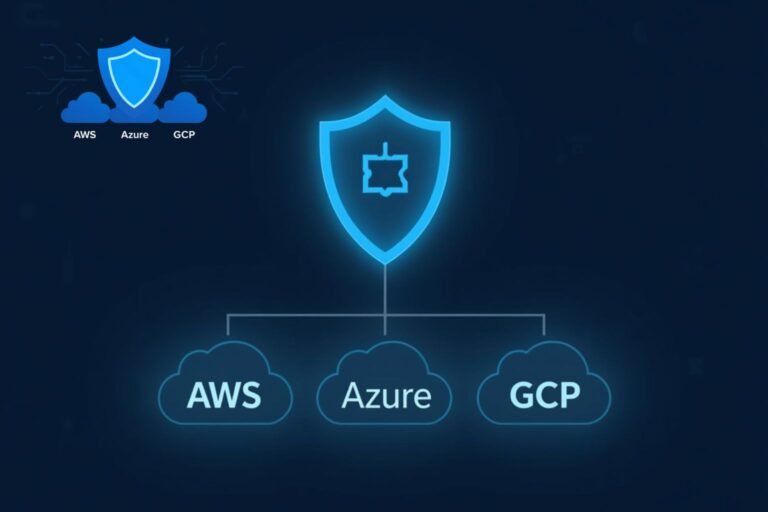
Cloud adoption has transformed the way businesses operate, but it has also introduced new security challenges. Employees access company applications from different devices, work remotely, and share information across multiple cloud platforms every day. Traditional security tools often struggle to monitor these activities effectively. That’s why Cloud Access Security Brokers have become an essential part of modern cybersecurity, helping organizations secure cloud environments without slowing business operations.
A decade ago, protecting an organization mostly meant defending the corporate network.
Today, business applications live in the cloud.
Employees connect from home offices.
Partners access shared platforms.
Customers expect digital services around the clock.
The security perimeter has expanded far beyond office walls.
Businesses now need visibility into every cloud interaction instead of simply monitoring internal networks.
What Are Cloud Access Security Brokers?
Cloud Access Security Brokers (CASBs) act as an intelligent security layer between users and cloud applications.
Rather than replacing existing security infrastructure, they extend protection into cloud environments where traditional firewalls have limited visibility.
Every time a user connects to a cloud application, a CASB can evaluate that session against organizational security policies.
This enables businesses to monitor activity, enforce access rules, and reduce security risks without disrupting everyday workflows.
Organizations use CASBs to support secure access across:
- Cloud storage platforms
- Collaboration software
- CRM systems
- Productivity suites
- Business applications
- Remote work environments
As cloud adoption increases, this additional layer of protection becomes increasingly valuable.
Why Modern Businesses Need Better Cloud Security
Cloud technology has improved flexibility for businesses of every size.
Teams collaborate faster.
Applications are easier to deploy.
Employees work from virtually anywhere.
These advantages also increase the number of potential security risks.
Sensitive files may be downloaded onto unmanaged devices.
Employees sometimes use unauthorized cloud applications.
Third-party vendors require temporary access to internal systems.
Without proper visibility, organizations may not recognize risky activity until after sensitive information has already been exposed.
Strong cloud security depends on continuously monitoring how users interact with cloud services rather than simply protecting office networks.
This shift has made CASBs an important part of enterprise cybersecurity strategies.
Supporting Zero Trust Security
Many organizations are moving toward Zero Trust security frameworks.
Instead of automatically trusting users after they log in, every request is continuously evaluated.
Identity alone is no longer enough.
Businesses also consider:
- Device security
- User location
- Login behavior
- Access history
- Requested resources
- Risk level
A CASB supports this approach by monitoring each cloud session in real time.
If suspicious behavior appears, additional authentication can be requested or access can be restricted automatically.
This continuous verification reduces opportunities for unauthorized access while allowing legitimate users to continue working normally.
Protecting Modern SaaS Security
Businesses now rely on dozens of Software-as-a-Service applications every day.
Email platforms.
Project management software.
Video conferencing.
Document collaboration.
Customer relationship management systems.
Every application increases operational efficiency.
It also creates another potential entry point for cyber threats.
Strong SaaS security means understanding exactly how these applications are being used.
A CASB provides visibility into cloud application activity while helping organizations enforce consistent security policies across multiple platforms.
Examples include:
- Preventing unauthorized file downloads
- Blocking risky third-party applications
- Monitoring external file sharing
- Restricting access from unmanaged devices
- Detecting unusual login activity
Rather than limiting productivity, these controls help employees use cloud applications more safely.
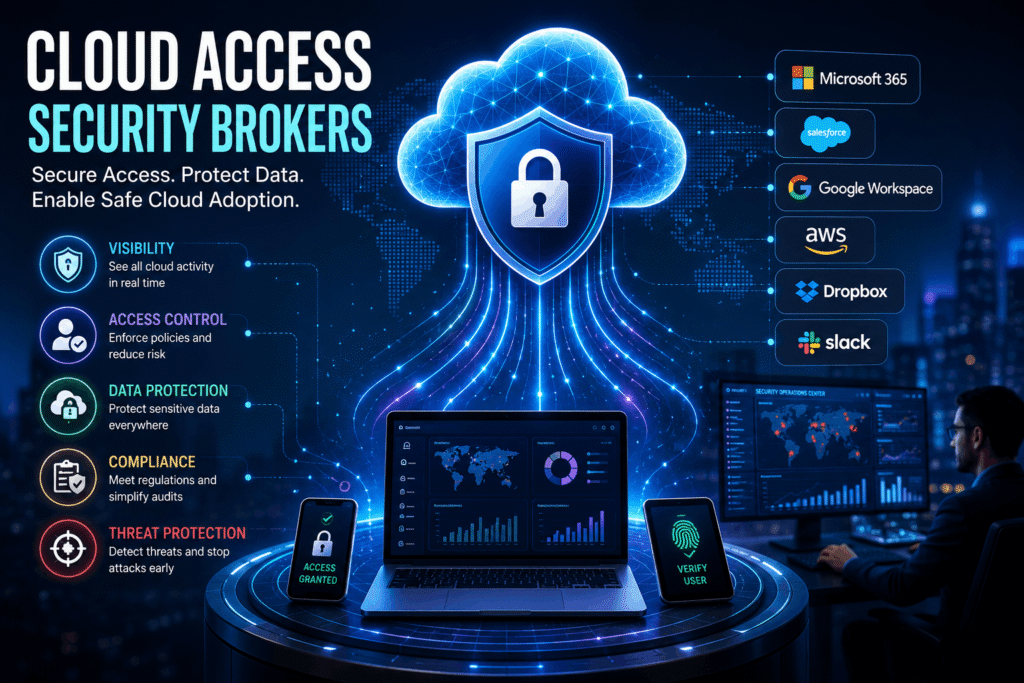
Improving Cloud Access Control
Managing user permissions across multiple cloud platforms can quickly become complicated. Different applications often have different permission structures. Manual administration increases the possibility of configuration errors. Effective cloud access control simplifies this process by applying centralized security policies.
For example, employees accessing approved business applications from company devices may receive full permissions.
Users connecting from unfamiliar devices or unusual locations can automatically receive limited access until additional verification is completed. This adaptive approach balances convenience with security. Instead of applying identical rules to every situation, organizations make decisions based on context.
Strengthening Cloud Data Protection
Information has become one of the most valuable assets businesses own.
Customer records.
Financial reports.
Employee information.
Intellectual property.
Contracts.
Protecting these assets requires more than encrypted storage.
Modern cloud data protection focuses on understanding where sensitive information moves and who can access it. CASBs help classify sensitive data before applying security policies automatically. If confidential information is uploaded to unauthorized applications or shared outside approved groups, security teams can receive alerts immediately. Some organizations also configure automated responses that block risky activity before data leaves the business environment. This proactive protection reduces accidental exposure while supporting regulatory compliance.
Enhancing Security Policy Enforcement
Creating security policies is only the first step.
Applying them consistently across dozens of cloud applications is where many organizations face challenges.
Every SaaS platform has its own settings, permission structure, and sharing options.
Managing each one individually increases administrative effort and leaves room for human error.
This is where security policy enforcement becomes far more effective.
A CASB enables organizations to create centralized rules that apply across multiple cloud environments.
For example, businesses can automatically:
- Block public sharing of confidential files
- Restrict downloads containing sensitive information
- Prevent uploads to unauthorized cloud services
- Require multi-factor authentication for high-risk logins
- Detect unusual account behavior
- Alert security teams about policy violations
Instead of depending on employees to remember security guidelines, policies are enforced automatically across the organization.
Supporting Cloud Compliance
Many industries operate under strict regulations regarding how customer and business data is stored, processed, and shared.
Healthcare providers protect patient records.
Financial institutions secure banking information.
Government agencies manage classified data.
Legal firms handle confidential client documents.
Meeting these requirements becomes increasingly difficult as organizations adopt more cloud applications.
Strong cloud compliance depends on visibility.
Businesses need to understand where sensitive information resides, who has access to it, and whether company policies are being followed consistently.
A CASB simplifies this process by monitoring cloud activity and maintaining detailed audit records.
Compliance teams can review centralized reports instead of collecting information from multiple disconnected systems.
This reduces audit preparation time while helping organizations demonstrate regulatory compliance more efficiently.
Improving Cloud Threat Protection
Cyber threats continue evolving alongside cloud technology.
Attackers increasingly target cloud accounts through stolen credentials, phishing campaigns, and unauthorized application access. Traditional security tools often detect these incidents only after suspicious activity has already occurred. Modern cloud threat protection focuses on identifying risks much earlier.
CASBs continuously analyze user behavior to detect anomalies such as:
- Multiple failed login attempts
- Large downloads outside business hours
- Logins from unfamiliar countries
- Unusual file-sharing activity
- Access from unmanaged devices
- Unexpected administrator actions
Not every unusual event represents an attack. However, identifying these patterns early allows security teams to investigate before significant damage occurs. Reducing response time often limits both operational disruption and financial losses.
Common Mistakes Organizations Should Avoid
Deploying a CASB doesn’t automatically solve every cloud security challenge.
One common mistake is implementing security controls without understanding how employees actually use cloud applications. If legitimate workflows become too restrictive, employees may begin using unauthorized software outside approved environments. Another issue involves treating every cloud application with identical security policies. Different business systems carry different levels of risk.
Customer databases require stronger controls than public collaboration platforms.
Security policies should reflect the sensitivity of the information being protected.
Regular reviews are equally important.
Cloud services evolve rapidly.
Applications introduce new features.
Business requirements change.
Organizations that periodically update their CASB policies maintain stronger security while avoiding unnecessary operational disruptions.
Choosing the Right CASB Strategy
Every organization has unique cloud requirements.
Some businesses primarily use productivity software.
Others operate hundreds of SaaS applications across multiple departments.
Selecting an effective CASB strategy begins with understanding the business itself.
Decision-makers should evaluate:
- Number of cloud applications
- Remote workforce requirements
- Regulatory obligations
- Existing identity management systems
- Current cybersecurity infrastructure
- Future cloud adoption plans
A well-planned implementation integrates smoothly with existing security investments rather than replacing them entirely.
Businesses should also prioritize scalability so security capabilities continue growing alongside cloud adoption.
The Future of Enterprise Cloud Security
Cloud computing continues expanding across every industry.
Artificial intelligence, hybrid work environments, and connected business applications are increasing the amount of sensitive information moving beyond traditional corporate networks.
Protecting these environments requires security models that adapt continuously rather than relying on static perimeter defenses.
This shift is making enterprise cloud security more proactive.
Instead of responding only after incidents occur, organizations are increasingly using intelligent monitoring, behavioral analytics, automated policy enforcement, and real-time visibility to reduce risk before threats escalate.
Businesses that combine Cloud Access Security Brokers, cloud security, Zero Trust security, SaaS security, cloud access control, cloud data protection, security policy enforcement, cloud compliance, cloud threat protection, and a comprehensive enterprise cloud security strategy are better equipped to secure modern cloud environments while supporting productivity, regulatory compliance, and long-term digital transformation.