Hey there, fellow small corporation proprietor. If you are on foot with a group of ten humans and juggling leads, patron emails, follow-ups, and income pipelines on spreadsheets or sticky notes, you’ve possibly puzzled about Free vs paid CRM. In 2026, the choice isn’t just about saving a couple of dollars; it is about choosing a device that certainly lets your CRM for small companies grow without consuming up some time or charging a variety. Whether you are a solopreneur in (USA, UK) scaling your issuer business employer or a startup founder monitoring each deal, the proper purchaser relationship management system can boost revenue by way of manner of as much as 29% and productiveness by way of the use of 34%, according to organization benchmarks. But with AI-powered capabilities exploding this year, deciding between the free CRM and a paid one feels more puzzling than ever. Let’s smash it down collectively, certainly and without the income pitch.
Why Small Businesses Need CRM in 2026
Running a small agency in 2026 means competing in a world in which customers count on on-the-spot responses, personalised offers, and seamless reviews across email, chat, and calls. A strong CRM for small businesses is now not a “pleasant-to-have”; it’s miles your fundamental hub for touch control, deal monitoring, and customer insights. Without it, you’re losing ground to forgetfulness, duplicating efforts, and missing growth possibilities.
Think about it: AI is now mainstream in most tools, helping with lead scoring, email writing, and even predicting when a customer might churn. Small teams that adopt the right system report an average $8.71 return for every $1 invested. Yet many owners still hesitate because of cost fears. That’s where the free vs paid CRM conversation starts. Free options get you in the door fast, but paid plans unlock the automation and scalability you need as you hit 50–100 contacts or add team members.
In 2026, CRM trends lean heavily toward AI integration, no-code workflows, and hyper-personalization. Your small business CRM should handle omnichannel communication and give you real-time dashboards without requiring a tech expert. The goal? Spend less time on admin and more time closing sales and delighting customers.
The Allure of Free CRM Solutions for Startups
Let’s be real, most people start with zero finances for a fancy software program. That’s why the best free CRM alternatives like HubSpot CRM, Zoho CRM’s loose tier, and Freshsales have turned out to be lifesavers for startups and micro-teams. These tools permit you to manipulate contacts, music deals in a simple pipeline, log emails, or even schedule meetings, interested in $0.
HubSpot’s unfastened CRM, for example, offers limitless customers (with some contact and electronic mail limits of 1,000 contacts and a pair of,000 emails/month) and primary marketing tools.
It’s perfect if you’re organizing your Gmail chaos into one place. Zoho CRM’s free plan supports up to three users with core features like task management and basic reporting. Freshsales throws in phone support and a clean dashboard for up to three users, too.
The big win? You test the waters risk-free. No credit card, no long-term commitment. Many small business owners I speak with love starting here because setup takes minutes, not days. You centralize customer data, stop losing leads, and get a feel for what a proper pipeline looks like. Plus, in 2026, even free ranges encompass simple AI helpers like smart electronic mail pointers or easy lead scoring that make you experience fantastically contemporary.
For bootstrapped groups or solopreneurs, unfastened CRM means you can focus coins on product improvement or advertising and marketing as opposed to software program subscriptions. It’s empowering. You prove your system works before investing.
Where Free CRM Shows Its Limits
But here’s the truth, most reviews gloss over: free isn’t always free when your business starts moving. Limits sneak up fast and quietly cost you time and money.
Most free CRM plans cap users at 2–3, contacts at 1,000–5,000, and storage space. Automation? Usually locked. Advanced reporting? Basic at best. Want AI-powered predictive insights or custom workflows? You’ll hit a wall. Support is often email-only with long wait times.
I hear stories all the time: A service business in its growth phase suddenly needs five team members logging calls and deals boom, they outgrow the free plan overnight. Manual data entry eats hours. Missed follow-ups cost deals. One founder told me switching later meant exporting messy data and retraining everyone, losing weeks of momentum.
Hidden costs add up. That “loose” hour you spend copying data among gears may be $50–a hundred in opportunity cost. Poor analytics means you are flying blind on which leads truly convert. And whilst customers anticipate custom-designed, lightning-fast carriers in 2026, fundamental loose tools begin feeling vintage.
Free works well for extremely early ranges or simple goals. But whilst you’re excessive about scaling, those limits become friction that slows you down.
Free vs Paid CRM: Breaking Down the Differences
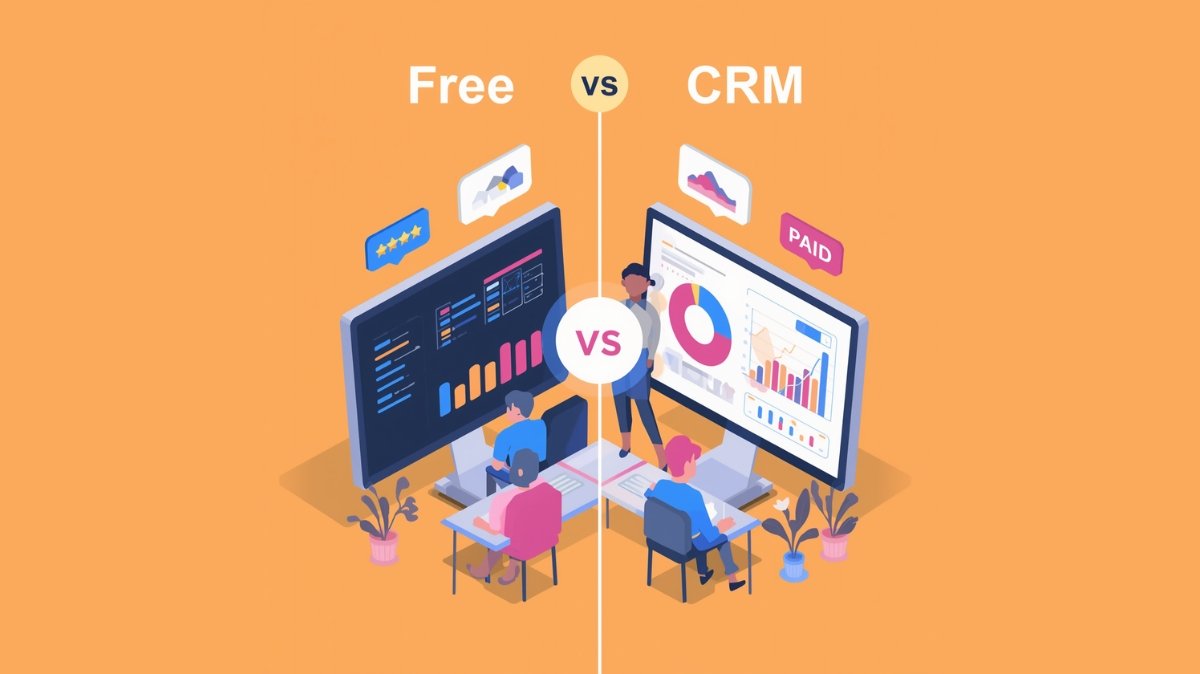
So permit’s without delay cope with the free vs paid CRM question with clear eyes. The middle difference is not simply a charge; it is functionality and scalability.
Free CRMs deliver necessities: contact and company data, primary pipelines, e-mail tracking, and project reminders. They’re light-weight and short to adopt. Paid CRMs (beginning at $14–25 regular with person/month) offer unlimited customers, big storage, advanced automation, AI capabilities, custom opinions, phone/priority support, and deep integrations with tools like WhatsApp Business, accounting software, or e-commerce platforms.
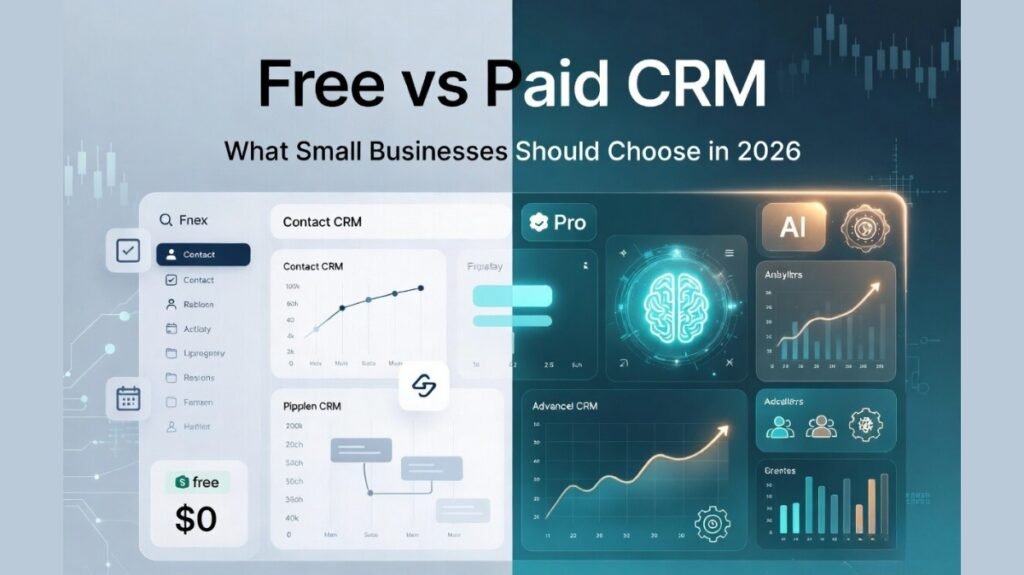
In 2026, paid plans shine with AI CRM features that maximum unfastened levels lack, such as automatic assembly summaries, predictive deal forecasting, clever lead routing, and generative AI that drafts custom-designed outreach. Paid gear additionally offers better security, compliance tools, and no sudden “enhance or lose statistics” strain.
Cost-clever, a paid plan for a five-person crew may run $70–one hundred fifty/month. But the ROI often pays for itself in saved time and further sales in internal months. Free vs paid CRM in the end boils right down to your stage: free for validation and studying, paid for vital increase and performance.
Many platforms (HubSpot, Zoho, Salesforce) make upgrading seamless so you don’t lose your history. That’s huge for peace of mind.
Top Free and Paid CRM Picks for Small Businesses in 2026
Here are practical recommendations based on the real 2026 performance for CRM for small businesses.
Free Standouts
Let’s talk about some genuinely helpful free CRM options that small businesses are loving in 2026:
- HubSpot CRM: It’s still the crowd favorite for a very good reason. The interface is super clean and easy to use, you get unlimited users on the free plan, and it comes with handy marketing add-ons. It’s a great pick if you think you might grow into full sales + marketing later on.
- Zoho CRM Free / Bigin: These are fantastic starters with super affordable upgrades whenever you’re ready. Bigin especially feels like a simple, no-frills pipeline tool made just for tiny teams.
- Freshsales Free: It includes solid automation basics right out of the gate and even offers 24/5 support, something that’s pretty rare in a free tier.
Paid Winners (Worth Every Dollar)
When you’re prepared to level up, the paid plans often pay for themselves fast with the greater strength they provide:
- Zoho CRM Standard (spherical $14 in keeping with character/month billed annually): It’s feature-complete with clever AI equipment, easy workflows, and a entire 360-diploma view of your clients, exceptional value for developing small groups.
- Pipedrive (Lite plan round $14 in step with customer/month, billed yearly): Purely profits-focused with the one lovely visible drag-and-drop pipelines. It’s easy yet relatively effective.
- Salesforce Starter Suite or HubSpot paid ranges: Perfect whilst your group is prepared for employer-grade AI and crucial scalability with no limits, protecting you against.
A brief contrast: Free options win on zero in advance fee and simplicity. Paid alternatives dominate in paid CRM skills like AI automation, limitless the entirety, and committed aid. In 2026 reviews, groups switching to paid file closing offer 20–30% faster access to smarter insights.
Choosing the Right Path: Free vs Paid CRM for Your Business
Deciding between free and paid CRM for your specific situation comes down to three questions:
- How many people need access right now, and how fast will you grow?
Under 3 users and under 1,000 contacts? Start free. - What features do you actually need in 2026?
Basic tracking = free. Automation, AI insights and advanced reporting = time to consider paid. - What’s your growth timeline?
Planning to double revenue in 12 months? Invest in paid early to avoid migration headaches later.
My advice: Begin with a beneficiant first-class free CRM like HubSpot or Zoho. Use it seriously for three 6 months. When you experience the pain points of lacking automation, group limits, or guide paintings piling up, evaluate paid enhancements. Most offer loose trials of top-rate features so that you can check without threat.
Look for tools with robust mobile apps, easy imports, and a supportive network. Read the latest consumer opinions centered on small enterprise use cases. And do not forget the human aspect: the pleasant small business CRM feels intuitive, not like some other chore.
Make the Smart Choice for 2026 and Beyond
At the end of the day, there may be no everyday winner in Free vs paid CRM. It depends on in which your small business stands today and in which you need to be day after today. Free receives you prepared, speedy and proves the concept. Paid unlocks the AI-powered, automatic, scalable magic that turns appropriate strategies into fantastic outcomes.
Whichever path you choose, start. Your customers (and your sanity) will thank you. Many owners who made the switch tell me it was the single best decision for focus and growth.
Ready to pick? Audit your current workflow, list your must-have features, and trial one free option this week. In 2026, the businesses winning are the ones using their CRM for small businesses as a strategic partner, not just a digital address book.