
A task that used to take 40 minutes can produce an AI draft in nine. If a person then spends 14 minutes checking it, 11 correcting errors and six routing it to the next system, the total is still 40 minutes. That calculation captures the hidden costs of AI delegation: the work that remains after a model produces an answer that looks finished.
The point is not that AI delegation never saves time. It can. But a fast first draft is not the same as a faster business process. The hidden costs of AI delegation show up in review queues, exception handling, system access, usage charges and the people who keep the work reliable after launch.
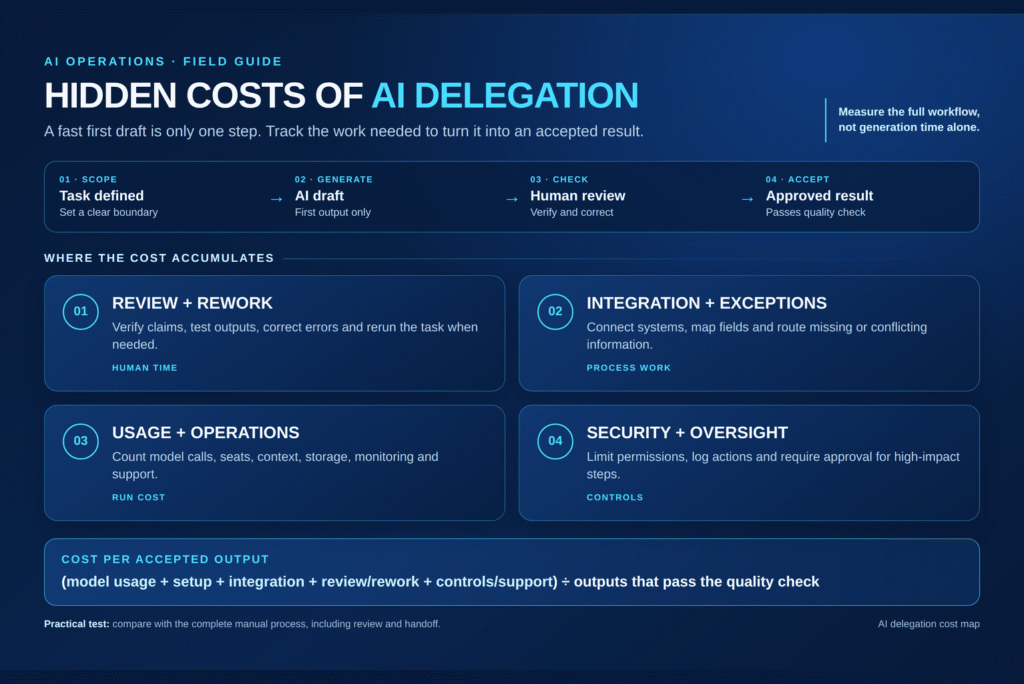
What the hidden costs of AI delegation look like in a real workflow
Delegation happens when a person hands a task, or part of one, to an AI system and relies on its output. That may mean drafting a response, summarizing a record, recommending an action or changing a field in a business system. The more the system can do, the more important it is to define what it may read, change or send.
The hidden costs of AI delegation depend on the handoff. If the model produces an answer that a person can quickly verify, the workflow may become faster. If it returns unsupported claims or a record that needs to be rebuilt, the person inherits another task. These hidden costs of AI delegation are easy to miss when the time spent configuring, checking and correcting the output is charged to a different team.
Productivity evidence depends on the task
In a randomized experiment, 453 professionals used ChatGPT for bounded writing assignments. They completed the tasks 40% faster and received 18% higher output-quality scores than participants without the tool. That result supports AI use for some writing work, but it does not show that a full publishing process becomes 40% cheaper. The experiment did not count every later fact-check, approval or handoff. Those unmeasured steps can change the hidden costs of AI delegation once the work leaves the prompt window.
A workplace study followed the introduction of a generative AI assistant among 5,172 customer-support agents at one firm. Access to the assistant was associated with 15% more successfully resolved chats per hour. Less experienced agents saw the strongest gains; effects were smaller for experienced workers, and some quality outcomes were less favorable. The assistant offered suggestions during support work. It did not own the entire customer issue, so its results cannot be assumed for autonomous agents. The hidden costs of AI delegation will differ when a person remains in the loop versus when software takes action across several systems.
METR’s early-2025 randomized trial gives a different result. Sixteen experienced open-source developers worked on 246 issues in repositories they knew well. The tasks assigned to the AI-allowed condition took 19% longer on average with the tools available at the time. METR later cautioned that the result is historical and should not be read as a measure of current tools. Its newer experiment had participant and task-selection effects that made the updated estimate unreliable. For a team estimating hidden costs of AI delegation, this is a measurement warning: results change with task type, worker experience, tool version and how time is recorded.
Harvard Business Review’s November 2026 article reported data shared by Current, a platform used by accounting firms. The firms said tax-preparation tools saved practitioners about one-third of preparation time and raised throughput by roughly 50%. One firm reported completing about $300,000 of additional work late in the season. Those figures came from platform-shared data, not an independent randomized evaluation. They still show a useful distinction: the hidden costs of AI delegation can exist alongside real gains when a firm has work ready to fill the time it frees. A team should compare those hidden costs of AI delegation with the value of extra capacity, not just saved minutes.
Review and rework become part of the task
An AI draft may look polished while containing a wrong figure, a missed requirement or a claim with no source. Someone still needs to catch it. In software, checking can include tests, dependencies and edge cases. In finance, it can mean reconciling a number to source records. In customer support, it may mean confirming that the response answers the question without promising something the business cannot deliver. The hidden costs of AI delegation often sit in this quality-control work rather than in the model itself.
This is one of the main AI delegation risks: the review task is added to someone’s workload while the original responsibility stays in place. If the reviewer lacks context, a plausible mistake may pass. If they rebuild the work from scratch, the handoff has moved effort rather than removed it. A search for Delegating tasks to AI risks usually points to this same concern: who catches an error before it reaches a customer or changes a record?
A useful pilot records four times separately: creating the AI output, reviewing it, correcting or rerunning it, and moving the accepted result into the next step. The 40-minute example at the start makes the hidden costs of AI delegation visible. If generation takes nine minutes but checking, correction and routing take 31, the time saving has disappeared before subscription fees or system costs are counted.
AI automation costs extend beyond subscriptions
A seat price or per-token rate is only one part of the bill. AI usage can also require API calls, long prompts and retrieved context, data storage, orchestration, software connectors, monitoring, evaluation and staff to maintain the workflow. A business may pay for a general assistant by seat, a model by usage and a separate service to connect it to internal systems. The FinOps Foundation recommends collecting AI-related costs across services and tracking cost per successful outcome, not tokens alone. Those surrounding expenses are part of the hidden costs of AI delegation.
A useful comparison is:
Cost per accepted output = software and usage charges + setup and integration + human review and rework + governance and support costs, divided by outputs that pass the agreed quality bar.
The hidden costs of AI delegation become clearer when a draft fails the agreed quality bar.
Use the same boundary for the manual process. If it includes checking, documentation and routing, compare it with the AI workflow after those steps, not with generation time. That is how a team can count hidden costs of AI delegation without relying on a vendor’s estimate or an internal impression.
Usage can change after launch. A model may process more context than expected. A workflow can repeat calls when it fails to reach a stopping condition. Seats may be added before anyone checks who uses them. Monitor spend by task or use case, and compare it with accepted output. Prices and billing visibility differ by service, so a generic estimate cannot replace the team’s own invoices and contract terms. Without that tracking, the hidden costs of AI delegation may grow quietly as the workflow scales.
Integration and exceptions can absorb the time saved
Real requests rarely arrive in the neat format used in a product demo. A field may be missing, a record may contradict another system or a request may need an exception. If every unusual case goes to a specialist, the AI may reduce routine handling while creating a new queue of difficult work. In that case, the hidden costs of AI delegation move from the front line to the exception team.
Integration takes time too. Someone must decide which system is authoritative, map fields, define what happens when an update fails and prevent duplicate records. Staff need a route to correct bad data and report recurring errors. These hidden costs of AI delegation do not disappear after launch if the workflow depends on changing products, policies or source systems.
Map the existing process before automating it. Remove unnecessary approvals or forms first. Otherwise, an AI tool may move a poorly designed process faster without fixing it. A practical cost of delegation can be the hours spent automating work that should have been simplified or removed. Track hidden costs of AI delegation in the exception queue, not just average handling time.
Permissions, privacy and accountability have a price
An AI system can expose information through its prompt and its connected tools. A summarizer may need read access to a folder, while its connector may also allow it to send or delete files. OWASP calls out excessive agency when an AI system has more functions, permissions or autonomy than its task requires. Its recommendations include narrow tools, least-privilege access, downstream authorization checks, logging and human approval for high-impact actions. These are conditional risks, but they belong in an AI delegation risks review before a system can act.
Those controls take time to set up and maintain. Teams need to classify what information the assistant can see, check data-retention terms, decide who can authorize actions and keep a record of what happened. For every delegated task, ask what could be read, changed, sent or deleted if the system misunderstood an instruction or responded to malicious content in a connected source. This is where hidden costs of AI delegation include security work that a subscription price does not show. Keep hidden costs of AI delegation visible when budgeting for access reviews and incident response.
NIST’s Generative AI Profile advises documenting system limits, assessing risk across the lifecycle and defining how people oversee AI outputs. It is voluntary guidance, not a universal legal requirement. Responsibility still needs a named owner, an escalation path and a way to stop the system from acting outside its remit. If no one owns those controls, the hidden costs of AI delegation may appear only after a mistake.
Human oversight in AI is work, not a checkbox
A reviewer adds time, but removing review can cost more when an error reaches a customer or changes a business record. Review should match the consequence of the task. A low-risk internal summary may be checked through sampling after its accuracy is established. A payment change, deletion or message to a customer needs a clear approval step and an audit trail. In those higher-risk workflows, the hidden costs of AI delegation include the time needed for someone to make a real decision.
Do not measure oversight by counting approval buttons. Measure whether the reviewer had enough time and information, how often outputs were rejected or corrected and what happened after an escalation. If one person must approve dozens of similar outputs under a tight time target, the control may exist on paper while attention has drained away. The hidden costs of AI delegation are higher when approval is treated as a click rather than a check.
The reviewer may also work in a different department from the person who receives the benefit. A team can report faster completion while another team takes on verification and exception work. Compare time and quality across the whole process so the hidden costs of AI delegation are not mistaken for savings created by shifting labor elsewhere.
AI workflow management should track accepted outcomes
Start with one task that has a clear beginning and end. Record the current completion time, error rate and acceptance criteria. Run the AI workflow on comparable work, then log review time, corrections, escalations, usage charges and the share of outputs accepted without changes. A pilot like this shows which hidden costs of AI delegation are recurring and which are setup work that may fall after the process is tuned.
Track quality and ownership, not just volume. Useful measures include cost per accepted result, rework hours, exception rate, time to resolution, human override rate and customer or internal-user satisfaction. If the AI is faster but a downstream team spends more time repairing its output, the hidden costs of AI delegation have not been offset yet. Recheck hidden costs of AI delegation whenever the model, task or approval path changes.
A search for Delegating tasks to AI risks often comes down to one question: what may the system do without a person’s approval? Answer that before enabling access. Start with read-only permissions where possible, narrow the available actions and require approval for steps that are difficult to reverse. Expand autonomy only after the workflow meets its quality bar across ordinary cases and exceptions.
FAQs
What are the hidden costs of AI delegation?
They include review and correction time, system integration, exception handling, usage charges, monitoring, training and security or governance work. The mix depends on the task. The hidden costs of AI delegation are easiest to see when a team measures the whole process instead of the time it takes to produce a first draft.
Does delegating work to AI always save money?
No. Writing and customer-support studies found gains in their settings, while one early-2025 coding trial found a slowdown with the tools tested then. Later evidence is hard to compare because tools, tasks and study methods change. Measure the current workflow before assuming AI automation costs will be offset by labor savings.
How should a business calculate the cost of AI delegation?
Add software and usage charges to setup, integration, review, rework, monitoring and support costs. Divide that total by outputs that pass the quality and compliance checks. Compare the result with the full manual process, then repeat the measurement after the workflow changes. That gives a more useful view of hidden costs of AI delegation than a license-price comparison alone.