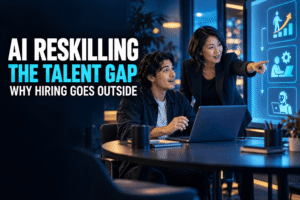
A company creates a role to review AI-generated customer responses. The people who know its customers and policies already work in support, but the job goes to an outside applicant. New Careerminds research captures that tension: 92% of HR professionals believe employees can be reskilled for AI-related roles, yet respondents say external hiring is more common than moving current staff into those jobs. AI reskilling sounds sensible in principle. The hard part is identifying who can move, what they need to learn, and who will give them the chance.
The finding is striking, but it needs context. The survey was commissioned by Careerminds and conducted with Censuswide. It included 1,142 HR professionals and people managers at organizations with 500 or more employees, with fieldwork in May 2026. The sample represents a single national labor market, so it should not be treated as a worldwide estimate. It records beliefs about AI reskilling and reported hiring activity; it does not prove that employees are ready for every AI job or that a training program would succeed without changes to work and management.
What the AI reskilling numbers actually show
The survey found that 92% of HR professionals and 88% of people managers believe employees in their organizations could be reskilled for AI-related roles. Yet 51% of HR respondents and 47% of managers said their organization was hiring externally for new AI positions, compared with 42% in each group who reported redeploying existing employees.
Those figures do not mean the same companies never move people internally. A business can hire externally for one AI role and redeploy a current employee into another. The result is a difference in reported practice, not a count of every vacancy or a direct comparison of all hires. Still, the gap raises a useful question for HR teams: if leaders believe their workforce can adapt, why are internal moves not the first thing they examine?
The picture also changes by sector. In technology and telecommunications, external hiring outpaced redeployment by 15 percentage points in both respondent groups. In media and entertainment, HR respondents were more likely to report redeployment than external hiring, 56% versus 25%. A single company-wide rule will not fit every job family. The cost of a skills gap, the urgency of the vacancy, and the time needed to teach the work all matter.
Belief is not a skills map
Managers can believe employees are capable of learning and still have no clear way to identify who should move. Careerminds reports that 43% of HR professionals and 34% of people managers had limited visibility into which employees should be reskilled. That is a practical obstacle, not a minor data problem. A serious AI reskilling effort needs a clearer view than job titles or a manager’s memory; otherwise, a hiring team may miss the support specialist who has tested workflow automations or the finance analyst who understands company data better than a new applicant.
A skills inventory helps only when it is tied to real work. Start with a role that is changing and break it into tasks. For an AI workflow analyst, the tasks might include checking model outputs, tracing errors to source data, documenting exceptions, and escalating privacy or safety concerns. Then list the skills each task needs. Some may be new, such as writing basic evaluation queries. Others may already be present in adjacent roles: product knowledge, quality assurance, customer judgment, or process documentation.
This makes AI skills training more specific. Instead of sending a large group through a general course and hoping a job appears later, HR can show an employee the target role, the gap between current and required skills, and the practice needed to close it. A manager can then judge the work sample, not just the course-completion badge.
Make AI skills training part of the job
A short course can introduce terms and tools. It rarely proves that someone can use AI safely in a live workflow. People need time to practice with realistic tasks, feedback from someone who knows the role, and a chance to make mistakes in a controlled setting before the work affects customers or business records.
Take the support employee considering a move into AI quality review. The employee may already know which answers frustrate customers and when policy exceptions arise. Training can cover evaluation methods, prompt testing, data handling, and escalation rules. A pilot assignment can then test whether the employee can spot fabricated answers, explain why an output fails, and record a clear incident report.
The company should make the training time visible in the employee’s workload. If people are expected to learn after hours while handling the same volume of work, completion will favor those with spare time rather than those with the strongest potential. A manager also needs a reason to release a capable employee. When teams are rewarded only for meeting their own short-term targets, they may keep talent even when another department has a better-fit opening. That is where AI reskilling can stall: the course exists, but no one makes room for the employee to use what they learned.
For reskilling employees for AI jobs, define the destination before the first lesson begins. State which tasks the person should be able to perform, what standard they must meet, and who will assess them. If the job changes during training, update the target. A certificate for a role that no longer exists is activity, not a workforce plan.
Put employee redeployment on the hiring checklist
A hiring manager usually knows how to request an external search. Internal movement often has no owner, timetable, or selection process. That is why employee redeployment should appear as a regular step when a new AI-related role is approved, not as an informal favor after an employee asks to move.
Before posting externally, HR and the hiring manager can share a short internal opportunity notice with the role’s main tasks, required skills, and trainable gaps. Let qualified employees apply without needing their current manager’s private permission. Assess them against the same criteria used for external applicants, while giving credit for relevant company knowledge. If an employee is close but not ready, make the bridge concrete: a temporary assignment, supervised project, or defined training period with a decision date.
Fairness matters here. HR Dive’s coverage of earlier internal-hiring research describes manager talent-hoarding and employee concerns about unfair access as barriers to movement. An internal job board alone will not fix that. Publish the selection criteria, tell applicants what evidence is required, and explain why a person was or was not selected. If people believe the decision was already made behind closed doors, they will stop applying.
Internal mobility in HR should also include lateral moves and project assignments, not only promotions. A new AI job may not sit higher in the org chart. It can still build experience with quality evaluation, workflow design, or data governance that prepares an employee for a later role. Make the pay, reporting line, and future path clear so a “development opportunity” does not become extra responsibility without recognition.
Give AI workforce planning a named owner
The survey found disagreement over who should lead planning for AI’s impact on the workforce. Sixty-three percent of HR respondents said HR had primary responsibility, while only 24% of managers agreed; 35% of managers pointed to senior leadership instead. When each group assumes another team is mapping role changes, the task tends to fall between them. That leaves AI reskilling without an owner who can connect workforce needs to actual openings.
A workable AI workforce planning process connects business forecasts to people decisions. Leaders identify where AI will change tasks, which roles may shrink or grow, and what skills those roles will require. HR can compare those needs with current skills and likely training time. Department heads can name the people who understand the work. Learning teams can build practice that fits actual workflows. One executive should be accountable for resolving conflicts between those groups.
The World Economic Forum’s 2026 report on early-career work argues that AI-related change calls for attention to job design, talent pipelines, and development, not only technology adoption. That matters because a company can automate the entry-level tasks people once used to learn an occupation, then discover it has no experienced internal candidates a few years later. Good planning asks what work will remain for people to learn, not just which tasks software can perform.
Know when external hiring is still the right call
Internal hiring is not automatically better. A new role may require a scarce specialty, a regulated credential, or production experience that the current team does not have. A time-sensitive project may not allow a long training period. In those cases, hiring externally can fill a real gap. The mistake is treating every new AI job as proof that the skills must be bought from outside.
Cost and time can help inform the choice, but they should not be used as a promise. The Josh Bersin Company’s Internal Hiring Factbook, based on five years of hiring data and roughly half a million records, says external hiring can cost three to five times more and internal hiring can reduce recruitment time by up to 20 days. Those figures are broad hiring benchmarks, not results for every AI role. A specific employer should compare its own recruiting costs, training time, time to proficiency, and retention.
A useful decision is often a mix: hire one experienced specialist to set standards, then build a pathway for current employees to take on related work. The specialist brings depth; existing staff bring customer context and knowledge of how the company actually operates. The arrangement works only if someone has time to coach and the new responsibilities are reflected in job expectations.
Measure whether the move worked
Do not count course enrollments as proof that AI reskilling is working. Track how many people apply for internal roles, how many receive structured assessments, and how many move into the new work. Record the time from training start to independent performance. Ask hiring managers whether redeployed employees meet the role’s standards after three or six months, and compare retention and pay progression with external hires.
Also record where candidates drop out. If few employees apply, the role may be invisible or the selection process may favor people with formal credentials. If many complete training but fail the practical assessment, the curriculum may not match the work. If people move successfully but leave soon after, compensation or career prospects may be the problem. These signals show whether AI reskilling is leading to a real job, rather than adding more courses to the catalog.
Careerminds cites separate analysis suggesting internal promotions and lateral moves can support retention, but that evidence is not specific to AI roles. A company should test the result in its own setting and share what it learns. In one department, the best route may be a six-week supervised project. In another, a longer technical apprenticeship may be necessary. Keep the standard consistent, but let the learning route reflect the job.
FAQs
What does AI reskilling mean?
AI reskilling is training an employee to move into work shaped or created by AI. It should be tied to a specific role and include practice, feedback, and an assessment of job tasks rather than a course alone.
Why do companies hire externally instead of redeploying employees?
External hiring can feel faster when managers cannot see employees’ existing skills, do not have time to train them, or lack a clear internal selection process. The Careerminds survey points to limited skills visibility and split ownership of AI workforce planning as possible barriers.
How can HR tell whether AI skills training is working?
Check whether employees can perform the target tasks to the required standard. Track completed internal moves, time to proficiency, manager assessments, retention, and pay progression. Course completion alone does not show that someone is ready for the job.