As groups race to scale artificial intelligence initiatives, many are discovering an important truth: effective AI models are only as stable as the infrastructure on which they run. Cloud Security for AI Projects has become one of the most important issues for companies in 2026. Without proper safeguards, even the most modern AI systems can expose sensitive data, create compliance nightmares, or become targets for malicious attacks.
This article stocks seven practical, actionable tips that will help you enforce robust AI Cloud Security while expectantly scaling your AI tasks. These AI Security Best Practices will help you protect sensitive information, reduce risks, and build a Secure AI deployment foundation that supports long-term success.
Why Cloud Security Matters More Than Ever for AI Projects
AI tasks are uniquely fact-hungry. They machine massive volumes of records, frequently alongside non-public, monetary, or proprietary business enterprise information. When walking within the cloud, those tasks create new attack surfaces and compliance-annoying issues that conventional protection methods cannot fully address.
Poor Cloud Security for AI Projects can result in data breaches, regulatory fines, high-profile asset theft, and customer acceptance issues. On the other hand, a robust Cloud Security Strategy enables faster innovation, smoother scaling, and greater confidence in your Enterprise AI Security posture.
1. Implement Strong Data Protection for AI from Day One
The foundation of Cloud Security for AI Projects starts with robust data protection. AI systems often handle sensitive information during training, inference, and storage.
Best Practice: Use encryption for data at rest and in transit. Implement dynamic data masking and tokenization for non-production environments. Classify your data by sensitivity and automatically apply appropriate controls.
Strong Data Protection for AI ensures that, even in the event of a breach, the exposed information remains unusable to attackers. This step is critical for maintaining compliance with regulations like GDPR, CCPA, and industry-specific standards.
2. Adopt a Zero-Trust Security Model for AI Workloads
Traditional perimeter-based security is no longer sufficient for modern AI environments. A Zero-Trust approach assumes that threats can exist both inside and outside your network.
Best Practice: Verify every access request to your AI models, data pipelines, and cloud resources. Use just-in-time and least-privilege access controls. Continuously monitor and validate user and system behaviour.
This AI Security Best Practices approach is especially important when scaling AI across multiple teams and cloud environments. It significantly reduces the risk of insider threats and of attackers’ lateral movement.
3. Secure Your AI Model Supply Chain
AI fashions and their education records represent high-cost objectives. Attackers are increasingly focused on the version delivery chain via poisoned datasets, compromised libraries, or backdoored pre-trained models.
Best Practice: Implement strict vetting tactics for 1/3-birthday party models and datasets. Use model scanning tools, maintain a software bill of materials (SBOM), and regularly audit your Secure AI Deployment pipeline.
Organizations serious about Enterprise AI Security treat their AI supply chain with the same rigour as they do conventional software supply chains.
4. Enable Continuous Monitoring and Threat Detection
AI workloads can behave unpredictably, making traditional safety monitoring inadequate. You need real-time visibility into both infrastructure and version behaviour.
Best Practice: Deploy advanced tracking answers that tune API calls, record access patterns, version overall performance float, and uncommon inference requests. Set up automatic indicators for suspicious sports.
Effective AI Risk Management requires combining cloud-local protection tools with AI-specific anomaly detection to catch threats that would otherwise go unnoticed.
5. Build Strong Identity and Access Management (IAM)
Weak access is a major cause. For AI projects, this hazard is amplified because models may be costly to train and contain valuable intellectual property.
Best Practice: Implement granular IAM rules with multi-factor authentication, position-based total access, and everyday permission opinions. Use temporary credentials wherever feasible and automate access revocation when team members change roles.
This discipline is crucial for keeping a secure, scalable AI Infrastructure as your projects develop.
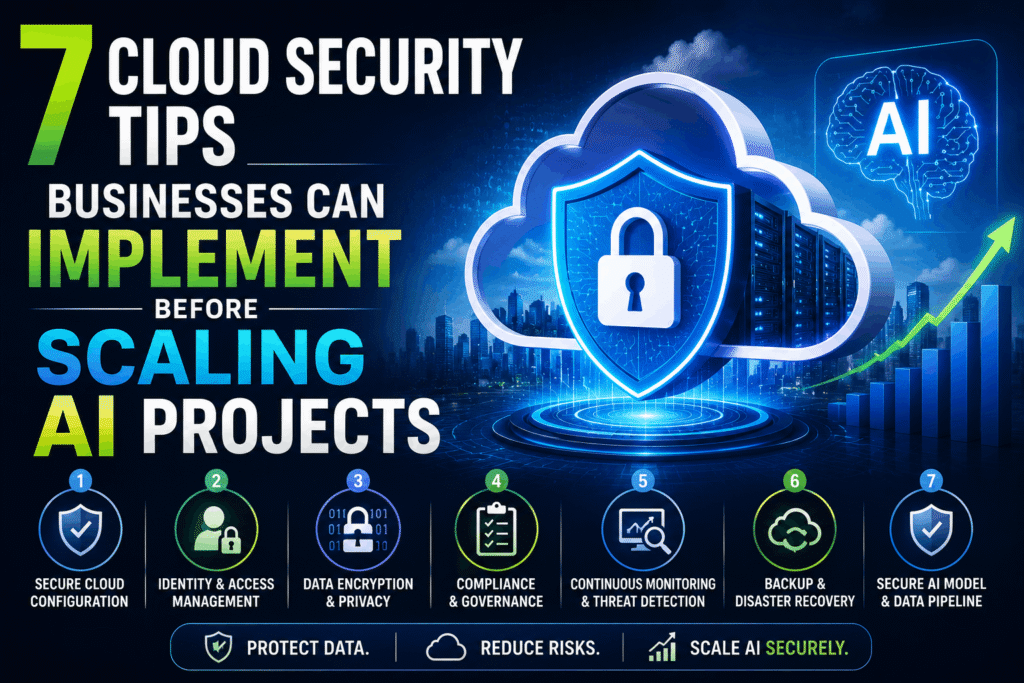
6. Ensure Compliance and Governance Throughout the AI Lifecycle
Regulatory requirements around AI are evolving rapidly. Organizations must address privacy, model transparency, and ethical issues from the outset.
Best Practice: Integrate compliance exams into your AI CI/CD pipeline. Maintain specialized audit logs, report on model choices, and establish clear governance rules for AI use.
A proactive Cloud Security Strategy that includes governance helps avoid costly compliance issues while building stakeholder buy-in for your AI projects.
7. Plan for Scalable and Resilient AI Infrastructure
Security must support growth, not hinder it. As your AI initiatives scale, your security features should keep pace without creating performance bottlenecks.
Best Practice: Design your architecture with computerized, elastic protection controls. Use infrastructure-as-code with built-in safety regulations. Regularly review your disaster recovery and incident response plans, particularly for AI workloads.
This forward-thinking approach ensures your Secure AI Deployment stays effective as you move from pilot projects to business-scale AI systems.
Measuring Success in Cloud Security for AI Projects
To ensure your efforts deliver real results, track key metrics such as:
- Mean time to detect and respond to security incidents
- Percentage of AI workloads with automated security controls
- Compliance audit pass rates
- Cost of security-related downtime or breaches
Regular security assessments and penetration testing tailored to AI systems should be part of your ongoing AI Risk Management program.
Common Pitfalls to Avoid
Many organizations stumble when implementing Cloud Security for AI Projects by:
- Treating security as an afterthought instead of a core requirement
- Over-relying on the cloud provider’s default settings
- Failing to secure the entire AI lifecycle (data → training → inference → deployment)
- Underestimating the unique security challenges of generative AI
Avoiding these mistakes will significantly improve your chances of building secure, scalable AI solutions.
Final Thoughts
Strong Cloud Security for AI Projects isn’t always a barrier to innovation; it is what permits a safe, responsible, and sustainable AI boom. By following these seven key hints, agencies can scale AI tasks while protecting sensitive data, maintaining compliance, and building customer trust.
The maximum achievement organizations view AI Cloud Security as a competitive advantage rather than a compliance checkbox. They integrate AI Security Best Practices into their way of life and techniques from the very beginning.
As AI becomes increasingly valuable to enterprise operations, businesses that invest wisely in Secure AI Deployment and Scalable AI Infrastructure will be well positioned to thrive in an increasingly virtual world.
Start by assessing your current-day Cloud Security Strategy against those seven recommendations. Identify the largest gaps and start systematically addressing them. Your destiny AI fulfillment depends on it.