
A demand-generation team can show that an email, webinar, paid campaign and sales call appeared before a deal closed. That does not tell the whole story. B2B marketing attribution software organizes those interactions and assigns credit to them, but the result depends on which data the platform sees and how the credit rules work.
Before comparing B2B marketing attribution software, decide what decision the report should support. Are you choosing where to spend next quarter’s budget, finding channels that help create qualified opportunities, or checking whether a campaign is associated with closed revenue? Those are related questions, but they are not interchangeable. A platform can produce precise-looking dashboards and still answer the wrong one. A useful B2B marketing attribution software report begins with a defined decision.
What B2B marketing attribution software actually measures
Attribution software gathers marketing and sales touchpoints, connects them to a person or account, and allocates credit for a result such as a qualified lead, opportunity or closed deal. Gartner describes the B2B multi-touch category as tools that track multiple marketing and sales interactions across complex buying cycles. Its market criteria include attribution models, identity resolution, channel views, integrations and reporting. A strong B2B marketing attribution software setup also keeps the event trail available for review.
The first setup choice is the outcome. A form fill is easy to count, but it may not be a good proxy for revenue. A team that sells through a long review process may want to measure qualified opportunities, pipeline created, pipeline influenced, closed-won revenue or renewal. B2B marketing attribution software should let the team distinguish those events instead of collapsing them into one “conversion” number.
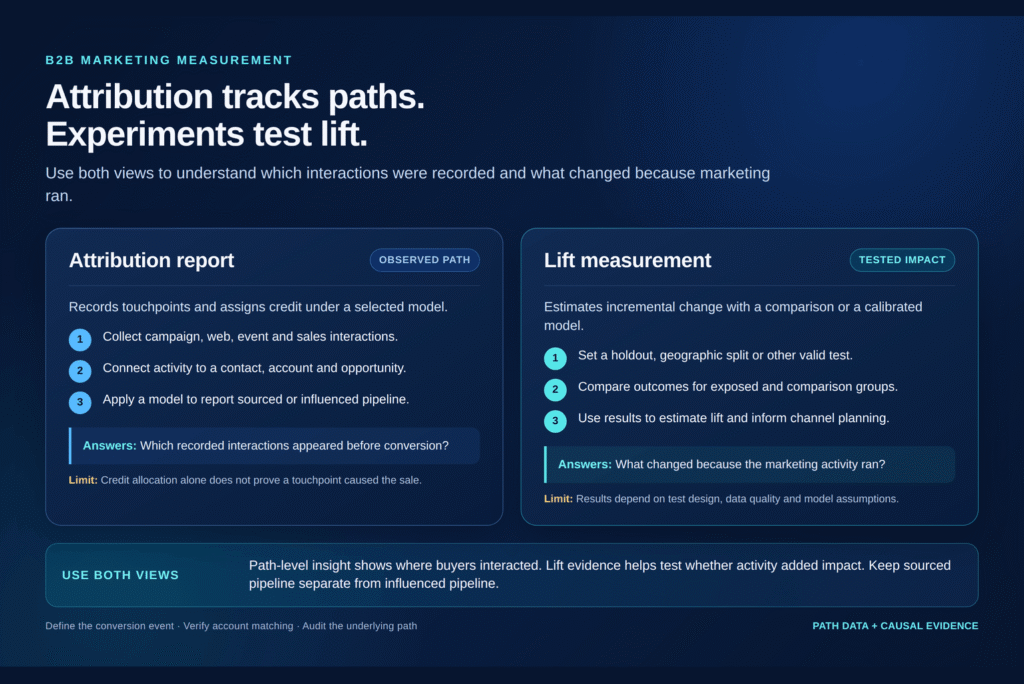
Attribution is also a record of observed paths. It can tell you which interactions were recorded before a conversion and how a model distributed credit. It cannot recover an interaction that was never tracked, or show with certainty what would have happened if a campaign had not run. That limit matters whenever B2B marketing attribution software is used to justify budget.
How B2B marketing attribution software handles marketing attribution models
A single-touch model gives all credit to one interaction, often the first recorded touch or the last non-direct touch. It is simple to explain and can help answer a narrow question, such as which source first brought a contact into the database. It also ignores other recorded activity. If a prospect reads a comparison guide, joins a webinar and speaks with sales before converting, a last-touch report may assign the full credit to the final click. The chosen model changes which channels B2B marketing attribution software appears to reward.
A multi-touch model distributes credit across several touches. Rule-based versions may divide credit equally or give more weight to selected stages. Algorithmic or data-driven models use observed paths to estimate how much different interactions contributed. These marketing attribution models can tell different stories using the same data, so a team should not switch models merely because one produces a more attractive channel ranking.
Google Analytics documents data-driven attribution, paid and organic last click, and Google paid channels last click in its current attribution reports. Its help page notes that first-click, linear, time-decay and position-based models were removed from those reports in November 2023. The data-driven model compares converting and non-converting paths and is specific to the advertiser and key event. Other B2B marketing attribution software may offer different model names or rules, so ask for the actual methodology rather than relying on a familiar label.
What B2B marketing attribution software needs from CRM and campaign data
A model cannot repair incomplete source records. Before evaluating B2B multi-touch attribution tools, list the systems that hold the data: CRM, marketing automation, web analytics, paid media, events, sales engagement and finance. Then check whether campaign names, contact IDs, account records, opportunity stages and revenue values are consistent across them. A webinar recorded as “Spring Webinar,” “Spring-webinar” and “Q2 event” may appear as three separate sources unless naming rules are enforced. Before a pilot, ask whether B2B marketing attribution software can connect these records without manual cleanup.
Identity resolution is another practical test. B2B purchases often involve several people at the same account. One person may attend an event, another may download a guide and a buying group may later speak with sales. If the platform only links activity to individual browser cookies, it can miss the account-level path. Gartner includes identity resolution, data integration and unified channel reporting among the features used to evaluate this software category. That is why B2B marketing attribution software should match contacts to accounts consistently.
Ask vendors how they handle anonymous visits, duplicate contacts, account matching, offline activity and CRM stage changes. Ask what happens when a contact changes companies or when one opportunity has several contacts and campaigns attached. A demo using clean sample data will not answer those questions. B2B marketing attribution software is only as useful as the records it can connect and the rules it uses when those records conflict.
What to compare in B2B marketing attribution software
The strongest B2B marketing attribution tools are not necessarily the ones with the longest list of charts. Compare them against the work your team needs to do. Start with coverage: can the platform ingest the channels and sales activity that matter, and can it connect that activity to a contact, account and opportunity? If the system omits a large part of the buying path, the model’s output may over-credit the channels it can see. A B2B marketing attribution software demo should show how an excluded channel is handled.
Next, look at model transparency. The interface should show which touchpoints received credit, what the attribution window is, and how the model handles direct traffic, repeat engagement and multiple contacts. A marketing analyst should be able to explain a result to sales or finance without treating a score as a black box. Multi-touch attribution software that exposes paths and assumptions is easier to audit than a dashboard that shows only a channel percentage. That clarity is essential when B2B marketing attribution software informs budget changes.
Check the reporting grain, too. Does the team need contact-level, account-level, campaign-level or opportunity-level reporting? Can a user move from a summary to the underlying path? Can reports separate sourced pipeline from influenced pipeline? The term “influenced” is often configured differently across companies, so record the definition in the report itself. B2B marketing attribution software should make that distinction visible.
Then test the operating details: native connectors, API access, data refresh delays, user permissions, data retention, onboarding support and total contract cost. Ask whether pricing is based on contacts, events, tracked channels, seats or data volume. A low starting price can rise once the team adds the CRM, advertising accounts or historical records it needs. Compare total annual cost with the manual work the tool replaces, not with the price of a basic dashboard.
What B2B marketing attribution software cannot prove
A useful attribution report does not prove that a campaign caused a sale. If a person sees a paid ad shortly before converting, the ad may have helped. The person may also have already intended to buy, or learned about the product through an untracked conversation. Credit assignment describes a recorded path; a causal test estimates what changed because the campaign ran. Strong B2B marketing attribution software should make that boundary clear in its reports and sales materials.
This is particularly important in B2B, where many buyers are not actively shopping at the same time. LinkedIn’s B2B Institute describes this with its 95-5 rule: most potential buyers may be out of market at a given moment and could become buyers later. The figure is a research framing, not a fixed percentage that applies to every category. It does underline why a short-term, last-touch view can miss earlier brand activity that may matter months later. A short attribution window can make B2B marketing attribution software miss those earlier exposures.
For broader channel questions, marketing mix modeling and incrementality experiments can complement attribution. Google describes Meridian as an open-source marketing mix model and points to using experiment results to calibrate models. A team need not run a large modeling program for every campaign. It can test a small holdout or geographic split when it needs evidence about lift, then compare that result with the path-level picture from B2B multi-touch attribution tools.
Connect marketing ROI measurement to pipeline quality
Marketing ROI measurement should start with a defined numerator and denominator. One useful business calculation is incremental gross profit linked to a campaign or channel, minus its total cost, divided by that cost. If the team uses pipeline instead of gross profit, label the result as pipeline contribution or pipeline return. Do not present it as realized revenue. Use B2B marketing attribution software to organize contribution data, but calculate profit with finance-approved cost and margin figures.
Include more than media spend in the cost. Add creative and agency fees, event costs, software, discounts and the people required to run or support the campaign. On the value side, distinguish new pipeline from influenced pipeline, and avoid counting the same opportunity in several campaigns as if each had created the full amount. B2B marketing attribution software can help organize the records, but the business still has to set the counting rules.
A practical dashboard might show sourced opportunities, influenced opportunities, conversion rates by stage, time to close, average deal size and cost per opportunity. Review the data with sales operations and finance before using it to shift budget. When the definition of “influenced” changes every month, a trend line becomes difficult to interpret.
Test B2B marketing attribution software before buying
Write down one decision the platform should improve, such as identifying which channels contribute to qualified pipeline. Choose a short list of existing opportunities and trace each path manually through CRM, campaign and web records. That exercise exposes missing data before a vendor implementation begins. It also gives the team a test set for B2B marketing attribution software.
During a pilot, compare the system’s output with the manual review. Check whether it misses known touchpoints, duplicates campaign activity or assigns credit to a channel that had no reliable connection to the account. Ask a marketer, sales operations lead and finance partner to review the same report. If they interpret the numbers differently, fix the definitions before rollout. A useful pilot shows whether B2B marketing attribution software answers one defined budget question.
A tool is worth keeping when it reduces reporting work and helps people make a better allocation decision. More attribution detail is not automatically better. If the result cannot be explained, audited or compared with a controlled test, it should not be used as the sole reason to cut a channel or expand another one.
FAQs
What does B2B marketing attribution software do?
It connects recorded marketing and sales interactions to contacts, accounts or opportunities, then assigns credit to those interactions under a selected model. It reports observed paths; it does not automatically prove that a touchpoint caused the sale.
Are B2B multi-touch attribution tools useful for long sales cycles?
They can help teams inspect more than the first or final recorded interaction, especially when several people and channels influence a purchase. Their usefulness depends on data coverage, identity matching and clear definitions for pipeline stages.
Which marketing attribution models should a team use?
There is no universal winner. Use a model that matches the decision, inspect the underlying paths and compare attribution results with experiments when causal lift matters. A team can keep more than one view for different questions, as long as each report labels its rules.