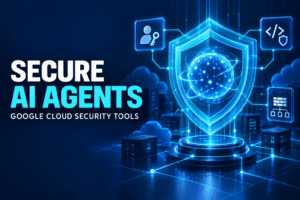
A code agent may need to run an exploit simulation to confirm that a bug is real, then prepare a patch for a developer to review. That job becomes risky if the agent can run unrestricted commands or carry a token that reaches unrelated systems. The new Google Cloud security tools for AI agents announced this month focus on those boundaries: what an agent can access, where it can act, and which steps still require a person.
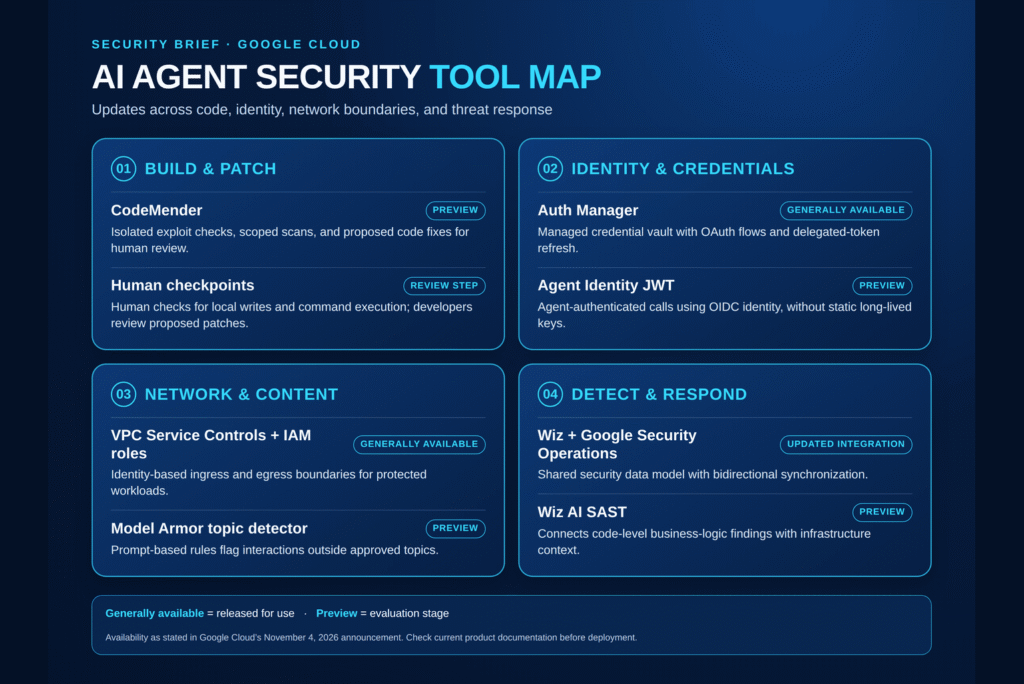
This is not one new security product. Google Cloud’s November 4 announcement groups together changes to CodeMender, agent identity and credentials, network and content controls, and security operations with Wiz. Some features are generally available; others remain in preview. That distinction matters. A preview control can be useful to test, but it should not be treated as production-ready protection for every workload.
What the Google Cloud security tools for AI agents include
The rollout follows an agent’s path through development and production. CodeMender addresses code vulnerabilities before or during software development. Agent Identity and Auth Manager deal with credentials and access. VPC Service Controls and Model Armor apply boundaries around network traffic and agent interactions. Wiz and Google Security Operations add investigation and response context.
That coverage is broader than a model filter. Agents can act through tools, APIs, code repositories and cloud resources, so a security failure may begin with a malicious instruction but become a credential leak, an unauthorized command or a vulnerable patch. Google’s updates address several points in that chain, though administrators still have to configure identities, permissions and review steps.
CodeMender adds isolated checks before code changes
CodeMender is Google Cloud’s code-security agent. It can scan software, check whether a vulnerability is exploitable and generate a proposed fix. The latest update adds options to run verification and exploit simulation in an operating-system sandbox or an isolated virtual machine. It also adds human checks for local file writes and command execution, plus more control over scan scope: a folder, a full repository or only files changed since the previous scan.
CodeMender remains in preview. The practical value is the combination of testing and containment. A scanner may flag a pattern that is not exploitable in the application’s real context. Verification can help security teams focus on flaws that pose a credible risk, while the isolated environment limits what a test can affect. The additional human checks are important because running exploit code is itself a sensitive action.
The agent can also generate and test a patch, but that does not mean the patch should be committed without review. Google’s CodeMender overview says developers remain responsible for reviewing and approving proposed changes before they enter a repository. Teams should keep that approval step, run their own tests and check that a security fix has not broken application behavior.
For software teams, these are useful AI agent security tools when the bottleneck is finding, validating and repairing code flaws. They are not a substitute for secure build permissions. If the agent can write to production branches, read secrets or execute arbitrary commands, the surrounding development environment still needs strict access limits.
Agent Identity and Auth Manager address credential sprawl
An AI agent often needs to call other services. A developer may connect it to a ticketing system, a database, a code host or an MCP server. Giving every agent a shared service account or a long-lived API key makes it difficult to tell which software took an action and what it was allowed to do.
Google says Auth Manager is now generally available. It centralizes API keys, OAuth client secrets and user tokens in a Google-managed credential vault governed by Identity and Access Management policies. It can automate OAuth 2.0 authorization flows, including PKCE, and refresh user-delegated tokens. The goal is to reduce hand-built credential storage and repeated consent flows. Auth Manager can still store API keys, so its presence alone does not make an integration keyless or automatically least-privileged.
Agent Identity JWT support is in preview. Google says it can issue standard OpenID Connect tokens for agents to authenticate to external services, other cloud environments, on-premises systems and MCP servers without relying on static, long-lived API keys. The underlying Agent Identity documentation describes a cryptographic identity for each agent, distinct from a human user or a shared service account. Administrators can grant permissions directly to that agent identity.
That separation gives security teams a clearer audit trail. If an agent reads a record or calls an API, logs can identify the agent principal rather than only the human who started the workflow. It also gives administrators a place to limit the agent’s authority. But a unique identity can still be over-permissioned. Teams need to grant only the access required for a task, review delegated access and remove obsolete permissions when agents are replaced or retired.
The new AI security controls are most useful when an organization maps them to actual decisions. Which agent can access customer data? Can it make changes, or only suggest them? Does it act on its own authority or on behalf of a named user? Those answers should determine the scope and lifetime of its credentials, not the convenience of the first integration.
Network and content protections put limits around agents
Google Cloud says VPC Service Controls ingress and egress rules now support IAM roles, with that capability generally available. Workload Identity Federation for Google Kubernetes Engine is in preview. These changes give administrators additional ways to apply identity-based network boundaries to workloads, rather than relying only on broad project-level access or manual exceptions.
Model Armor’s custom topic detector is also in preview. It lets an organization define prompt-based rules to identify whether interactions stay within approved topics. That can help contain an assistant designed for a narrow job, such as answering questions about an internal policy. A topic rule is not a complete defense against prompt injection, a compromised tool or an agent with excessive permissions. The control needs to sit alongside identity checks and limits on what the agent can do.
Other updates protect the cloud workload around the agent. Cloud NGFW advanced malware sandboxing and project-level firewall resources are generally available. Cloud Armor managed rules are in preview and draw on threat intelligence from Thales Imperva. These are network and application protections, not agent reasoning safeguards. Their role is to help detect or block threats moving through the infrastructure the agent uses.
Taken together, these updates expand Google Cloud AI security beyond the model endpoint. They touch identity, network egress, code changes and runtime traffic. That is helpful because an agent’s risk is rarely confined to its prompt window. A useful review asks what information it can reach, which tools it can call, what happens if a tool response is malicious and how quickly the organization can revoke access.
Wiz and Google Security Operations connect code findings to response
Google and Wiz are also linking more of their security products. Wiz Defend and Google Security Operations now use a shared data model and support bidirectional synchronization. Google lists a Wiz Content Pack and Wiz Blue Agent investigation analysis in Google Security Operations, along with an integration between Wiz Defend and Google Threat Intelligence.
Wiz AI Static Application Security Testing, or SAST, is in preview. Google says it uses agentic reasoning to examine application behavior and find business-logic flaws. The findings can be correlated with infrastructure context in the Wiz Security Graph, helping a team judge whether a weakness is exposed in a real deployment.
This connection could help analysts avoid treating every code alert as equally urgent. A flaw in a public-facing service with access to sensitive data may deserve attention before a similar issue in a test environment. Still, correlation is not the same as remediation. Teams need to confirm the finding, assess exploitability and decide whether a proposed fix is safe. The AI agent threat detection pieces can speed up investigation, but they do not remove the need for accountable response decisions.
What these tools cover, and what they leave to the operator
Security Command Center’s AI Protection can help teams inventory AI assets, identify some vulnerabilities and risks, find over-privileged agents, check compliance and detect threats. Google’s documentation notes that available findings depend on the Security Command Center service tier and whether it is activated at the organization or project level. Agent Platform Threat Detection for Agent Runtime is in preview. Buyers should check their existing tier and deployment pattern before assuming every capability is included.
A broader set of design principles helps explain what to look for. NIST authors’ proposed tenets for agent identity call for distinct agent identities, least privilege, short-lived and revocable authorization, human-review triggers for sensitive actions, and separation between the system that reasons and the system that enforces access. Those principles line up with the direction of Google’s announcements, but they are not a claim that one vendor feature automatically satisfies them.
In practice, teams should test Secure AI agent workflows against failure cases, not only successful demos. Try an agent with an expired credential. Give it a tool response containing an instruction it should ignore. Check whether it can write to a location outside the task. Confirm an operator can see the action in logs and revoke access without shutting down unrelated services. For CodeMender, test that an exploit simulation stays inside the selected sandbox and that no patch reaches a protected branch without approval.
The main question for a security review is not whether an AI agent has a guardrail. It is whether the guardrail limits a real permission or action. Prompts can tell an agent what it ought to do; identity, network policy and approval checks determine what it is able to do. That is where the Google Cloud security tools for AI agents may fit into a broader program, provided the organization checks preview status, service-tier requirements and the configuration behind each control.
FAQs
What are Google Cloud’s new security tools for AI agents?
They include CodeMender updates for isolated vulnerability testing, Auth Manager and Agent Identity features for credentials and authentication, network and content controls, and expanded Wiz integrations with Google Security Operations. Availability varies: some features are generally available, while others are in preview.
Is CodeMender generally available?
No. Google’s November announcement lists CodeMender as being in preview. It can scan code, verify vulnerabilities in an isolated environment and prepare fixes, but developers should review and approve patches before committing them.
Do the new AI security controls prevent prompt injection?
They can help limit access and actions, but no single control prevents every prompt-injection attack. Use identity-based permissions, network boundaries, monitoring and human review for sensitive actions. Google’s Model Armor custom topic detector is in preview and should be treated as one layer, not a complete defense.