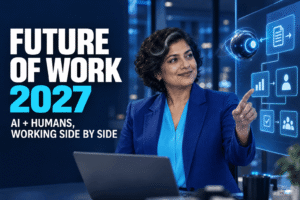
A customer support case arrives with a missing document, a past exception and a deadline that cannot move. An AI agent can gather the account history, compare the policy, and draft a response. A person still has to decide whether the exception is fair, explain the choice and own the result. That handoff offers a more useful picture of the Future of Work 2027 than a prediction that software will simply replace a job.
The phrase AI and human collaboration at work describes a change in how tasks are divided. Software may take on more routine execution; employees may spend more time setting direction, checking outputs and handling cases that do not fit the usual pattern. That shift is not guaranteed to happen in every company next year. But several 2026 forecasts point toward work being redesigned around a combination of people and AI rather than around headcount alone.
What the Future of Work 2027 could look like
The phrase “AI and human adjacent” in a recent 2027 forecast does not mean that every employee will sit beside a robot or supervise an agent all day. It points to a workforce where people, AI-assisted roles and software agents contribute to the same operating process, with different permissions and responsibilities. The prediction’s author, Angela Vidler, argues that boards will need to ask what AI systems are responsible for, who owns them and who answers when an automated action causes harm.
That is an expert’s forecast, not a settled outcome. Still, it is a useful question for employers to test now. If an agent can approve a routine refund, which cases must go to a person? Who can change the rules? What information can the system access? Those are workforce-design questions as much as software questions.
For the Future of Work 2027, a more realistic unit of change is often the task, not the occupation. A claims specialist may spend less time gathering documents and more time reviewing unusual cases. A recruiter may use AI to sort applications but still judge experience and speak with finalists. In one team, that creates time for higher-value work. In another, it may simply increase the number of cases assigned to each person. The outcome depends on how leaders redesign the job and measure it.
AI workplace trends 2027: from pilots to redesigned work
Signs of adoption are real, but they need context. Microsoft’s 2026 Work Trend Index reports that the number of active agents in its Microsoft 365 ecosystem grew 15 times year over year, rising to 18 times in large enterprises. That figure describes activity in Microsoft’s own environment; the release does not give a simple public baseline for the number of agents. It should not be read as proof that agent use has grown at the same rate across all employers.
The same report draws on anonymized Microsoft 365 activity and a survey of 20,000 AI-using workers. Microsoft found that organizational factors such as manager support, culture and talent practices were associated with twice the reported AI impact of individual effort alone. In other words, handing an employee a tool does not fix a workflow that has unclear rules, poor data or no time for learning.
Deloitte’s 2026 survey shows the gap between expectations and readiness. Among 501 senior leaders at organizations already piloting agentic AI, 74% expected nearly half of their business processes to be redesigned or rebuilt around agents within four years. Sixty-one percent expected most agents they use to be generally autonomous, with human oversight. Yet only 5% said their business processes were highly prepared for agents. These are leaders’ expectations, not observed results across all employers, and the sample was drawn from organizations already testing the technology.
This is why the Future of Work 2027 is unlikely to be defined by software licenses alone. A company can automate a step without removing the old approvals around it. That creates two systems to maintain: the old process and the new agent. A better pilot starts with a problem, maps who makes each decision, tests the handoffs, and changes the workflow only after the team can see what the agent does well and where it fails.
The Human-AI workforce will be planned by task and responsibility
Workforce planning has usually started with roles, staffing levels and skills. AI makes those measures less complete. A team may have the same number of employees but a different capacity because agents now handle first drafts, routine lookups or record updates. Counting agent instances will not answer whether the work is accurate, whether customers receive a good result or whether a human can intervene when needed.
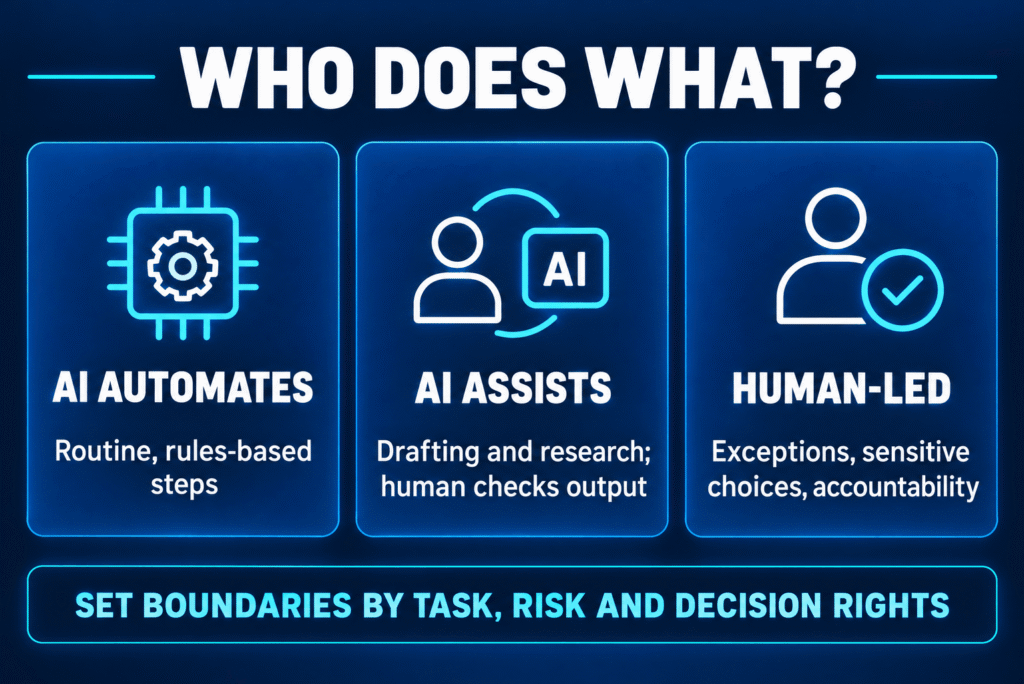
A practical Human-AI workforce plan separates tasks into three groups. Some work is suitable for automation with a clear review path, such as sorting incoming requests by topic. Some work is better done with an assistant, such as drafting a summary for an employee to check. Other work should remain human-led because it involves an uncertain judgment, a sensitive conversation or a decision with serious consequences. These boundaries will vary by role and risk; they should be written down rather than left to individual guesswork.
Gartner predicts that by 2027, half of enterprises without an organization-wide AI people plan will lose top AI talent to competitors that prioritize workforce enablement. The forecast is based in part on a 2026 survey of 12,004 employees and managers. In separate executive research, only 27% reported having a company-wide AI plan and 20% believed their workforce was truly AI-ready. Those results do not prove that a people plan alone prevents departures, but they underline the gap between acquiring tools and preparing employees to use them.
Customer service offers another warning against reading automation as a simple headcount story. Gartner predicts that 50% of companies that attributed staffing cuts to AI will rehire people for similar work under different job titles by 2027. The release also says that, in an earlier survey of 321 customer-service leaders, only 20% had actually reduced agent staffing because of AI. The prediction is specific to service and does not show that half of all AI-related job cuts will be reversed. It does suggest that reducing headcount before testing quality, customer expectations and exception rates can create a costly reversal.
Human skills remain part of the job
The Future of Work 2027 will still require people who can ask whether an answer is sound, explain a decision and notice when the task has changed. AI can produce a fluent response even when a source is incomplete or the request is ambiguous. A human reviewer needs enough subject knowledge to catch that gap. If the reviewer is expected to check dozens of outputs in minutes, the role has not been redesigned safely; the checking step has merely been squeezed.
Microsoft’s survey respondents named quality control of AI output and critical thinking among the human skills they expect to matter more as AI takes on work. The report says 86% of surveyed AI users treat AI output as a starting point rather than a final answer. These are self-reported views from Microsoft’s research, not a universal ranking of worker skills. They nevertheless match a practical requirement: employees need time and authority to challenge a system, not just training in where to click.
The World Economic Forum’s 2025 Future of Jobs Report expects 39% of workers’ core skills to change by 2030. AI and big data are among the fastest-growing skills, while analytical thinking remains the top core skill employers report needing. Resilience, leadership, creative thinking, curiosity and lifelong learning also rank among skills expected to matter. The report reflects employer expectations across several forces, not an AI-only forecast. Its message is not that every worker needs to become a machine-learning engineer. Many will need enough technical fluency to use tools responsibly, alongside the judgment and communication their work already requires.
That is the point of Human-centered AI at work: training should follow the tasks employees actually perform. A claims reviewer needs examples of when to accept a summary, when to inspect the source record and when to escalate. A manager needs a way to review agent decisions and explain how performance will be judged. General AI training can introduce a tool; it cannot substitute for practice on real work.
Trust, access and job security will shape adoption
Employees often learn about a new tool before they learn what it means for their jobs. That silence is costly. Gartner’s 2026 findings say that employee confidence in current and future roles, along with clear communication about how AI will be used, is associated with a more positive outlook toward AI. The company does not need to promise that no role will change. It does need to say what work is being tested, what decisions remain human, what support will be offered, and how changes will be reviewed.
Access matters too. Gartner reports that 88% of employees with enterprise AI access also use personal AI tools for business tasks. That is a sign that people may be reaching for tools that feel more useful or easier to use than the approved option. It also creates data and privacy risks. Banning personal use without fixing the underlying friction can push activity out of view rather than resolve it. Employees should have a clear way to request approved tools and report when they do not meet the needs of the job.
A good AI and human collaboration at work policy is specific about decision rights. It states which actions an agent may take, which require a human check, and how an employee can stop or correct the process. For higher-risk work, teams also need a record of what the system considered and what the human reviewer changed. Rules like these protect customers and staff while giving managers a basis for deciding whether the arrangement is working.
How to read Future of work predictions without mistaking them for guarantees
Forecasts are useful when they identify decisions that deserve attention. They are less useful when a headline turns an expectation into a certainty. The World Economic Forum estimates that 170 million jobs could be created and 92 million displaced by 2030, for net growth of 78 million, based on structural labour-market projections. Those estimates combine technology with economic, demographic and other forces; they do not say AI alone will create or remove those jobs.
The same caution applies to company surveys. A leader saying that half of a process may be redesigned is not evidence that the process has already changed. A platform reporting more active agents does not establish whether work quality rose. Even time saved can mislead. Gartner found that 19% of employees in its 2026 survey said AI had saved them no time. Teams should pair time measures with accuracy, rework, customer outcomes and the number of cases that needed human intervention.
A useful way to assess Future of work predictions is to ask what has changed in a real workflow: Did the employee spend less time on repetitive searching? Did the team handle exceptions correctly? Could workers explain the tool’s limits? Did the new process deliver better service without quietly shifting unpaid checking onto employees? These questions make forecasts testable without treating every adoption figure as proof of productivity.
For the Future of Work 2027, the strongest signal may be whether organizations can describe their combined capacity in concrete terms. Which tasks are handled by people, which are assisted by AI, and which are delegated to agents? Who owns the result? What skills and review time are required? Those answers matter more than a count of accounts activated or agents deployed.
FAQs
What does “AI and human adjacent” mean for the Future of Work 2027?
It describes people and AI systems working within the same process, with distinct tasks and responsibilities. An agent might gather information or draft a response while a person checks the facts, handles exceptions and remains accountable for the decision. The arrangement will differ by role and risk.
Will AI replace jobs by 2027?
Some tasks and roles will change, but current forecasts do not establish a single outcome for every employer. Gartner’s customer-service prediction expects some companies that cut staff because of AI to rehire for similar functions under new titles, while the World Economic Forum projects both job creation and displacement through 2030. Neither forecast guarantees what will happen in a particular workplace.
Which skills matter most in the Future of Work 2027?
Technical fluency will help workers use AI tools, but employers also expect analytical thinking, creative thinking, resilience, leadership and continued learning to matter. People who review AI work need enough subject knowledge to catch errors and enough authority to correct them.