A marketer shouldn’t have to dig through five reports just to answer a simple question: why did campaign performance change this week? Google’s new Google AI Reporting Tools are aimed at that exact problem. The company says it will roll out AI-powered dashboards for Google Ads and Google Analytics that can turn raw account data into visual reports using ordinary language prompts.
That matters because reporting is often where campaign work gets bogged down.
The numbers are there.
The problem is figuring out what they mean.
A sudden traffic increase might come from a seasonal sales period. A drop in conversions could be tied to a landing page, a change in search behavior, or something happening inside the campaign itself.
Google wants its new reporting features to make that investigation less tedious.
Google AI Reporting Tools Put Natural-Language Reporting Inside the Ad Platform
The most interesting part of Google’s announcement isn’t simply that AI will create reports.
It’s how marketers will ask for them.
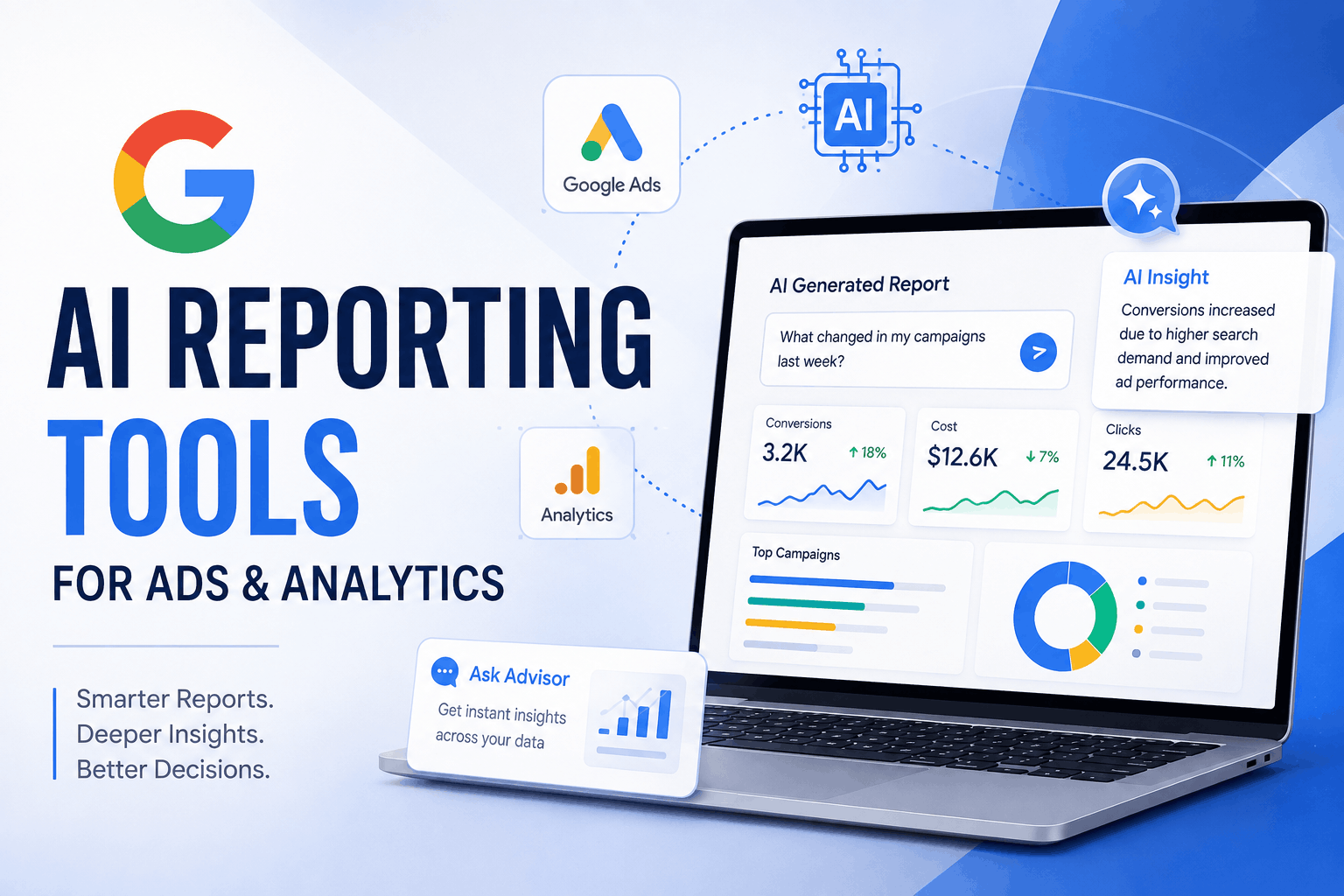
Google says advertisers will be able to use natural-language prompts to create visual performance reports from raw data. Each report can also generate a real-time explanation of the results, including the reasons behind changes in campaign performance.
That changes the reporting workflow.
Instead of building a report manually and then interpreting the numbers, a marketer could start with a question.
What changed?
Which campaign lost conversions?
Where did traffic increase?
Which period performed differently from the previous one?
The answers are still based on the account’s data, but the route to those answers becomes much shorter.
For smaller marketing teams, that could be particularly useful. They may have plenty of campaign data but not enough time to spend hours turning it into charts and written explanations.
Google Ads Reporting Is Moving Beyond Static Dashboards
Traditional Google Ads Reporting usually begins with selecting metrics, dimensions, date ranges, filters, and visualizations.
None of that is especially difficult.
It just takes time.
The new dashboards are designed to let advertisers describe what they want in plain language. Google says the system can then build visual reports from the underlying data.
That makes reporting more conversational.
A marketer doesn’t necessarily need to know which combination of filters will reveal a particular pattern.
They can start with the question instead.
This doesn’t make the underlying numbers less important. If anything, it puts more pressure on marketers to understand what they’re asking for and whether the answer makes sense.
A polished chart can still tell the wrong story if the question is poorly framed.
Google Analytics Reporting Gets Its Own AI Layer
The reporting changes aren’t limited to advertising accounts.
Google says Google Analytics Reporting will also receive AI dashboards, with the Analytics experience coming soon. The company is adding AI-generated summaries to the Analytics home page that highlight important changes in traffic and account activity.
That could make routine account checks much quicker.
Instead of opening Analytics and scanning several sections for anything unusual, marketers will see summaries of important changes near the top of the home page.
Google specifically points to examples such as seasonal sales peaks and traffic changes.
Those are useful signals, but the real value comes from what happens after the signal appears.
A traffic spike isn’t automatically good news.
A conversion drop isn’t automatically a campaign problem.
The marketer still has to investigate.
The new tools are meant to make that investigation easier.
AI Marketing Reporting Needs Context, Not Just More Charts
There is a temptation with AI reporting to create more dashboards simply because the software can.
That isn’t necessarily useful.
A marketing team doesn’t need 40 new charts.
It needs answers to questions that affect spending and campaign decisions.
That’s where AI Marketing Reporting becomes more interesting.
A report could help identify a meaningful change, explain what happened, and give the marketer a starting point for further investigation.
Google says its new reporting experience is designed to provide a summary explaining the “why” behind data changes.
That distinction matters.
A dashboard showing that conversions fell by 18% is easy enough to build.
A report that helps a marketer understand what changed around that decline is more useful.
The second piece is where Google’s AI reporting push gets interesting.
Ask Advisor Connects Ads, Analytics and Merchant Center
Google is also tying these reporting features to Ask Advisor, its in-product agent announced earlier this year.
According to the announcement, Ask Advisor can connect Google Ads, Google Analytics, Merchant Center, and the Google Marketing Platform. A new benchmarking feature in Google Analytics will also feed into Ask Advisor, allowing advertisers to compare their performance with competitors.
That brings several sources of marketing information closer together.
For an advertiser, the benefit is fairly obvious.
Campaign performance doesn’t exist in isolation.
Advertising data can be affected by website behavior, product activity, search demand, and other parts of the customer journey.
Putting those pieces closer together could make performance analysis less fragmented.
It also raises an important question: how much control will marketers retain over the way these systems interpret their data?
That question will become more important as AI moves from reporting into campaign actions.
AI-Powered Reporting Could Change the Daily Work of Marketers
Reporting is rarely anyone’s favorite part of campaign management.
There are spreadsheets to update, screenshots to capture, charts to explain, and performance changes to investigate before the next meeting.
Google’s new AI-Powered Reporting features are designed to cut down some of that manual work.
The company says its new AI experiences can help advertisers create reports, uncover insights, diagnose performance drops, generate creative assets, and set up campaigns using natural-language commands.
That is a much broader role than simply producing a weekly report.
It puts reporting closer to the rest of campaign management.
A marketer could discover a problem and move toward the next task without switching between several parts of the platform.
Still, speed isn’t the only thing worth watching.
The quality of the interpretation matters.
If the system points to the wrong reason for a performance change, a faster report doesn’t help much.
The Human Part of Reporting Isn’t Going Away
Numbers don’t explain themselves.
A report might show that a campaign performed differently this month. Someone still needs to decide whether that change matters.
Was the campaign affected by a promotion?
Did competitors change their offers?
Was there a holiday?
Did the landing page change?
Did the business run out of inventory?
Those details may not be obvious from a single advertising dashboard.
That’s why Google Ads Analytics and AI reporting should be treated as tools for investigation rather than replacements for marketing judgment.
The useful marketer won’t be the person who creates the most reports.
It will be the person who knows which questions are worth asking.
Google’s Reporting Push Fits a Larger Advertising Shift
The new reporting features aren’t appearing by themselves.
Google has been adding AI deeper into its advertising products throughout 2026.
Earlier this year, the company introduced AI Max for Search and began moving away from some older Dynamic Search Ads workflows. Google has also added AI-based bidding and budget management features for Search, Shopping, and Performance Max campaigns.
The direction is clear: more campaign work is being handled through AI-assisted systems.
Reporting is becoming another part of that shift.
The interesting question now isn’t whether marketers will use AI to look at campaign data.
It’s how much of the reporting, interpretation, and eventual decision-making will move into Google’s own tools.
What Marketers Should Watch as Google’s AI Reporting Rolls Out
The biggest change may not be the report itself.
It may be how marketers start working with the data.
For years, campaign reporting has followed a familiar routine. Export the numbers, compare periods, build charts, write observations, then explain everything to someone who wasn’t looking at the account all week.
Google is trying to shorten that chain.
With AI Reporting Tools, some of the work between asking a question and getting an explanation can happen inside the advertising platform.
That sounds convenient.
But marketers will still need to check whether the explanation fits what actually happened in the business.
A campaign can look unusual in an account while having a perfectly reasonable explanation outside the account.
Reporting Questions Could Become More Specific
Most reporting dashboards work around predefined metrics.
Clicks.
Conversions.
Cost.
Revenue.
Impressions.
Those numbers matter, but marketers often need to ask questions that don’t fit neatly into a standard dashboard.
Why did this campaign change after Tuesday?
Which products are getting more traffic but fewer purchases?
Did the recent increase in spending produce better customers?
Are branded searches responsible for most of the conversion increase?
This is where Google AI Reporting Tools could change the way marketers approach analysis.
Instead of starting with a report template, they can start with the question.
That is a small change in workflow, but it could have a noticeable effect on how quickly teams investigate campaign performance.
Reporting Could Become More Accessible to Smaller Teams
Large marketing departments often have analysts or specialists who can build custom reports.
Smaller teams don’t always have that luxury.
One person may handle paid search, Analytics, reporting, landing pages, and client communication.
For that marketer, building another dashboard isn’t necessarily the best use of an afternoon.
The natural-language approach behind Google’s new tools could reduce some of that workload.
That’s one reason AI Reporting for Google Ads is worth watching beyond Google’s largest advertising customers.
A small team doesn’t need fewer questions.
It needs an easier way to answer them.
If the reporting tools can handle routine analysis reliably, marketers may have more time to work on the parts of campaigns that require actual judgment.
The Quality of the Data Still Sets the Ceiling
AI doesn’t remove the basic rules of analytics.
Bad tracking is still bad tracking.
If conversion actions are configured incorrectly, an AI-generated report won’t magically know the difference.
If important purchases aren’t being recorded, the resulting analysis will be incomplete.
The same applies to inconsistent naming conventions, broken integrations, duplicate events, and missing campaign information.
That puts Google Ads Analytics setup back in the spotlight.
Before asking an AI system to explain campaign performance, marketers need to know whether the underlying measurement is trustworthy.
Otherwise, the system may produce a very convincing explanation of a very bad data set.
That’s not a reporting problem.
It’s a measurement problem.
Benchmarking Adds Another Layer to Google Analytics
Google is also bringing benchmarking into the conversation.
The company says its Google Analytics benchmarking feature will allow advertisers to compare performance against competitors, with those insights available through Ask Advisor.
Competitive comparisons can be useful because an account’s own history doesn’t tell the whole story.
Suppose conversion rates fall from 4% to 3.5%.
That sounds negative.
But what if similar businesses experienced an even larger decline during the same period?
The internal number hasn’t changed, but the interpretation has.
Benchmarking can provide that missing context.
There is still a catch: marketers need to understand what is actually being compared. A benchmark isn’t automatically an apples-to-apples comparison just because it appears in a dashboard.
Ask Advisor Could Become More Important
Google’s Ask Advisor is particularly interesting because it sits beyond simple reporting.
The announcement describes it as an in-product agent that can connect information from Google Ads, Google Analytics, Merchant Center, and Google Marketing Platform.
That creates the possibility of asking questions that cross data sources.
For an ecommerce advertiser, the useful question may not be limited to ad performance.
It could involve products, traffic, conversions, and campaign activity together.
That matters because marketing problems rarely stay inside one platform.
A drop in sales might look like an advertising issue until someone checks inventory.
A traffic increase might look like a campaign success until Analytics shows that visitors aren’t reaching important pages.
Connecting the sources gives marketers more context before they make a decision.
More Automation Means More Scrutiny
There’s an interesting tension here.
The easier Google makes campaign analysis, the easier it becomes to accept an answer without checking it.
That is risky.
A marketer may see an AI-generated explanation, agree with it, and move on.
But campaign performance can change for reasons that aren’t obvious from the available data.
A competitor may launch a promotion.
A product may go out of stock.
A website change may affect checkout.
A sales team may change its qualification process.
AI reporting can point marketers toward possible explanations. It doesn’t remove the need to investigate them.
Creative Reporting Is Also Entering the Picture
Google’s announcement connects the reporting changes with a broader set of AI capabilities for advertisers, including campaign creation, creative generation, and performance analysis.
That means reporting is becoming part of a larger AI-assisted workflow.
A marketer could move from finding a performance issue to investigating it, then potentially creating campaign assets or making changes from within the same environment.
That is convenient.
It also means mistakes can travel faster.
If an incorrect interpretation leads to a campaign change, and the campaign change is also assisted by AI, the distance between a bad assumption and a real-world marketing decision gets much shorter.
Human review becomes more important, not less.
Marketers May Spend Less Time Building Reports
There is a difference between reporting work and marketing work.
Building a chart isn’t the same thing as deciding what the campaign should do next.
Writing a paragraph explaining that conversions increased 12% isn’t the same as understanding why customers converted.
If Google’s AI Marketing Reporting tools work as described, more of the mechanical reporting work could move into the platform.
That could leave marketers with a different job.
Less time formatting.
More time questioning.
Less time copying numbers between systems.
More time deciding which numbers deserve attention.
That shift could be useful, particularly for teams that have been spending too much time preparing reports and too little time acting on what those reports reveal.
What This Means for Google Ads Reporting in Practice
The practical value of these tools will come down to how well they handle ordinary marketing questions.
Not impressive demos.
Not polished charts.
Actual account problems.
A marketer wants to know why conversions dropped.
A retailer wants to understand which products are driving profitable sales.
An agency wants to explain performance changes to a client without spending half a day preparing the report.
Those are the situations where Google Ads Reporting will earn its place in the workflow.
If the new AI features can answer those questions accurately and show marketers where the underlying evidence comes from, they could become a regular part of campaign analysis.
If the answers are vague or difficult to verify, marketers may continue relying on the reporting tools they already know.
The rollout will reveal which side wins.
Google’s Bigger Bet Is on AI Inside the Workflow
Google isn’t simply adding another chatbot to its advertising products.
Its reporting announcement points toward something broader: AI becoming part of the everyday work of advertisers.
Reporting is one piece.
Campaign creation is another.
Creative development, performance analysis, recommendations, and account management are moving closer together.
For marketers, that means the skill set around advertising may change.
Knowing where to find a metric will matter less when the platform can retrieve it through a question.
Knowing how to interpret the metric will matter more.
And knowing when the platform’s explanation doesn’t make sense may become one of the most valuable skills of all.