A fast response matters, but speed alone doesn’t close deals. Sales teams often discover that the first person they contact isn’t always the right buyer. That’s why AI Lead Quality has become a bigger priority than simply shortening response times. Instead of pushing every lead into the sales pipeline, AI helps identify people who are more likely to become paying customers. The result is fewer wasted conversations, stronger opportunities, and better use of every sales representative’s time.
Many companies still measure success by the number of leads collected each month. That number looks impressive on a report, but it doesn’t always reflect business growth. Ten qualified prospects often create more revenue than hundreds of contacts with little interest in buying.
Why AI Lead Quality Matters More Than Speed
Imagine two companies receiving the same number of website inquiries.
The first sales team calls every lead within five minutes.
The second team spends a few extra minutes letting AI evaluate each inquiry before making contact.
The second company may actually close more deals.
Why?
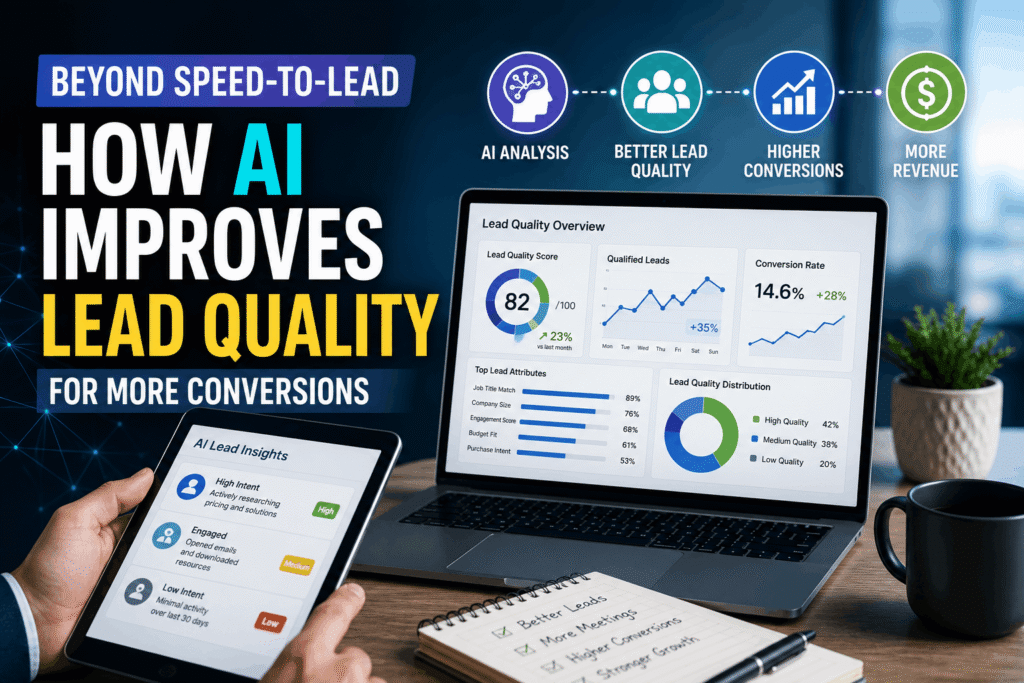
Because AI Lead Quality focuses on identifying buying intent instead of treating every lead the same. Someone downloading a pricing guide after visiting multiple product pages usually deserves more attention than someone who briefly viewed the homepage and left.
Speed still has value.
Prioritization creates better outcomes.
The Difference Between More Leads and Better Leads
Marketing campaigns often celebrate higher lead numbers.
Sales teams usually ask a different question.
“Which of these people are actually ready to buy?”
That’s where businesses begin separating quantity from quality.
A larger database doesn’t automatically create more revenue.
It often creates more follow-up work.
When AI reviews customer behavior, engagement history, company information, and previous interactions, patterns begin to appear.
Some prospects consistently match the profile of successful customers.
Others rarely move beyond an initial inquiry.
Understanding those differences allows both sales and marketing to focus their energy where it matters most.
How AI Finds High-Value Prospects
Modern AI systems don’t rely on a single action.
They evaluate dozens of signals together.
For example, AI might examine:
- Company size.
- Industry.
- Job title.
- Website activity.
- Email engagement.
- Content downloads.
- Previous purchases.
- CRM history.
- Product interest.
- Geographic location.
Individually, these details reveal very little.
Combined, they create a much clearer picture of buying intent.
Instead of guessing which prospect deserves immediate attention, sales teams receive recommendations based on real customer behavior.
How AI Lead Scoring Changes Sales Priorities
Traditional lead scoring often depended on simple rules.
Five points for downloading an eBook.
Ten points for requesting a demo.
Twenty points for opening three emails.
Those rules worked for basic qualification, but customer behavior has become more complex.
AI Lead Scoring continuously analyzes historical sales data alongside current engagement.
Rather than assigning points through fixed formulas, it identifies patterns that successful customers have in common.
A prospect who visits pricing pages several times, attends a webinar, and returns within a few days may receive a much stronger score than someone who downloads multiple free resources without showing purchase intent.
The scoring improves as more customer data becomes available.
That means sales teams spend less time reviewing low-priority leads.
Marketing and Sales Finally Work From the Same Data
One of the biggest challenges inside growing companies isn’t technology.
It’s alignment.
Marketing celebrates campaign performance.
Sales focuses on closed revenue.
Sometimes both departments look at the same leads and reach completely different conclusions.
Using AI Lead Quality helps create a shared view of customer readiness.
Marketing understands which campaigns produce qualified opportunities.
Sales gains confidence that incoming leads deserve attention.
Instead of debating lead quality during weekly meetings, both teams can review measurable customer signals.
That shifts conversations away from opinions and toward data.
AI Lead Generation Starts Before Someone Fills Out a Form
Many businesses think AI Lead Generation begins after a visitor submits their contact details.
In reality, AI starts learning much earlier.
Every interaction provides another clue.
A visitor may:
- Read multiple comparison articles.
- Return several times during the same week.
- Watch product videos.
- Browse pricing information.
- Download technical documentation.
Those actions often reveal stronger buying intent than a single form submission.
AI connects those signals into a broader picture, helping marketers recognize promising prospects before direct conversations begin.
Why Lead Qualification Keeps Improving Over Time
Traditional qualification processes usually remain unchanged until someone manually updates the rules.
AI works differently.
As new customers move through the sales pipeline, the system continues learning.
It notices:
- Which industries convert faster.
- Which company sizes generate higher revenue.
- Which campaigns attract long-term customers.
- Which behaviors rarely result in sales.
Those insights gradually improve Lead Qualification without requiring constant manual adjustments.
Over time, recommendations become more accurate because they’re based on growing amounts of customer data rather than assumptions.
Better Conversations Start With Better Information
A sales representative doesn’t need twenty facts before making a phone call.
They need the right facts.
When AI Lead Quality highlights recent customer activity, previous interactions, product interests, and engagement history, conversations become far more relevant.
Instead of asking broad questions, sales teams can begin with context.
That creates a better experience for both the customer and the representative.
People appreciate speaking with someone who understands why they reached out instead of starting every conversation from scratch.
AI for Sales Works Best When It Supports People
AI can recommend the next step.
It can summarize customer activity.
It can even predict which opportunities deserve immediate attention.
What it cannot do is replace trust.
Customers still expect thoughtful conversations, clear answers, and genuine expertise before making a purchase.
That’s why successful organizations treat AI for Sales as an assistant rather than a decision-maker.
For example, AI might suggest that a prospect has a high probability of converting based on previous buying patterns.
The salesperson still decides how to approach that conversation.
Technology speeds up preparation.
People close the deal.
AI Conversion Optimization Starts Before the Sales Call
Many businesses think conversion optimization begins after someone becomes a lead.
The reality is much broader.
Every interaction shapes the buying journey.
Landing pages.
Product comparisons.
Email campaigns.
Webinars.
Live chat.
Customer reviews.
Each touchpoint influences whether someone continues moving toward a purchase.
AI Conversion Optimization studies these interactions together.
It identifies where visitors lose interest, which content keeps them engaged, and which marketing channels consistently produce customers instead of casual browsers.
That allows marketing teams to improve the entire customer journey rather than focusing on a single stage.
Different Industries Use AI Lead Quality in Different Ways
No two businesses qualify leads the same way.
A software company may value repeated product demonstrations.
A manufacturing business might focus on company size and purchasing authority.
A healthcare provider could prioritize appointment requests and service inquiries.
The flexibility of AI Lead Quality makes it useful across industries because it adapts to customer behavior instead of relying on one universal formula.
Some practical examples include:
Software Companies
AI identifies prospects who repeatedly compare pricing plans, attend webinars, and request technical documentation.
Financial Services
Customer engagement, financial goals, and consultation requests help prioritize qualified opportunities.
Manufacturing
AI highlights companies researching product specifications, requesting quotations, and downloading technical resources.
Professional Services
Consulting firms often monitor proposal requests, case study downloads, and repeat website visits to identify serious prospects.
Each business measures buying intent differently.
AI simply learns those patterns faster than manual processes.
Choosing the Right AI Platform
The market offers hundreds of AI-powered sales and marketing solutions.
Not every platform fits every business.
Before investing, organizations should evaluate whether the software supports existing workflows instead of creating new complexity.
Useful questions include:
- Does it integrate with the current CRM?
- Can marketing and sales access the same information?
- Does it explain why leads receive certain scores?
- Is reporting easy to understand?
- Will employees actually use it every day?
The best software doesn’t always include the longest feature list.
It solves everyday problems without slowing people down.
Common Mistakes Businesses Make With AI
AI produces valuable insights.
Only when the data is reliable.
Several mistakes continue appearing during implementation.
Treating Every Recommendation as Correct
AI identifies probabilities.
It doesn’t guarantee outcomes.
Sales representatives should combine AI recommendations with their own experience.
Ignoring Data Quality
Duplicate records, incomplete customer profiles, and outdated information reduce prediction accuracy.
Clean customer data remains essential.
Expecting Immediate Results
Machine learning improves over time.
The first month rarely reflects the system’s long-term performance.
Forgetting Human Feedback
Sales representatives notice customer behavior that software cannot always measure.
Their observations help improve future models.
Measuring Success Beyond Conversion Rates
Closing more deals matters.
It’s only part of the picture.
Organizations using AI Lead Generation, Lead Qualification, and AI Conversion Optimization often monitor several performance indicators together.
Common metrics include:
- Sales-qualified leads.
- Lead-to-customer conversion rate.
- Average sales cycle length.
- Revenue per customer.
- Customer acquisition cost.
- Sales productivity.
- Marketing return on investment.
- Pipeline growth.
Looking at multiple measurements creates a more accurate understanding of business performance.
A slight improvement across several areas often delivers greater long-term value than one dramatic increase in a single metric.
Building Trust With Better Customer Insights
People notice when conversations feel relevant.
They also notice when they don’t.
A prospect doesn’t want to repeat information they already shared through a contact form or previous meeting.
Using AI Lead Quality, sales teams can review customer activity before reaching out.
They understand which resources someone explored.
Which products attracted attention.
Which challenges appeared during previous conversations.
That preparation changes the discussion completely.
Instead of asking generic qualifying questions, representatives can focus on solving problems that already matter to the customer.
The experience feels more personal because it starts with context instead of assumptions.
Sales Teams Keep Learning Alongside AI
AI continues improving as customer behavior changes.
Sales teams should do the same.
Regularly reviewing successful deals helps identify new buying signals that may not have mattered six months earlier.
Some industries change quickly.
Customer expectations shift.
New competitors enter the market.
Buying cycles become shorter or longer.
Organizations that combine continuous learning with AI Lead Quality adapt more easily because both the technology and the people behind it improve together.
The strongest results usually come from that partnership rather than relying on software alone.