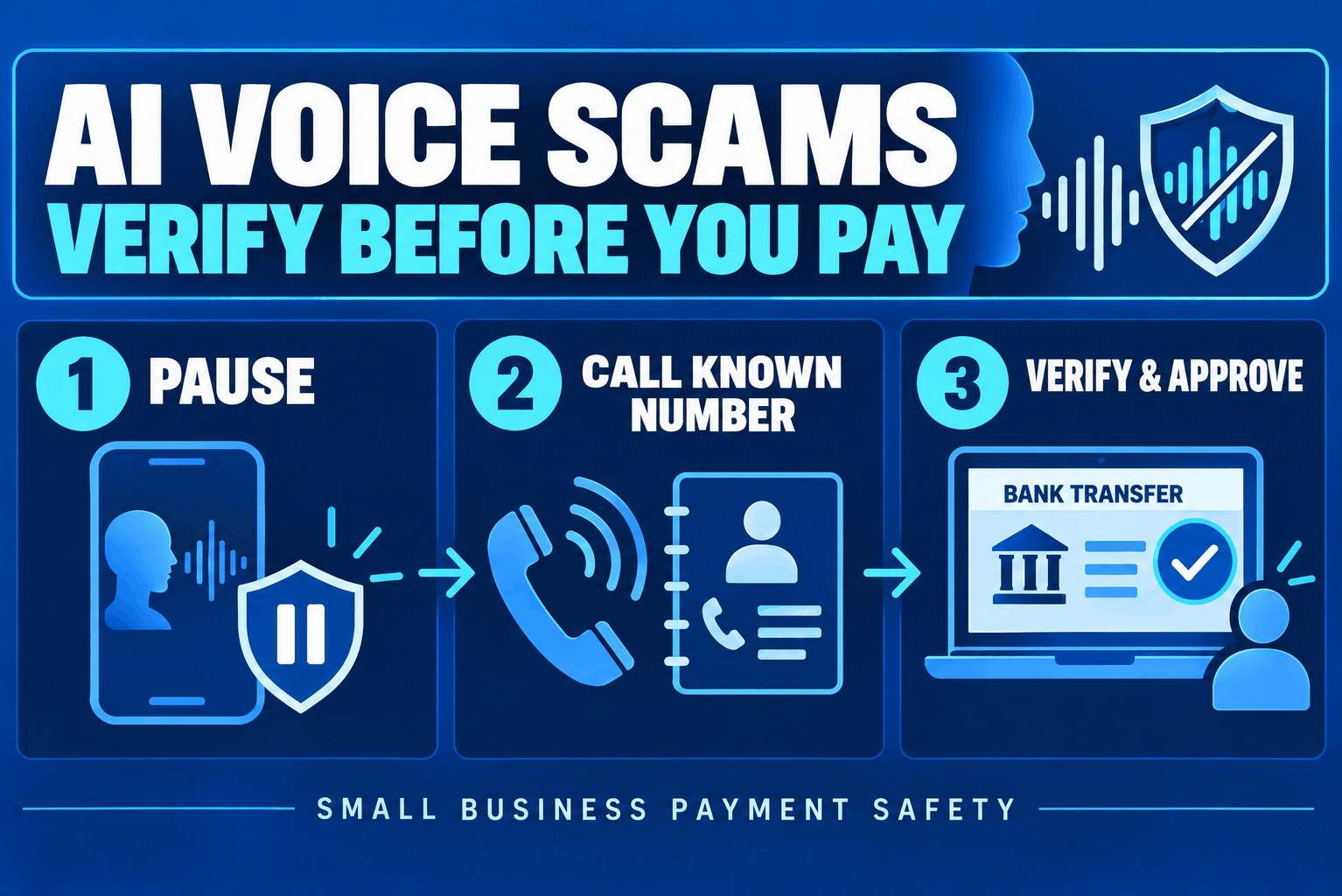
A supplier emails to say its bank details have changed. A few minutes later, the owner gets a call from someone who sounds exactly like the supplier’s account manager, apologizing for the mix-up and asking for payment before the end of the day. That voice may feel familiar. It still is not proof. AI voice scams for small businesses exploit a simple weakness in ordinary payment routines: people are asked to trust a convincing sound instead of checking the request through a separate channel.
The call might be genuine. The danger is the pressure to treat familiarity as verification. A cloned voice can be paired with a spoofed email, a compromised mailbox or details lifted from public posts. Small teams are especially exposed when one person raises invoices, approves transfers and has no colleague to call for a second look. The useful response is procedural, not technical: pause, use contact details already on file, and require a second approval for unusual payments. For AI voice scams for small businesses, that pause matters more than voice quality.
How AI voice scams for small businesses can work
An AI voice cloning scam can use software to generate speech that resembles a person from an audio sample. The sample may come from an interview, webinar, social video, voicemail or a recording posted for another reason. The FTC has warned that scammers can use a short clip to imitate a familiar voice. Its example concerns family emergency scams, but the basic warning also applies at work: a voice match does not prove who is speaking. That is why AI voice scams for small businesses cannot be screened by ear alone.
In a business setting, the caller may claim to be the owner, a finance lead, a supplier or a service provider. The request usually has a reason to move quickly: a shipment will be delayed, a contract will expire, or a confidential deal cannot wait. A scammer may know names, schedules and current projects from public posts or a compromised email thread. That context can make a false request sound ordinary. This is a common pattern behind AI voice scams for small businesses.
A likely scenario is a bookkeeper receiving a voice message from the managing director: “I’m heading into a meeting. Pay the new contractor account now and I’ll send the invoice later.” The message is brief, confident and plausible. But if a payment is unusual, a known voice should not bypass the usual checks. AI voice scams for small businesses succeed when urgency pushes a worker to skip a step they would normally follow.
The voice may not be the first clue. A payment change can arrive by email, followed by a phone call meant to reassure the recipient. It can also start with a text that claims a vendor has switched banks. These variations overlap with business email compromise, where a criminal spoofs or takes over an account and asks for a legitimate-looking transfer. The FBI lists altered vendor invoices and payment-procedure changes among the examples businesses should verify directly. That overlap makes AI voice scams for small businesses harder to spot by checking just one message.
Red flags that deserve a pause
An urgent request is not automatically fraudulent. Real suppliers sometimes change banks, and managers do occasionally need a fast payment. The issue is whether the request changes a known process. Watch for a new account number, a last-minute beneficiary change, secrecy, a demand to ignore the usual approver, a request to use gift cards or cryptocurrency, or instructions to keep the call open while the transfer is made. This is where AI voice scams for small businesses can exploit routine pressure.
Check the whole message, not just the voice. Does the email address match the saved vendor contact exactly? Is the request part of an existing invoice thread, or did a new address appear? Does the caller avoid a simple verification question? A slight difference in a domain can be hard to notice on a phone screen. The FBI specifically advises checking addresses and URLs, and not using contact details supplied in an unsolicited message to validate that same message. A separate call helps stop AI voice scams for small businesses from controlling both sides.
A voice that sounds flat, has odd pauses or pronounces a name strangely may raise suspicion. So can an unusual background noise or a sudden change in speaking style. But these are clues, not a reliable test. Audio quality varies, and synthetic speech keeps changing. Don’t try to decide by ear alone. Deepfake voice scams are better handled with a process that does not depend on detecting a perfect imitation. For AI voice scams for small businesses, sound quality alone offers no dependable answer.
A simple business payment verification routine
Use a contact number already stored in the vendor record, a previous invoice, or the supplier’s official website. Do not call the number in the new email, text or voicemail. Ask the supplier to confirm the change and its start date. If someone claims the vendor’s phone number has changed too, confirm through a second known route or another person at the supplier. A caller ID can be spoofed, so an incoming call from a familiar number is not enough by itself. This callback step is central to AI voice scams for small businesses protection.
For an executive request, end the call and ring the person back using the number in the company directory. Ask a specific question about the payment, but do not rely on a personal secret or public fact as the only check. If your business uses a code phrase, keep it private and change it if it is ever shared in a suspicious interaction. A callback is simple, but it breaks the attacker’s control over the conversation. It is a useful safeguard against AI voice scams for small businesses.
Build business payment verification into the written process. For example: any first payment to a new account requires a callback and written confirmation, while a second employee reviews the beneficiary name and amount before release. The person who updates the vendor record should not be the only person who approves the transfer. Even a two-person business can split those duties: one checks with the supplier and a second person reviews the bank details before clicking “send.” That check also blocks AI voice scams for small businesses that rely on one-person approval.
Keep vendor contact details outside the email thread. A small business can store a primary and backup contact in its accounting system or shared vendor list. Limit who can edit those records. Record when a change was confirmed, who confirmed it, and which number they called. This creates a traceable note without adding much work to accounts payable. Written records make AI voice scams for small businesses easier to investigate. This record helps resolve AI voice scams for small businesses disputes later.
These steps address AI voice scams for small businesses as well as ordinary invoice fraud. They do not require special software, and they still work when the caller uses a cloned voice, a real voice recording or a hacked mailbox. The point is not to catch every suspicious detail. It is to make sure one convincing message cannot change where company money goes. These steps address AI voice scams for small businesses without special software.
Reduce the chance of account takeover
Voice impersonation often arrives alongside email or messaging tricks. Protect the accounts that contain invoices, payroll details and supplier conversations. Use multifactor authentication where available, starting with email and financial services. Choose unique passwords and store them in a reputable password manager rather than reusing the same login across vendor portals. For AI voice scams for small businesses, email security matters because requests often arrive together.
The FBI recommends multifactor authentication and asks businesses to verify account-number or payment-procedure changes directly with the person making the request. IC3 also recommends a second channel or two-factor authentication when confirming account information changes. A second channel means the confirmation does not travel through the same email thread or phone conversation that delivered the request. Separate-channel checks limit AI voice scams for small businesses even when a caller sounds familiar.
Review who can change payment details in bookkeeping and banking tools. Remove access when an employee or contractor leaves. Turn on alerts for new payees, changed beneficiaries and transfers above a sensible threshold. If the bank supports approval limits, require a second user to release larger or first-time payments. These controls can feel a little slow on a quiet afternoon. That is preferable to discovering that an unfamiliar account received a month’s cash flow. That approval rule gives AI voice scams for small businesses fewer ways around routine checks.
Train staff with a short example rather than a long warning document. A useful exercise: send a mock message requesting a vendor bank change and ask the team what they would do next. The expected answer should be clear: stop the payment, call the stored number, check the details, and get another approval. Make it safe to question a request from a senior person. If workers fear being blamed for a delay, they may comply before checking. Use the same drill for AI voice scams for small businesses and changed-invoice requests.
Invoice fraud prevention after a suspicious call
If an employee spots an odd request before a transfer, preserve the message and report it internally. Contact the supposed sender through a known number. If the request came from a compromised mailbox, the real supplier may need to secure its account too. Do not reply to the suspicious thread to ask whether it is legitimate; an attacker who controls the inbox can simply confirm their own request. This is simple AI voice scams for small businesses response practice.
If money has already moved, call the bank or payment provider immediately. Ask whether the transfer can be recalled or frozen. Record the time, amount, beneficiary details, email headers or message screenshots, and the names of people contacted. The FBI’s IC3 says time matters after a fraudulent transfer and advises contacting the financial institution and requesting a recall as soon as possible. Recovery is not guaranteed, but waiting to investigate internally can reduce the time available to act. Those first minutes matter in AI voice scams for small businesses response.
Report the incident through the relevant local reporting channel and follow your bank’s instructions. If email credentials may have been exposed, reset them from a trusted device, revoke active sessions, check forwarding rules and review account recovery details. Notify affected vendors and employees through a separate channel. An incident can leave a business with two jobs at once: trying to recover funds and keeping normal payments moving. A written contact list helps both. A playbook also limits AI voice scams for small businesses damage.
Good invoice fraud prevention is less about buying a voice detector and more about controlling the payment path. Such AI voice scams for small businesses controls address the payment route. Detection tools may flag suspicious messages, but no audio classifier can replace a callback to a known number and a second approval for an unusual transfer. A mistaken alert can annoy staff; a false sense of certainty can be worse if someone assumes a “human-sounding” call must be safe.
Set a rule staff can remember
Write the rule in plain language and keep it near the payment workflow: “Never change supplier bank details from an email or call alone. Confirm using a known contact method and get a second approver.” Make it apply to everyone, including the owner. If the owner can bypass it, staff will learn that the process is optional. Such a rule addresses AI voice scams for small businesses without audio detectors.
Use the same rule for urgent payroll changes, refunds, equipment purchases and requests for confidential files. Make exceptions visible and documented rather than handled in a hurried private call. A manager can still approve an emergency payment, but the business should verify the recipient through a second route and retain the record. It helps staff handle AI voice scams for small businesses calmly.
AI voice scams for small businesses are unsettling because the caller may sound like someone the team knows. The safer question is not “Does this sound like them?” It is “Have we confirmed the request somewhere the caller cannot control?” That small distinction gives staff permission to pause, verify the account and protect the next payment. AI voice scams for small businesses call for independent confirmation, not guesswork.
What are AI voice scams for small businesses?
They are scams in which someone uses a cloned or synthetic voice to impersonate an owner, employee, or supplier and prompt a payment or sensitive action.
How can a small business verify a payment request?
Call the requester using a number already saved in company records, confirm the payment details, and have a second person approve unusual or first-time transfers.
What should a business do if it has sent money to a scammer?
Contact the bank or payment provider immediately and ask whether the transfer can be recalled or frozen. Preserve messages and transaction details, then report the incident through the appropriate channel.