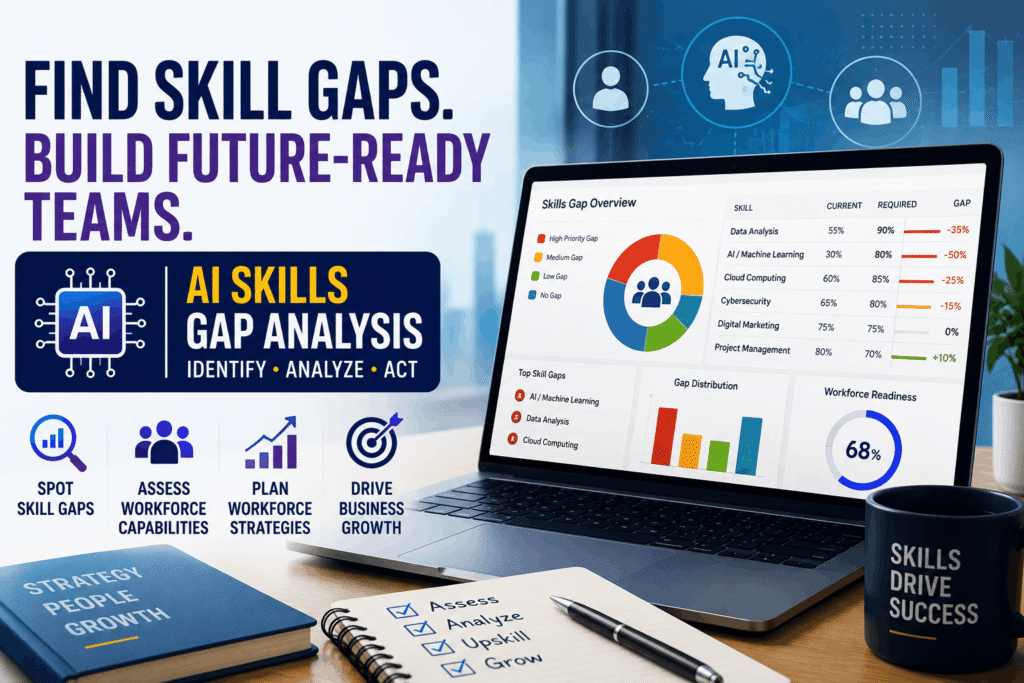
Every organization depends on the skills of its people, but knowing exactly where those skills are strong, or where they need improvement, isn’t always easy. That’s why AI Skills Gap Analysis is becoming an important part of workforce planning. Instead of relying on annual reviews or spreadsheets, HR teams can use AI to identify missing capabilities, recognize emerging skill requirements, and help employees prepare for future roles before shortages begin affecting the business.
A company may appear fully staffed on paper.
That doesn’t necessarily mean it has the expertise needed for tomorrow’s projects.
Technology evolves.
Customer expectations change.
New regulations emerge.
The workforce has to keep pace.
Why Skills Gaps Are Harder to Spot Than Ever
Most businesses know when they need more employees.
Recognizing missing skills is far more difficult.
A software company may have enough developers but very few with cloud security experience.
A manufacturing business might need technicians trained to operate automated equipment.
A marketing agency may require specialists in AI-powered content strategy instead of traditional campaign management.
These gaps often remain hidden until projects slow down or hiring becomes urgent.
By then, businesses are reacting instead of preparing.
That shift from reactive hiring to proactive planning is one reason AI Skills Gap Analysis has become a growing priority for HR leaders.
A Skills Gap Isn’t Always About Hiring
When organizations hear the phrase “skills gap,” many immediately think about recruitment.
Hiring is only one solution.
Sometimes the right talent already works inside the company.
The challenge is identifying where existing employees can grow.
An experienced customer support representative may have the communication skills needed for account management.
A data analyst might be ready for leadership after developing project management capabilities.
Without clear visibility, those opportunities remain hidden.
Using Skills Gap Analysis, HR teams can compare current employee capabilities with future business needs instead of assuming new hiring is the only answer.
How AI Changes the Assessment Process
Traditional assessments usually happen once or twice each year.
Managers complete evaluations.
Employees fill out self-assessments.
HR combines the information into reports.
The process takes time.
The information often becomes outdated before planning even begins.
AI Skills Assessment works differently.
Instead of depending on occasional reviews, AI continuously evaluates information from multiple sources, including learning platforms, certifications, project participation, performance data, and internal workforce records.
Rather than producing static reports, it creates an updated picture of organizational capabilities.
That gives HR teams a clearer understanding of where expertise exists and where additional development may be needed.
HR Skills Analytics Turns Workforce Data Into Action
Most organizations already collect valuable employee information.
Training records.
Performance reviews.
Certifications.
Promotion history.
Internal mobility.
Learning completion rates.
Unfortunately, this information often lives inside separate systems.
That makes identifying trends difficult.
HR Skills Analytics connects these data points to reveal patterns that might otherwise remain unnoticed.
For example, HR may discover:
- Leadership skills are concentrated within one department.
- Cybersecurity certifications are declining.
- Customer service teams consistently complete advanced training faster than other groups.
- Several business-critical skills depend on employees nearing retirement.
These insights help leaders make informed workforce decisions before shortages affect daily operations.
The Biggest Warning Signs Often Go Unnoticed
Organizations rarely wake up one morning and realize they have a serious capability gap.
The warning signs usually appear gradually.
Projects begin taking longer.
Recruitment becomes more difficult.
Training requests increase.
Specialized contractors become necessary.
Internal promotions slow down.
Customer expectations evolve faster than employee capabilities.
Viewed separately, these challenges seem unrelated.
Together, they often indicate a growing Workforce Skills Gap.
AI helps HR recognize these patterns earlier by analyzing information across departments rather than reviewing isolated reports.
Spreadsheets Can’t Keep Up With Modern Workforce Planning
Many HR departments still rely on spreadsheets to monitor employee development.
For small organizations, that may work.
As businesses grow, manual tracking becomes increasingly difficult.
Employees complete new certifications.
Job responsibilities change.
Business priorities shift.
Managers update skill profiles inconsistently.
Keeping everything accurate becomes a full-time responsibility.
This is where AI Workforce Planning offers practical advantages.
Instead of requiring manual updates across multiple documents, AI continuously organizes workforce information, making it easier to identify future staffing needs, succession opportunities, and training priorities.
The result isn’t simply better reporting.
It’s faster decision-making.
Looking Beyond Job Titles
Job titles rarely tell the whole story.
Two employees with the same role may have completely different strengths.
One project manager may excel at client communication.
Another may specialize in budgeting and resource planning.
One software engineer might focus on cybersecurity.
Another may be highly experienced in artificial intelligence.
By evaluating actual capabilities rather than titles alone, Employee Skills Assessment creates a more accurate understanding of workforce potential.
This broader perspective helps businesses uncover hidden expertise that might otherwise remain unused.
It also opens new opportunities for internal mobility because decisions are based on demonstrated skills instead of assumptions.
Preparing for Jobs That Don’t Fully Exist Yet
Technology changes faster than job descriptions.
Many positions growing today barely existed a few years ago.
Organizations can’t wait until demand appears before developing new capabilities.
This is where Skills Intelligence Platform solutions provide long-term value.
By analyzing industry trends, workforce data, and emerging business requirements, these platforms help HR teams identify skills likely to become important in the future.
That information supports learning programs, succession planning, and recruitment strategies before shortages become critical.
Instead of chasing talent after competitors have already hired it, organizations gain time to develop expertise from within.
Building a Skills Strategy That Lasts
Finding a skills gap is only the first step.
The real value comes from deciding what to do next.
Some organizations immediately begin recruiting.
Others invest in training.
Many discover the strongest approach combines both.
Using AI Skills Gap Analysis, HR teams can prioritize the skills that have the greatest impact on business goals instead of trying to improve everything at once.
For example, if customer demand for cybersecurity services is increasing, developing those capabilities may deliver greater value than expanding skills that already exist across the workforce.
That kind of planning keeps learning initiatives focused and measurable.
Learning Becomes More Personal
Not every employee needs the same training.
Someone preparing for a management role requires different development than an employee moving into data analytics.
Traditional learning programs often place everyone in identical courses.
The results are mixed.
Some employees already know the material.
Others need more advanced instruction.
With AI Skills Assessment, learning paths can be tailored to each person’s current abilities and future career goals.
Instead of assigning training based on job titles, HR teams can recommend courses that address individual development needs.
Employees spend less time completing unnecessary modules.
Managers gain confidence that training budgets support meaningful growth.
Internal Mobility Starts With Better Visibility
Many businesses search outside the company before looking within.
That approach often increases recruitment costs while overlooking experienced employees ready for new opportunities.
Imagine a business opening a project management position.
Rather than starting an external hiring campaign immediately, HR reviews workforce data.
An operations coordinator has already completed leadership training.
A business analyst recently earned project management certification.
Another employee has successfully led cross-functional initiatives.
Without HR Skills Analytics, these candidates might never appear on a recruitment shortlist.
By identifying transferable skills across departments, organizations strengthen internal mobility while reducing hiring time.
Employees also see clearer career opportunities, improving retention over the long term.
Managers Make Better Decisions With Better Data
Performance reviews remain valuable.
They also represent one moment in time.
Managers make workforce decisions throughout the year.
They approve promotions.
Assign projects.
Build teams.
Recommend training.
Support succession planning.
Having access to updated Employee Skills Assessment data helps those decisions become more consistent.
Instead of relying on memory or informal observations, leaders can review verified skill profiles before assigning responsibilities.
That creates stronger project teams and reduces the risk of overlooking capable employees.
Preparing the Workforce for Future Business Goals
Business strategy changes constantly.
New markets appear.
Products evolve.
Technology reshapes customer expectations.
The workforce has to evolve alongside those changes.
AI Workforce Planning helps HR connect long-term business objectives with employee development.
If leadership plans to expand into automation, cloud services, or advanced analytics over the next three years, HR can begin identifying capability gaps long before recruitment becomes urgent.
That creates time to reskill existing employees while reducing dependence on highly competitive hiring markets.
Planning ahead almost always costs less than reacting after shortages appear.
Common Mistakes During Skills Gap Projects
Technology alone doesn’t solve workforce challenges.
Several common mistakes continue limiting successful implementations.
Treating Skills as Static
Employees learn continuously.
Certifications change.
Projects build experience.
Responsibilities expand.
Organizations that update skill information only once each year quickly lose accuracy.
Collecting Data Without Taking Action
Reports have little value if they never influence workforce decisions.
Insights should guide learning, hiring, promotions, and succession planning.
Ignoring Employee Career Goals
Business priorities matter.
Individual ambitions matter too.
Development programs become far more effective when both align.
Focusing Only on Technical Skills
Leadership.
Communication.
Critical thinking.
Collaboration.
These abilities often influence business performance just as much as technical expertise.
A balanced Skills Gap Analysis should evaluate both.
Measuring Progress Beyond Training Completion
Completing a course doesn’t automatically close a skills gap.
Organizations should evaluate whether learning creates measurable business improvements.
Useful indicators include:
- Internal promotion rates.
- Time required to fill critical roles.
- Certification growth.
- Employee retention.
- Project success rates.
- Learning participation.
- Productivity improvements.
- Cross-functional mobility.
Tracking these measurements over time helps HR understand whether workforce development efforts are producing meaningful results.
The objective isn’t simply delivering more training.
It’s building capabilities the business genuinely needs.
Technology Supports People, It Doesn’t Replace Them
AI can identify trends.
It can recommend learning opportunities.
It can compare workforce capabilities with future business requirements.
Human judgment still matters.
Managers understand team dynamics.
Employees know their career aspirations.
Leaders define organizational priorities.
The strongest results happen when AI Skills Gap Analysis supports those decisions instead of replacing them.
Technology provides clarity.
People provide direction.
Together, they create workforce strategies that adapt as business needs continue to change.
Skills Intelligence Will Shape the Future of HR
Organizations are moving away from managing employees solely by job title.
Skills are becoming the foundation for hiring, workforce planning, learning, and internal mobility.
Modern Skills Intelligence Platform solutions help HR teams understand not only where talent exists today but also where new capabilities will be needed tomorrow.
As these platforms become more connected with learning systems, performance management, and recruitment tools, businesses will gain a clearer picture of workforce readiness.
That visibility allows HR to respond faster to market changes while creating more meaningful career opportunities for employees.
For organizations planning long-term growth, investing in AI Skills Gap Analysis is no longer just about identifying weaknesses.
It’s about building a workforce that’s ready for whatever comes next.