The AMD vs Nvidia debate is often framed as a contest between chip speeds. For investors, that misses the part customers live with every day: software, developer familiarity, deployment work, and the cost of moving a production workload. Nvidia’s CUDA platform has a long-established place in GPU computing. AMD’s ROCm is an open software stack that has gained more AI tools and model support. The question is not simply which chip looks faster on a product slide. It is which platform can deliver useful work reliably, at an acceptable total cost, while turning demand into durable earnings.
There is a striking scale gap in the latest reported results. AMD reported Q3 2026 revenue of $13.377 billion, including record Data Center segment revenue of roughly $8.5 billion, up 97% year over year. Nvidia reported Q3 fiscal 2027 revenue of $115.8 billion, including $107.6 billion from Data Center, up 110% year over year. These are not matching calendar quarters: AMD’s period ended September 26, 2026, while Nvidia’s ended October 25, 2026. They show scale and momentum but should not be treated as a perfectly synchronised comparison. AMD’s Q3 results Nvidia’s Q3 FY2027 results
The software comparison: CUDA and ROCm
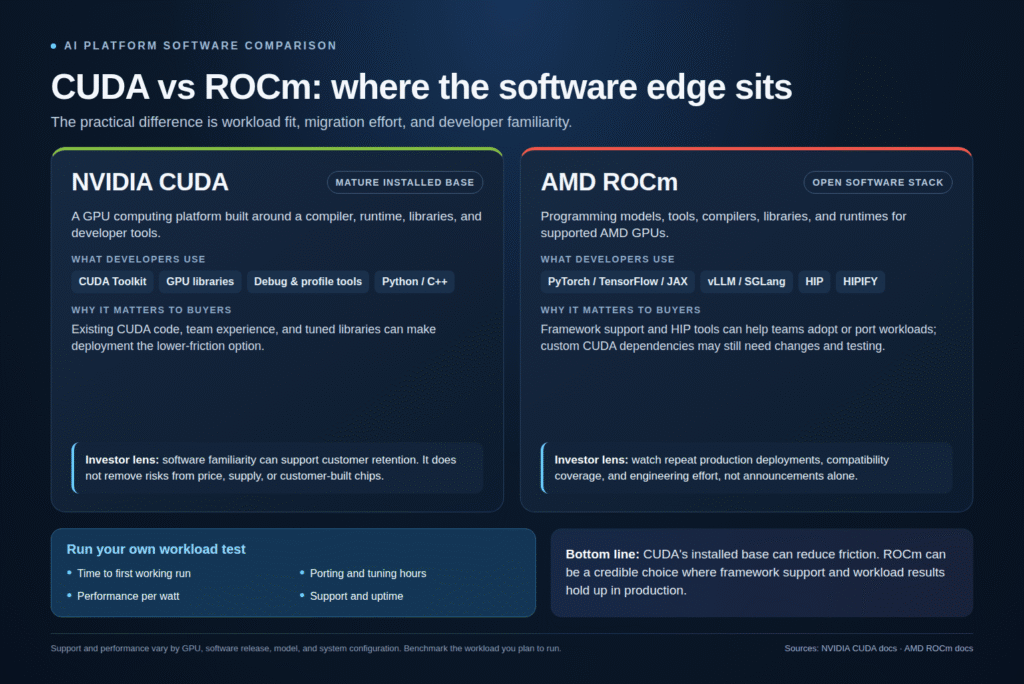
Nvidia’s central software advantage is accumulated familiarity. CUDA includes a compiler, runtime, GPU libraries, and developer tools. Teams can use it directly or through higher-level frameworks and libraries. Once a company has code, staff expertise, testing routines, and production support built around CUDA, switching has a cost. Some workloads can move through widely used frameworks with relatively little change; code that calls CUDA-specific APIs, depends on tuned libraries, or relies on custom kernels may need substantial porting and retesting. Nvidia’s CUDA documentation
That switching friction matters to investors because it can help Nvidia defend demand even when a rival product appears attractive on price or hardware specifications. Developers do not make infrastructure decisions in a vacuum. They care about whether software installs cleanly, whether supported libraries cover their models, whether their team can debug a failure at 2 a.m., and how many engineering weeks a migration would consume. CUDA’s breadth and history are real commercial strengths. They are not a guarantee that every customer will keep buying Nvidia indefinitely.
AMD’s answer is ROCm, an open GPU software platform with programming models, compilers, libraries, runtimes, and tools for AI and high-performance computing. AMD lists support for popular frameworks such as PyTorch, TensorFlow, and JAX, and describes workflows using vLLM and SGLang for serving. Its HIP programming model can help developers adapt CUDA code, while HIPIFY can assist with translation. Neither tool makes every application a one-click port: dependencies, custom operations, hardware-specific tuning, and validation still take work. AMD’s own documentation advises checking the supported hardware and software compatibility for the specific system and release. AMD ROCm overview and documentation
The practical comparison is therefore less “closed versus open” than “mature installed base versus an alternative whose value depends on the workload”. ROCm can be compelling where a framework already supports it, where the customer has engineering capacity to tune and test, or where procurement wants a second source. CUDA can remain the lower-friction choice where existing software is deeply tied to it or where the time to deployment outweighs the chip’s purchase price. Investors should be wary of broad claims that a new accelerator is automatically interchangeable with the installed base. The software bill includes people, porting, system integration, uptime, and the cost of delay.
What the latest numbers do, and do not, say
AMD’s Q3 2026 revenue grew 45% year over year, and its reported GAAP gross margin was 54%. Its non-GAAP gross margin was 56%. Nvidia’s Q3 FY2027 GAAP gross margin was 74.8%, while its non-GAAP figure was 74.9%. Those margins offer evidence of different current economics, but the reported revenue bases are dramatically different and the companies have different product mixes. The non-GAAP figures also exclude items defined by each company, so investors should not compare them as though they were a single standardised measure. Start with GAAP, then review each issuer’s reconciliation before drawing a margin conclusion. AMD results and reconciliation Nvidia Q3 release
Nvidia’s latest quarter shows that demand has translated into exceptional sales at present. It does not establish how long spending by large cloud and AI buyers will grow at this rate, how quickly new systems will be installed, or what returns those buyers will earn on the capital. AMD’s smaller base gives it room to post rapid percentage growth if more customers adopt its GPUs and rack-scale systems. Yet a smaller base does not itself mean the shares are cheap, and high growth is not proof that AMD can capture enough business to close the financial gap.
At the time of writing, this comparison does not include a current share-price or valuation analysis. That matters. A strong business can be a poor investment at an excessive price, while a lower-multiple stock can remain cheap for sound reasons. Before treating the AMD vs Nvidia stocks question as a choice between two product roadmaps, investors should check current market capitalisation, forward earnings assumptions, cash generation, share dilution, and what the price already expects. Without that work, this is a company and platform comparison, not a buy or sell call.
Competitive strengths, including the less comfortable parts
Nvidia sells more than a standalone GPU. Its data centre offer spans accelerators, CPUs, networking, systems, and software. That can make procurement and deployment easier for customers that want a complete infrastructure stack, and it gives Nvidia several ways to attach value to a large system sale. The risk cuts both ways: greater complexity raises execution demands. A delay or bottleneck in one part of a rack-scale system can affect the usefulness of the whole deployment.
AMD’s case rests on more than its accelerator line. EPYC server processors create an established data centre presence, and the company is building out Instinct GPUs and full-system offerings. Its Q3 release attributed record Data Center revenue to demand for EPYC processors and the launch of MI450-series GPUs. For investors assessing AMD AI accelerators, that mix is important: the segment’s growth cannot be attributed to GPUs alone. Watch for disclosures that separate accelerator sales, CPU demand, system deployments, and customer wins. A headline segment growth rate can hide shifts in what is actually driving revenue.
The Nvidia data centre GPUs franchise benefits from scale, software usage, and a broad customer base of cloud operators and businesses. Still, a market leader can face concentration risk even when it has many end users. A relatively small set of very large buyers can account for a meaningful share of purchases or receivables, and those customers may negotiate hard, delay capacity, develop custom chips, or spread workloads across suppliers. AMD’s filing also warns that a small number of customers account for a substantial portion of its revenue and receivables. That is a company-disclosed risk, not a forecast that any named buyer will leave. AMD Q3 2026 Form 10-Q
Risks investors should put on a watchlist
Customer spending and concentration. AI infrastructure budgets can rise quickly, but purchase orders are not the same as productive capacity or long-term recurring demand. If customers build more than they can use, pause data centre construction, or shift to custom silicon, accelerator orders could soften. Track customer concentration disclosures, accounts receivable, inventory, and signs that bookings are translating into installed, revenue-producing systems. A customer can remain committed to AI while buying fewer third-party GPUs.
Supply and execution. Advanced AI systems depend on manufacturing capacity, memory, packaging, networking, power, cooling, and data centre readiness. Nvidia’s Q2 FY2027 filing described supply constraints, large commitments made to secure future capacity, and the possibility that customers may defer purchases if infrastructure or funding is not ready. That filing reported supply and capacity commitments of $279 billion as of July 26, 2026. The number is not a bill due immediately, but it shows how much working capital and forecasting risk sits behind rapid growth. If demand estimates prove too high, inventory and purchase commitments can become painful. Nvidia Q2 FY2027 Form 10-Q
Export rules and geopolitics. Sales restrictions can change which products may ship to certain markets, what performance levels can be sold, or whether an order can be fulfilled at all. Nvidia’s filing describes shifting export controls, restrictions on sales, and charges tied to excess inventory and purchase obligations. AMD likewise lists export restrictions among factors that may affect results. Investors should read these disclosures as operating risks: rules can affect revenue, inventory, customer relationships, and product design. The details can shift, so older assumptions should not be carried forward without checking the latest filings.
Competition and in-house chips. Cloud providers and large technology customers have both the money and motivation to build custom accelerators. Even if those chips do not replace merchant GPUs across the board, they can take specific workloads or reduce bargaining power. AMD identifies competitors’ software advantages and customer-developed custom accelerators as risks in its filing. Nvidia also faces a different long-run risk: as its customers build internal expertise and diversify workloads, they may become less dependent on one platform. Software lock-in can slow that shift, but it cannot make customers captive forever.
Product cadence, margins, and valuation. New chip generations can bring speed gains, but each launch raises questions about supply yield, system reliability, customer transition timing, and the price customers will pay. Nvidia’s Q3 FY2027 guidance projected revenue of $130 billion, plus or minus 3%, for a quarter that includes an extra week; the company said its outlook assumed no data centre compute revenue from a restricted market. Guidance is management’s expectation, not a result already earned. AMD’s Q4 2026 revenue outlook was about $17 billion, plus or minus 3%, with non-GAAP gross margin around 55%. Compare those forecasts with reported results after each period closes, and keep non-GAAP definitions visible. Nvidia outlook AMD outlook
For AI chip stocks, the investor’s job is to separate a good product story from a sound price and a durable earnings path. A useful quarterly checklist is concrete: Did Data Center revenue rise because of repeatable volume or a small number of large shipments? Are gross margins holding after product mix changes? Are receivables and inventory growing faster than revenue? Are management’s capacity commitments matched by customer demand? Are software ports and production deployments expanding beyond pilots? Those answers say more than a demonstration benchmark on its own.
How to compare AMD and Nvidia for an investment decision
Start with your own thesis. If it rests on Nvidia keeping the broadest developer base and extracting value across an integrated system, monitor software adoption, customer spending, supply execution, and margin direction. If it rests on AMD winning as a second source, monitor production shipments, compatibility updates, repeat orders, software support, and the share of growth tied specifically to accelerators. A one-time evaluation or announced partnership is not equal to recurring, profitable sales.
Next, test the software claim using the intended workload. Compare time to first working run, engineering hours spent porting, tokens or jobs completed per watt, memory use, total system cost, and support burden. Results should come from the customer’s own models and code. A vendor’s benchmark may be accurate for its chosen setup and still say little about a different model, sequence length, batch size, or inference pattern.
Finally, price the risk. Review the latest filings, then compare valuation against a range of earnings outcomes rather than assuming today’s growth rate persists. Consider a case where customer spending cools, a case where AMD wins a larger share, and a case where Nvidia’s software and system breadth keep its lead. Include the possibility that both companies grow while the stocks disappoint because expectations were too high. That distinction sits at the center of AI semiconductor investing: owning a fast-growing market is not the same thing as earning an attractive return from every company in it.
Frequently asked questions
Is AMD software ready to compete with CUDA?
ROCm supports major frameworks and provides tools for AI and high-performance computing on supported AMD GPUs. It can be a practical choice for workloads whose frameworks and libraries already work well on the target setup. CUDA retains a wider-established installed base, and moving custom CUDA-dependent software takes engineering time. The right test is a workload-specific deployment trial, not a general claim that one stack has replaced the other.
Are AMD or Nvidia better AI chip stocks?
That depends on business execution and valuation, not only chip performance. Nvidia currently reports far greater revenue scale and data centre sales, while AMD has recently reported fast growth from a much smaller base. Without checking current prices and valuation assumptions, recent earnings alone cannot identify which stock offers the better prospective return.
What should investors track before buying either company?
Review each company’s latest reported results and guidance, data centre growth, GAAP margins, inventory, customer concentration, supply commitments, and export-control disclosures. Then compare the stock price with a range of earnings scenarios. For software, check whether real customers can deploy their own workloads reliably and whether AMD or Nvidia can earn repeat business after the initial purchase.