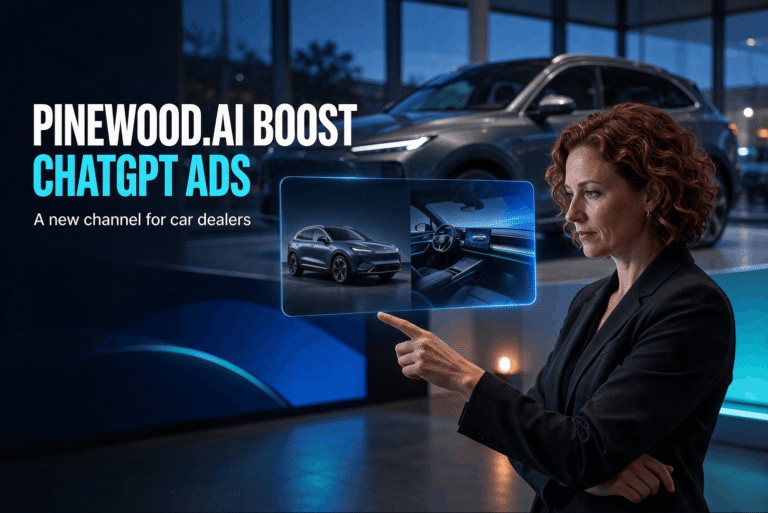
A car shopper can now ask an AI assistant to compare family SUVs, estimate ownership costs, or suggest vehicles for a daily commute. Pinewood.AI says its advertising product, Pinewood.AI Boost, now includes ChatGPT as a paid media channel, letting automotive dealers manage a new kind of sponsored placement alongside campaigns on Meta, Google, TikTok, and Snapchat. The launch gives dealers a way to test advertising inside vehicle research conversations, though the channel still needs to prove its value against enquiries, appointments, and sales rather than attention alone.
What changed in Pinewood.AI Boost?
Pinewood.AI announced on November 18, 2026, that its Boost performance marketing tool had added ChatGPT advertising. The product is developed by Seez, the automotive technology business Pinewood.AI acquired in 2025. The company says dealers and dealer groups can manage the new placement together with other paid channels from one service.
This is a channel expansion, not a claim that every part of ChatGPT advertising is now available through the platform. The announcement names the Sponsored Card format, where an advertisement appears alongside a ChatGPT response. It says the current offering supports that format, with further advertising formats to be added if and when OpenAI makes them available.
For marketing teams, that distinction matters. A new placement can sound like a wholesale change to how a dealership buys media. In practice, it is one more route to reach potential buyers, with its own audience, creative requirements, reporting details, and cost profile. Dealers should ask what inventory is included, what targeting controls exist, and how the platform reports a conversation that later becomes a showroom visit.
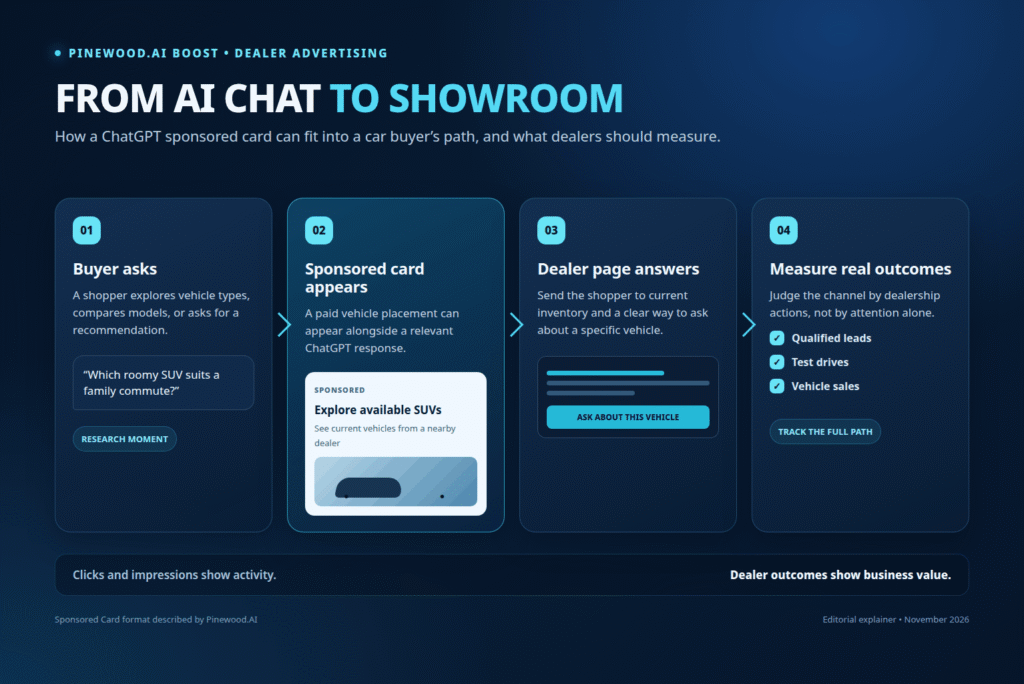
The announcement describes ChatGPT Ads as contextual. An ad may appear in a relevant conversation when a user is exploring options, comparing models, or asking for recommendations. That differs from an approach built mainly around prior browsing behavior. But a contextual match is not proof that the person is ready to buy, nor does it guarantee that the placement will lead to a qualified enquiry.
Why the ChatGPT ads channel is relevant to car retailers
Vehicle purchases involve a long research phase. A shopper may compare fuel types, passenger space, warranty terms, monthly costs, and several models before contacting a dealer. Search engines and automotive marketplaces have long served this research. Conversational assistants add another place where buyers can ask follow-up questions in plain language.
The new ChatGPT ads channel puts sponsored content near some of those questions. For a dealership, the appeal is the moment of consideration: a shopper who is actively narrowing a shortlist may be more receptive to a relevant offer than someone who has only glanced at a broad display ad. That is a sensible hypothesis to test, not a result to assume.
Pinewood.AI cited research from Invoca saying that 60% of car buyers surveyed in its market used generative AI tools to research a vehicle purchase in 2026, up from 47% the year before. The company also noted ChatGPT’s weekly user count in the announcement. Those figures provide context for why the channel is attracting attention. They do not show how many users saw a dealer ad, clicked it, booked a test drive, or bought a vehicle.
That gap between usage and commercial performance is where local testing matters. A high number of assistant users does not automatically mean a useful audience for every retailer. A dealer needs to know whether the placement reaches people near its sales area, whether the inventory shown is current, and whether the resulting leads match the dealership’s capacity and sales priorities.
How the Pinewood.AI advertising tool fits the media mix
The Pinewood.AI advertising tool is positioned as a central place for managing paid media across channels. On its product page, Pinewood describes SeezBoost as an AI-supported ad management service, with audience targeting, automatically generated ads for live inventory, and budget allocation among campaigns.
The announcement says Boost allocates dealer marketing budgets across channels, campaigns, and audiences, and shifts spend toward activity that produces qualified leads, test drives, and sales. Pinewood also says the service uses each retailer’s own data to connect ad spend with dealership outcomes. These are product claims from the company; dealers should confirm how the data connection works, which systems are supported, and what counts as a conversion in their own account.
Adding ChatGPT creates a practical measurement question: how does a conversation-based placement get credit when a sale may follow several interactions? A shopper might see a sponsored card, later search for the dealer, call the showroom, and complete a purchase days afterward. If the measurement model only credits the final click, the first interaction disappears. If it gives too much credit to the ad, the channel may look better than its contribution warrants.
A useful setup begins with agreed definitions. Decide what qualifies as an enquiry, a sales-ready lead, an appointment, a completed test drive, and a sale. Then compare the ChatGPT placement against other channels using the same definitions and a consistent time window. If the product’s reporting differs from the dealership’s CRM records, note the discrepancy rather than blending the numbers.
What dealers should measure first
A launch plan should start with a small, clearly bounded test. Choose a group of models or a single sales objective, set a spending limit, and decide how long the test will run before reviewing it. A test with no baseline or end date can turn into an open-ended budget line that is difficult to assess.
Clicks and impressions can help explain whether an ad is being shown and whether people interact with it. They are not the final measure of a dealership campaign. The more useful questions concern the path after the interaction: Did the shopper submit accurate contact details? Was the vehicle still available? Did the person book a visit? Did the visit happen? Did it lead to a sale?
Track lead quality as well as lead volume. A small number of buyers asking about specific vehicles may be more valuable than a larger set of vague enquiries. Sales staff can record whether each lead named a model, had a realistic purchase timeframe, or asked about availability. That feedback gives marketing teams a better view of whether the placement is reaching buyers or simply producing activity.
Dealers should also watch for operational issues. If an ad mentions a vehicle that has sold, the campaign may waste spend and frustrate shoppers. If response times are slow, an extra source of enquiries can increase the backlog without adding completed appointments. Make sure inventory feeds, lead routing, and response ownership are checked before increasing spend.
The role of a ChatGPT advertising platform in buying journeys
A ChatGPT advertising platform sits within a different kind of interaction from a standard search results page. The user is asking a question and may refine it through several turns. A sponsored card in that setting needs to be relevant to the conversation and clear about what it offers. Dealers should inspect the actual placement, understand the labeling, and check what users see when they click through.
That makes the landing page part of the ad experience. If a shopper asks for a compact hybrid with room for child seats, a generic homepage is a weak destination. A page with matching vehicles, current stock status, clear pricing information where available, and a direct route to ask about a specific car gives the user a more coherent next step.
Creative should answer a real buyer question rather than repeat a broad slogan. For instance, a dealer could test messages tied to a vehicle’s current availability, a service offer, or a specific category of stock. The claim must be accurate and easy to verify. The retailer should also confirm which creative elements it can control and which are formatted by the advertising service.
Conversation context raises another point: relevance can be useful, but it should not become a reason to make assumptions about a person. Dealers need to understand what audience or context signals inform delivery, what customer data is used, and what privacy controls apply. Ask the provider for documentation on data handling and consent, then involve the appropriate privacy or compliance lead before connecting customer records.
Is this an AI advertising platform or a new paid channel?
It is both a new paid channel within Boost and part of a broader AI advertising platform proposition. The phrase can make the product sound more autonomous than it is. The announcement describes automated budget allocation and channel management, but it does not say that a dealer can leave the entire campaign unattended or that the software replaces human approval.
Dealership teams should retain control over campaign goals, budgets, claims, and the vehicles being promoted. Automated allocation can respond to performance signals, but those signals are only as useful as the underlying data and definitions. If the system sees a large number of low-quality form fills as success, it may direct spending toward the wrong outcome.
Ask the vendor practical questions before switching on a larger budget. Can a dealer set channel-level caps? Can it pause a campaign immediately? How often does the allocation change? Can a manager see why spend moved? Does the reporting separate ChatGPT from other channels? What customer or sales data enters the system? Clear answers matter more than an impressive feature list.
What to check before scaling advertising campaign management
Good advertising campaign management depends on routine checks as much as platform features. Before expanding a ChatGPT test, compare the channel’s cost per qualified lead and cost per completed appointment with the dealership’s normal range. Review results by model or campaign where the sample is large enough to be meaningful. Avoid drawing a firm conclusion from a handful of enquiries.
Also compare the channel’s role with the rest of the media plan. Search advertising may capture a shopper already looking for a specific model or dealer. Social campaigns may introduce a vehicle to someone who has not begun an active search. A conversational sponsored card may reach a person in the middle of evaluating options. These paths overlap, so reporting should show both channel-level activity and the broader customer journey where possible.
A useful review includes sales staff. Ask whether leads arrive with a clear vehicle interest, whether the contact information is usable, and whether the buyer remembers the offer. Marketing dashboards cannot answer every question about what happens during a phone call or showroom visit. A short weekly feedback loop can uncover issues faster than waiting for a monthly report.
The product page presents SeezBoost as a service for automotive retailers, with AI-assisted audience targeting, dynamic ads using live inventory, and automated lead qualification features. Those details help explain the product’s wider purpose, while the ChatGPT announcement adds a new advertising destination to the mix. Dealers evaluating it should treat the release as an invitation to test and measure, not evidence that the new channel will outperform established media for every store.
FAQs
1. What is Pinewood.AI Boost?
Pinewood.AI Boost is Pinewood.AI’s performance marketing service for automotive retailers. The company says it helps dealers manage paid campaigns across multiple channels and allocate budgets using campaign and dealership data. The exact features and data connections available to a retailer should be confirmed with Pinewood.AI.
2. What does the ChatGPT ads channel include?
Pinewood.AI’s announcement says Boost currently supports ChatGPT’s Sponsored Card format, which appears alongside a ChatGPT response. The company says additional formats may be added as OpenAI makes them available.
3. How should a dealership judge whether ChatGPT ads are working?
Set a defined test budget and period, then track qualified enquiries, booked and completed test drives, and sales alongside clicks and impressions. Use the same conversion definitions across channels, check lead quality with sales staff, and account for inventory availability and response time before increasing spend.