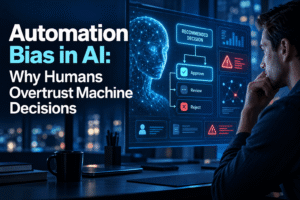
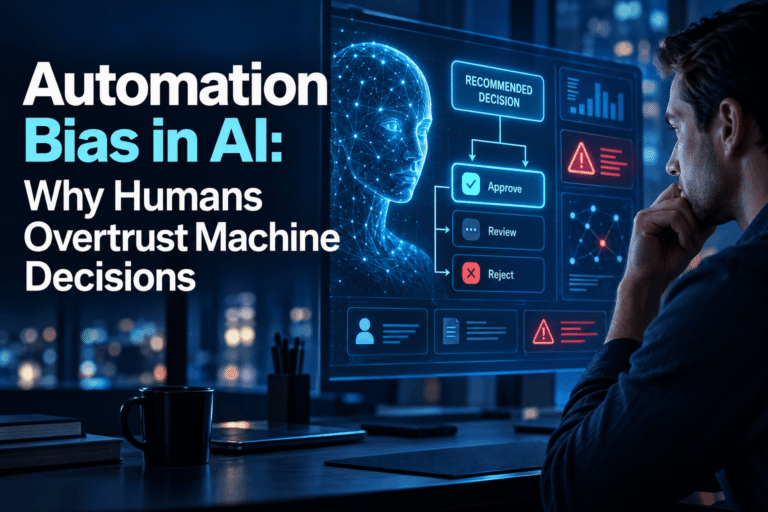
Most people assume that human judgment is the final safeguard when software makes a mistake. In practice, that safeguard can weaken quickly. Automation bias in AI appears when people accept a machine recommendation too readily, overlook warning signs, or stop checking information because the system seems more informed than they are. The problem is not simply that software can be wrong. It is that people may treat its output as the default answer, even when their own experience suggests otherwise.
This pattern can affect hiring, healthcare, finance, security, education, transport, and customer service. It can also appear in everyday tools that rank applications, flag unusual activity, assess risk, or suggest what a person should do next. Once a recommendation arrives with a score, label, or confident explanation, challenging it takes effort. Many people choose the easier path: accept the result and move on.
What Is Automation Bias in AI?
AI automation bias is the tendency to favor a computer-generated recommendation over independent judgment. A person might accept a system’s risk score without reviewing the evidence behind it. A manager may reject an applicant because a screening tool rated the application poorly. A clinician may give too much weight to a software alert and too little weight to symptoms that do not fit the suggested pattern.
The effect is strongest when the tool looks authoritative. Clean dashboards, precise percentages, and technical language can make a result feel objective. Yet a polished display does not prove that the underlying data is complete, current, or suitable for the decision at hand.
Automation bias is also different from deliberate misuse. In many cases, people are trying to work carefully. They may be handling too many cases, working under time pressure, or receiving limited training. If the system is presented as a trusted assistant, the surrounding process can quietly reward agreement rather than careful review.
Why People Overtrust Machine Decisions
A machine recommendation often arrives faster than a human review. It may also appear consistent, while human decisions can feel tiring or uncertain. This creates a strong psychological pull toward the automated answer, especially when staff members believe that questioning the system will slow down the workflow.
Several factors make this worse:
•Overtrusting AI systems becomes more likely when users do not understand how a recommendation was produced.
•A high-confidence score can hide the fact that the system has seen very few similar cases.
•Repeatedly correct suggestions can create a habit of acceptance, even when later results become less reliable.
•Workplace policies may focus on speed and volume instead of careful review.
•Users may fear being blamed for rejecting a machine recommendation that later turns out to be correct.
How Human Oversight in AI Breaks Down
The phrase human oversight in AI sounds reassuring, but placing a person somewhere in the process does not automatically create meaningful review. Oversight only works when the reviewer has enough time, information, authority, and confidence to challenge the system.
A common failure occurs when a person reviews only the cases that the software has already selected. If the system misses an important case, the reviewer may never see it. Another problem appears when users receive a recommendation without the evidence needed to assess it. They are asked to approve a result, but not given a practical way to test it.
Real oversight requires clear stop rules. Users should know when to pause a decision, request a second review, gather more information, or ignore the recommendation. They also need protection when they raise a concern. If every disagreement is treated as poor performance, people will learn to approve the system quietly.
The Cost of AI Decision-Making Bias
AI decision-making bias can produce unfair outcomes even when no user intends to discriminate. The software may reflect gaps in historical records, uneven data collection, or assumptions built into the design. Human reviewers can then reinforce those patterns by accepting the output without asking whether it makes sense for the individual case.
The impact depends on the setting. In recruitment, a biased ranking may reduce access to interviews. In lending, a flawed assessment may affect who receives an offer or how much they pay. In healthcare, an incorrect alert may delay attention for a patient whose symptoms do not match the data used to train the system. In security, an inaccurate flag can expose a person to unnecessary scrutiny.

Understanding the Risks of AI Automation
The risks of AI automation extend beyond inaccurate predictions. Organizations may become dependent on a tool that no longer receives proper maintenance. Employees may lose important skills when software handles routine judgment. Managers may struggle to explain a decision because responsibility is spread across a vendor, a data team, and a frontline user.
Building Better Human AI Collaboration
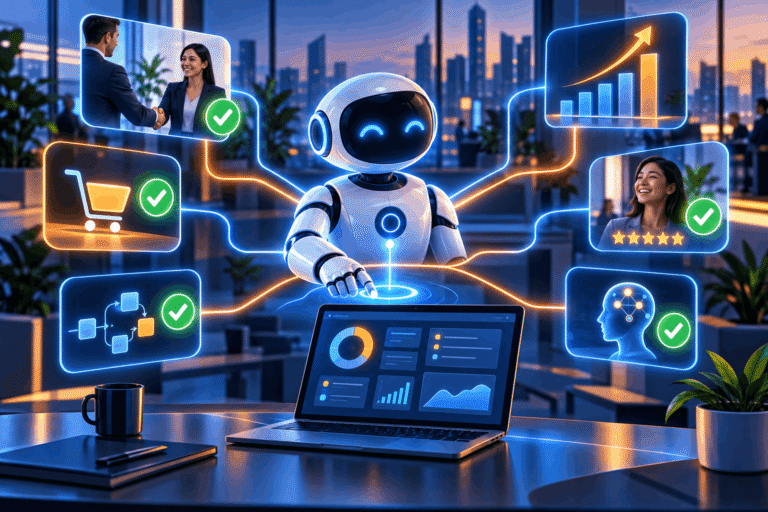
Good human AI collaboration does not mean dividing work into “the machine decides” and “the person approves.” It means giving each side a useful role. Software can search large records, identify patterns, and bring relevant information forward. People can add context, notice exceptions, question assumptions, and consider consequences that are difficult to represent in a data field.
Why Human-in-the-Loop AI Needs Real Authority
A human-in-the-loop AI process only works when the human has genuine authority. If the reviewer cannot delay a decision, request more evidence, or reject the recommendation without penalty, the person is acting as a rubber stamp.
A stronger process includes four practical safeguards:
1.Clear responsibility: Name the person or team responsible for the final decision.
2.Visible uncertainty: Show when the system has limited evidence or a low-confidence result.
3.Independent checks: Review selected cases without showing the automated recommendation first.
4.Appeal and correction: Give affected people a way to challenge an outcome and have it reconsidered.
Reducing Algorithmic Decision-Making Risks
Algorithmic decision-making risks become easier to manage when organizations treat monitoring as an ongoing responsibility rather than a launch task. Before deployment, teams should define the purpose of the system and identify decisions it must not make on its own. They should also document the data sources, known limitations, review steps, and escalation routes.
Vendor claims should be checked against local results. A tool that performed well in one environment may behave differently with another population, workflow, language, or data quality. Independent testing is especially important when the vendor does not explain how the system was evaluated.
AI Governance and Accountability in Practice
AI governance and accountability give an organization a way to turn good intentions into repeatable decisions. Governance should cover who approves a system, who monitors it, who can suspend it, and who responds when someone is harmed. It should not be limited to a general statement about responsible technology.
Reviewers should also keep a short record of important disagreements. These notes help teams see whether errors come from poor data, unclear instructions, weak training, or a system being used beyond its original purpose.
Strong AI ethics and safety work also includes the people affected by a decision. Their feedback can reveal errors that internal teams do not notice. Listening to complaints is not just a public-relations exercise; it can expose gaps in data, language, access, and process design.
The most reliable approach is modest and practical: treat machine output as evidence, not authority; make disagreement possible; record the reasoning behind important decisions; and keep a clear path for correction when the system gets it wrong.