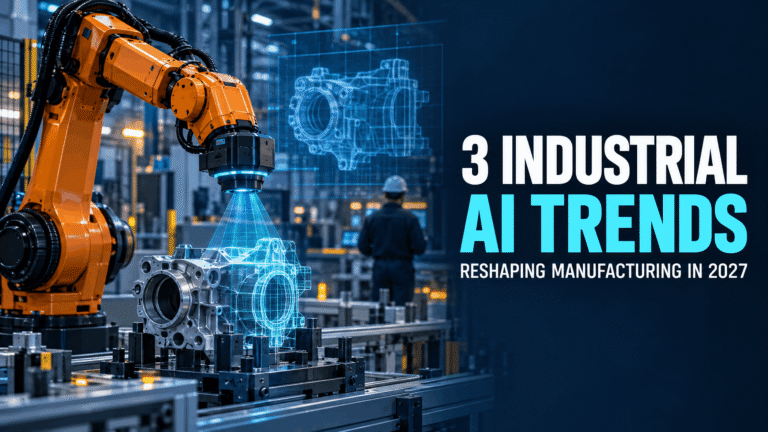
Factories are being asked to make more product variants, keep aging equipment running, and catch defects before they become expensive scrap. The most useful industrial AI trends for 2027 are therefore less about humanoid robots taking over entire plants and more about software and machines making better decisions inside specific production tasks. Three shifts stand out: in-process quality correction, live digital models of factory operations, and more adaptable robots for work that changes from one run to the next. A November 2026 industry outlook points to the same areas, while stressing that early physical AI deployments remain supervised and task-specific. These industrial AI trends are worth watching because each connects a model to an operating decision, not just another dashboard.
The distinction matters. A model that spots a possible fault is not the same as a system allowed to change a machine setting. In the coming year, many manufacturers are likely to extend AI from analysis into tightly bounded actions, with operators retaining authority over safety-critical decisions. That is a more credible outlook than assuming every pilot will become autonomous production. For the industrial AI trends ahead, this boundary between advice and control will shape which use cases earn trust.
Why these industrial AI trends are worth watching
In a 2026 survey of more than 350 manufacturing decision-makers, conducted by Cisco with Sapio Research, respondents reported using or exploring AI for process automation, supply-chain and logistics work, quality inspection, predictive maintenance, and robotics. The report says 59% of surveyed manufacturers had reached mature or scaled AI deployment. Because it is a vendor-sponsored survey of firms above a stated revenue threshold, it should be read as a useful snapshot of that sample, not a universal adoption rate.
The same survey shows why adoption is uneven. Cybersecurity concerns topped the reported barriers, followed by shortages of skilled people and integration issues. In other words, installing a model is often the easy part. Getting reliable machine data, connecting older equipment, and agreeing who can approve changes take longer.
That is the context for the industrial automation trends likely to matter in 2027. Each one can pay off, but only when it solves a defined problem on a line or asset that the plant already understands. The industrial AI trends with staying power will be those that help a team catch a loss early or make a decision with better evidence.
1. Quality systems move from inspection to correction
Many production lines already use cameras or sensors to identify defects. The next step is to connect that signal to the process that caused the defect. A vision system can flag a seam that is drifting, for example, while measurements from the line help determine whether temperature, feed rate, pressure, or alignment is responsible. If the system can make a small, permitted adjustment and then check the next part, quality control becomes a feedback loop rather than a report produced after the run.
This is one of the more practical AI in manufacturing applications because it builds on equipment plants already know: cameras, metrology tools, programmable controllers, and process sensors. It does not require a factory to hand broad authority to a general-purpose model. The AI can instead recommend a correction within preset limits, or adjust a single variable after validation. If readings move outside the safe range, the process should stop or ask for an operator decision.
The commercial case is straightforward. A defect caught at the end of a batch may mean rework, scrapped material, or a delayed shipment. That is why quality control remains one of the most concrete industrial AI trends for plant managers to evaluate. A deviation caught early can limit the damage to a handful of units. Still, “real time” is not automatically “right.” Sensor drift, lighting changes, new materials, or a different product recipe can alter what the model sees. Plants need a baseline for scrap and rework, documented thresholds, and a way to compare system decisions with the judgment of experienced operators.
The same pattern applies to maintenance. Predictive maintenance AI can compare vibration, temperature, current draw, or cycle data with an asset’s normal behavior and alert technicians when readings begin to diverge. The warning is useful only if it arrives early enough to schedule an inspection and if the maintenance team can tell a developing fault from a harmless change in operating conditions.
A Siemens-published case study says a predictive-maintenance program at steelmaker BlueScope avoided more than 1,950 hours of machine downtime and prevented 53 complete process stops. Those results are specific to that customer and program; they are not a forecast for every plant. They do show why buyers should ask vendors for operational measures such as hours of downtime avoided, false alarm rates, and maintenance work orders completed, rather than counting models or alerts.
For manufacturing automation, the sensible 2027 direction is a gradual move from detecting problems toward controlled correction. Among the industrial AI trends, this one has a clear path to a measurable production outcome. Start with one recurring defect or failure mode. Keep an operator in the loop while the system learns how a particular line behaves, then widen its permissions only after the results hold across shifts, products, and maintenance cycles.
2. Digital twins become more closely tied to live operations
A digital twin is a computer representation of a physical asset, process, or facility. Its usefulness depends on how closely it reflects the real system. One of the industrial AI trends to watch is the shift from static models to representations refreshed with current operating data. A model built for a one-time layout study may become stale after a line moves, equipment is replaced, or production volume changes. In 2027, more attention is likely to go toward linking digital models with current sensor and production data, so teams can compare what is happening on the floor with what the model predicts.
That connection gives smart manufacturing teams a way to test decisions before making them on a live line. Among the industrial AI trends in this article, digital twins may be especially useful when production planning changes often. They might check whether a new product mix will create a bottleneck, whether a maintenance window fits the production schedule, or how a change in material flow affects a robot cell. The value is not the visual model by itself. It is the ability to ask a specific operational question and check the answer against a usable representation of the plant.
Siemens describes a BlueScope deployment that compares live production data with a machine-specific “fingerprint” of expected operation. When readings deviate, the system alerts staff, who can consult an AI assistant for more information before choosing a response. Siemens reports nearly 2,000 hours of avoided unplanned downtime for the deployment. Again, that is a company-reported customer result, not an independent benchmark. The workflow itself is instructive: model and sensor data provide context, while people review the anomaly and decide what to do.
Spatial AI extends this idea beyond an individual machine. Cameras, LiDAR, and other sensing can help keep a 3D representation of equipment and movement in a facility closer to current conditions. That may help planners evaluate a layout change or help mobile robots navigate a shared aisle. But this kind of system needs reliable location data, suitable visibility, and safeguards for changing conditions. A digital representation should not be treated as an infallible map when equipment, people, or stock can move without warning.
This is where industrial AI trends meet the less glamorous work of data engineering. The model only earns a place in smart manufacturing when its inputs stay current and its users can see why it raised an alert. Older factories often have machines from several generations, with different controls and data formats. Before a twin can support decisions, teams need to know which measurements are trustworthy, how frequently they update, and what units or operating states they represent. A polished 3D view cannot repair a bad sensor feed.
For managers assessing manufacturing automation, a useful test is whether the model changes a decision. If staff still rely on spreadsheets because the twin is stale or hard to query, it has become another screen to maintain. A smaller model tied to a real bottleneck can be more valuable than a detailed digital replica that nobody uses during a shift.
3. Robots take on more variable work, with people setting limits
Traditional industrial robots excel at repeatable tasks. When the part, position, and sequence stay the same, a robot can perform the job consistently. The industrial AI trends in robotics are aimed at the exceptions: variation in parts, placement, and task sequence. High-mix production is harder: a new part may need a new fixture, program, or safety assessment. Physical AI aims to make some robots more responsive to variation by combining cameras or other sensors with learned models that interpret objects and guide movement.
This does not mean a general-purpose robot can safely take on any factory job. A more realistic near-term example is a bounded task such as picking a known family of components, tending a machine, or moving materials between defined locations. The robot still needs a clear work area, a tested failure response, and a person who can intervene. Physical AI can reduce reprogramming for certain variations, but it does not remove the need to engineer the cell.
The existing installed base provides context, not proof of AI capability. The International Federation of Robotics reported 542,000 industrial robots installed worldwide in 2024, more than twice the number installed a decade earlier. It also counted 4.664 million robots in operational use that year. These figures show how widely factory robotics has spread; they do not say that those machines use AI or can adapt to unfamiliar tasks.
A 2026 Cisco and Sapio Research survey found that 36% of its manufacturing respondents were exploring or deploying robotics as an AI use case. The same report identifies cybersecurity, skills, and integration as barriers to broader use. Those constraints are especially relevant when a robot’s sensing or planning software connects to production networks or can affect physical movement.
Of the industrial AI trends discussed here, adaptive robotics will be measured less by whether a robot looks human and more by whether it can switch between approved tasks without a lengthy reprogramming job. Plants should test performance on the actual range of parts, lighting, and workspaces they expect. They should also record how often a worker has to intervene. A demonstration video may show a perfect pick; production data reveals how the system behaves after the hundredth cycle, during a tool change, or when an unexpected object appears.
People remain central for another reason: they know why a process is run a certain way. A model may see that a parameter differs from the usual range, but a technician may know that the change follows a planned product transition. That knowledge should be available to the system without turning the operator into a passive approval button. Good human oversight means staff can understand the recommendation, reject it, and report when the model’s assumptions no longer fit.
What manufacturers should put in place before scaling
The three industrial AI trends share a dependency: trustworthy operating data. Their progress will depend on whether plants can connect useful signals to the people and control systems that act on them. Teams need to identify where each signal comes from, how often it refreshes, and what to do when it disappears or conflicts with another reading. A model that silently continues after a sensor failure can create a more serious problem than one that stops and asks for help.
Cybersecurity belongs in the design, not in a checklist after installation. The 2026 survey found that 40% of respondents cited cybersecurity concerns as a barrier to AI adoption. Systems that only read data have a different risk profile from systems that can write to a controller or alter a robot’s path. Keep access narrow, log changes, separate networks where appropriate, and test recovery procedures before connecting AI to production controls.
A pilot also needs an owner who can translate between operations, IT, engineering, and maintenance. This work rarely makes the headline, but it will decide which industrial AI trends move beyond a demonstration. This is not just project coordination. Someone has to decide what counts as a successful result, who responds to an alert, and who is accountable if the system makes a poor recommendation. For smart manufacturing, one clear use case with a baseline is a better starting point than a plant-wide AI mandate.
The business case should include the work around the model. That means data cleanup, integration, staff training, validation after a product or equipment change, and time spent reviewing false alarms. Track a measure the plant already cares about: scrap per unit, unplanned downtime, changeover time, first-pass yield, or technician hours. If the number does not move, the system may be answering an interesting question instead of a costly one.
FAQs
What are the main industrial AI trends for manufacturing in 2027?
The three to watch are in-process quality systems that can recommend or make limited corrections, digital twins connected to current plant data, and more adaptable robots for tasks with some variation. Most deployments are likely to remain bounded and supervised rather than fully autonomous.
How does predictive maintenance AI help a factory?
It looks for changes in equipment data, such as vibration or temperature, that may signal wear or an emerging fault. Maintenance teams can use those warnings to inspect equipment and schedule work before a breakdown, provided the alerts are accurate and tied to an asset’s operating context.
Does manufacturing automation mean fewer operators are needed?
Not necessarily. AI and robotics can change the work, reducing some repetitive checks while increasing the need for people who can supervise equipment, interpret exceptions, and maintain connected systems. The effect depends on the task, plant, and how the technology is introduced.